


Leland Phi
B2B Marketing & Sales Admin

Today, logistics operations control are much more challenging. When processes become overload because of more orders, higher inventory, multiple warehouses, and greater customer expectations, it’s time to reset and consider new solutions.
If your system is not connected, you can suffer from inventory inaccuracies, delayed delivery and lack of visibility throughout your operations. This is where ERP logistics management can come into the picture.
This article will discuss the advantages SMEs can gain from ERP logistics management, including enhanced inventory management, warehouse productivity and efficiency, procurement, and order fulfillment, as well as its role in long-term business expansion.
- 1 What Is ERP Logistics Management?
- 2 How ERP Logistics Management Improves SME Operations
- 3 ERP Logistics Management vs Traditional Logistics Software
- 4 How to Choose the Right ERP Logistics Management System
- 5 Industries That Benefit from ERP Logistics Management
- 6 Why SMEs Choose Synergix for ERP Logistics Management
- 7 Frequently Asked Questions
- 7.1 What is ERP logistics management?
- 7.2 What is the difference between ERP and logistics software?
- 7.3 When should a SME migrate to an ERP system?
- 7.4 Can ERP logistics management replace a warehouse management system (WMS) completely?
- 7.5 Why do we still have inventory discrepancies with inventory software?
What Is ERP Logistics Management?
On the other hand, ERP logistics management is the utilisation of an ERP (Enterprise Resource Planning) system to oversee and interface logistics processes in a business. An SME can have all these functions under one roof without having to use different tools for inventory, purchasing, warehousing and finance.
A logistics ERP system enables businesses to handle inventory, purchase orders, manage warehouse operations, process sales orders and record financial transactions in real-time. All departments use the same data so information is consistent throughout the organisation.
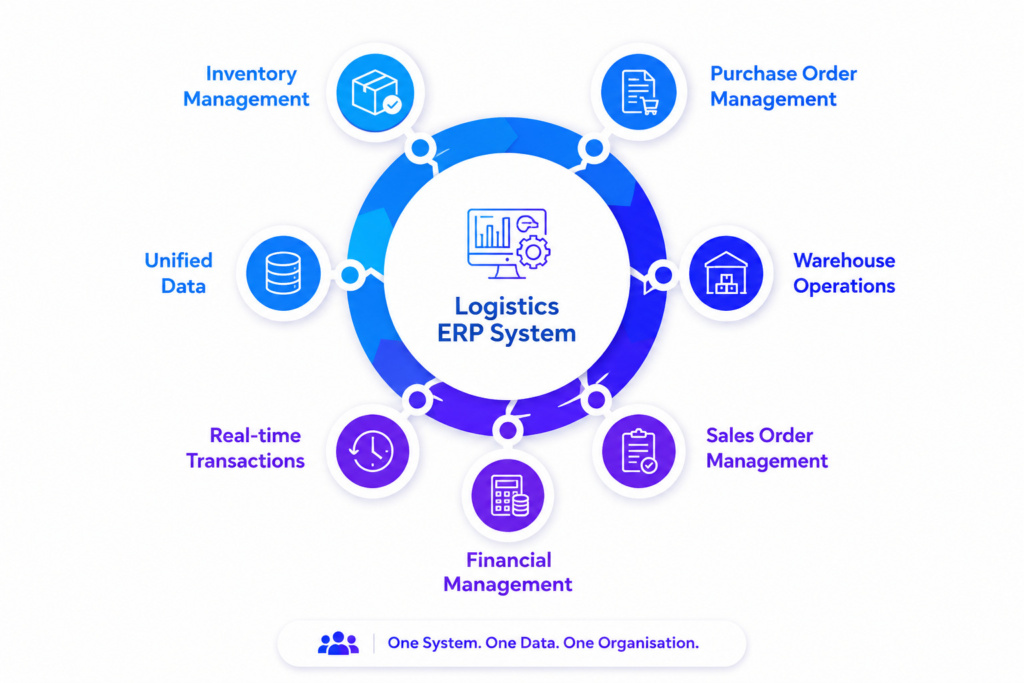
For instance, during a sales order entry process, the ERP system can instantly adjust stock levels, alert warehouse staff to pick and pack orders, and produce the financial documents needed. This minimises the amount of manual work and enhances the coordination between departments.
The study by Microsoft Singapore and ASME, found that 83 percent of Singapore SMEs have digital transformation plans, indicating that operational efficiency is a key priority for digital transformation.
ERP logistics management integrates logistics activities with other business processes, providing a better overview of inventory management, order processing, procurement, and performance.
>>> Read more: What’s Logistics ERP and How It Boosts Your Supply Chain
How ERP Logistics Management Improves SME Operations
A study by Harvard Business School almost 370,000 inventory records determined that 65% of inventory records were inaccurate, that it is not inventory as recorded on the system that matched actual inventory.
ERP logistics management is designed to optimise inventory, warehousing, procurement, and order processing for SMEs in one system. This integration can help eliminate manual tasks, enhance data precision, and provide greater visibility into business operations.
Real-Time Inventory Visibility
As inventory is received, moved or removed it is automatically updated. This ensures that companies have the right product mix, avoid stock out and prevent overstocking. Manual inventorying systems can only manage to achieve an inventory accuracy rate of 60-70%, whereas automated warehouse systems can manage to achieve in the range of 95-99% accuracy.
Source: https://apsionscan.com/en/resources/precision-manuelle-vs-wms
Improve the efficiency of warehouses.
Warehouse teams can manage receiving, stock transfers, picking, packing, and stock counts more efficiently. Barcode scanning further improves accuracy and reduces manual data entry.
Better Purchasing Control
Efficiencies are achieved in receiving, moving, picking, packing and stock counts at the warehouse. In addition, barcode scanning provides further accuracy and minimises manual data entry.
Faster Order Fulfillment
The ERP integrates with sales orders, inventory allocation, and warehouse management, enabling companies to accept orders faster and enhance their delivery service.
Improved Decision-Making
ERP systems generate real-time reports of all inventory, purchasing, warehouse operations and order fulfillment. Correct information enables management teams to make informed decisions about their operations and to adjust more rapidly to demand fluctuations.
>>> Read more: How Smart Logistics Help in Warehouse Management
ERP Logistics Management vs Traditional Logistics Software
Most of the SMEs begin with their own logistics tools to manage their inventory, warehouse operations or deliveries. These solutions can be used for certain functions, but most of the time they are not integrated with buying, selling, and financial systems.
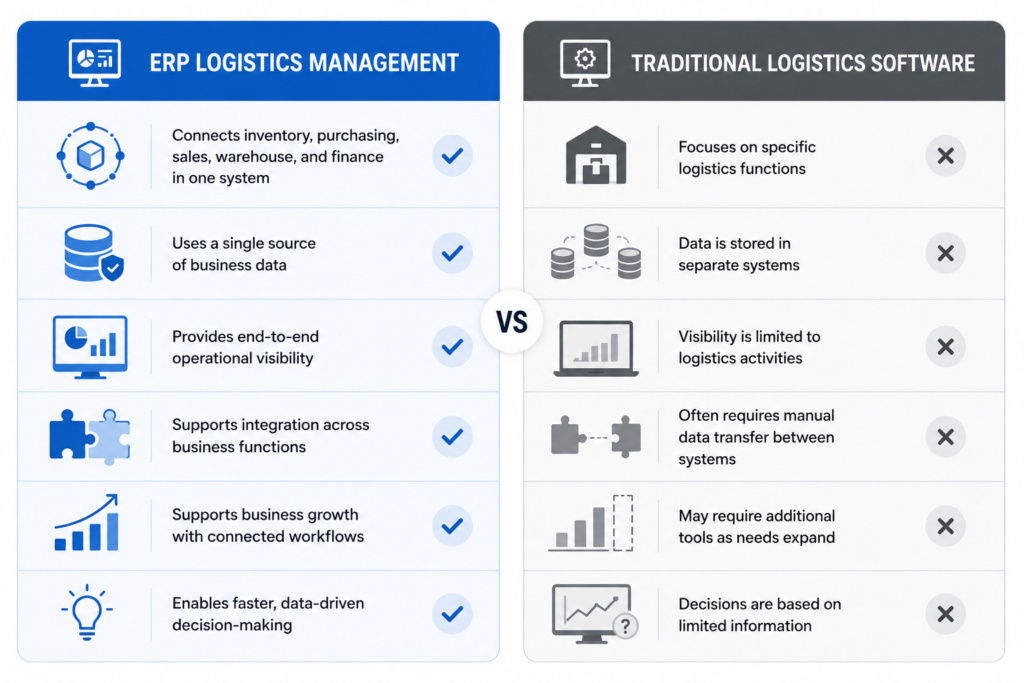
ERP vs Traditional Logistics ERP Comparison
For instance, a certain level of inventory can be a trigger for ERP to notify purchasing and warehouse personnel. In standalone software, teams might require to manually move information from one system to the opposite before taking action.
An ERP system gives more control for SMEs who want to have more control of their logistics processes with the rest of the business to enhance overall operational efficiency.
How to Choose the Right ERP Logistics Management System
It’s not just about comparing features – there’s more to selecting the right ERP system. SMEs need to take into account the solution’s ability to meet current and future needs.
Scalability
The ERP system should accommodate growing volumes of transactions, more warehouses, and more products without having to make significant changes to the process.
Integration Across Business Functions
Logistics is closely related to sales, purchasing, inventory and finance. A connected ERP system is a way of ensuring information flows seamlessly between departments.
Ease of Use
An intuitive and user-friendly system can enhance user adoption, minimise training time, and optimise team efficiency.
Reporting and Visibility
Real-time reporting and dashboards enable companies to track the inventory, buying activities, order processing, and operational performance.
Implementation and Support
It takes time to implement an ERP system. SMEs should seek out a solution provider that will provide guidance with system implementation, user training and continuous support to help achieve maximum system value.

Industries That Benefit from ERP Logistics Management
ERP logistics management can benefit numerous businesses, especially businesses that are small to medium enterprises (SMEs) that have a high level of transactions involving suppliers, warehouse activities, or a high volume of inventory.
Manufacturing
There is a need for a balance between the availability of raw materials and the production schedule, on the part of the manufacturers. By tracking raw materials, work in progress stock and being able to see what is being produced by the purchasing team, an ERP system can help. It helps to minimise production delays due to stock shortages.
Wholesale and Distribution
Typically, distributors process thousands of stock movements each month. With ERP logistics management, you can coordinate inventory across various warehouses, manage supplier orders, and enhance order fulfilment precision. Real-time inventory visibility also enables a more accurate and reliable delivery promise to the customer for the sales teams.
Retail and eCommerce
For retailers and online sellers, it is essential to have accurate inventory information to prevent over-fulfillment. During high sales periods, ERP systems can help keep inventory levels on track, optimise order processing, and enhance fulfillment efficiency.
Food and Beverage
Food and beverage companies frequently must keep track of batch numbers, stock turns, and expiration dates. ERP systems streamline inventory management to ensure accuracy, and facilitate traceability along the supply chain.
>>> Read more: https://www.synergixtech.com/erp-solutions/
Why SMEs Choose Synergix for ERP Logistics Management
For SMEs, the most effective ERP logistics management is when inventory, purchasing, warehousing, sales and finance are working together in a single system. It reduces manual processes, increases data accuracy and offers management teams a better view of business operations.
Synergix ERP helps SMEs to manage these functions through an integrated platform. Businesses can now view inventory records, purchase orders, warehouse transactions, sales information and financial data from one source instead of having to toggle between multiple systems.
Integrating logistics processes with other key business processes helps SMEs improve their inventory management, minimise administrative workload, and make timely business decisions.
The system is expandable, so as business processes evolve, it can be extended to include new processes and workflows, ensuring that the company stays as efficient as possible.
Conclusion
The more inventory, suppliers, customers and transactions, the more difficult logistics operations become to manage. In the absence of connected systems, SMEs may find themselves facing with the problems of inaccurate stock management, workflow inefficiencies and lack of visibility between operations.
ERP logistics management helps overcome these challenges by integrating inventory management, warehousing, procurement, order fulfilment and finance on a single platform. This allows teams to have access to accurate data, better departments cooperation and faster response to the changing business needs.
For manufacturers, wholesale distributors, retailers and food and beverage companies, a comprehensive ERP system can help enhance performance in your logistics operations and enable you to see what’s going on in your business to help you plan for growth.
When you’re looking at ERP logistics management solutions for your business, take into account how an integrated ERP system can help smoothen operations and reduce your business’s inventory mistakes and provide a better base for growth.

Frequently Asked Questions
What is ERP logistics management?
ERP logistics management is the management and coordination of logistics processes (such as inventory management, warehousing, procurement, order fulfillment, and financial monitoring) using ERP. This translates to all these functions being centralised and given businesses insight about their operations and less manual efforts.
What is the difference between ERP and logistics software?
Logistics software is usually targeted at providing functionality to carry out certain activities such as inventory management, warehousing or transport planning. ERP systems are a more comprehensive solution that integrates logistics with other business processes, such as purchasing and sales, finance, and more. This means there is the ability to get data from one department to another without needing to use a number of disjointed systems.
When should a SME migrate to an ERP system?
Many SMEs consider ERP logistics management when manual processes start to impact daily operations. Most commonly, mismatched inventory, duplicate data entry, slow order times, and inventory issues are difficult to track between multiple locations. If teams are spending too much time of trying to reconcile information between systems, ERP systems can help in centralising operations.
Can ERP logistics management replace a warehouse management system (WMS) completely?
This will depend on the complexity of the warehouse. An ERP system can manage inventory management, stock transfers, barcode scanning, and order fulfillment for many SMEs. However, if the business has more advanced requirements, such as tracking the bins or more complicated picking operations, a dedicated WMS might still be beneficial.
Why do we still have inventory discrepancies with inventory software?
Inventory problems are usually caused by disconnected processes, not the software. During purchase, warehouse, sales and inventory data are separated, information can become inconsistent quickly. ERP logistics management bridges these gaps by linking the important parts of business in one system.