



Danny Lim
Digital Solution Provider

In modern times, manufacturers are using both execution tools and planning systems to operate effectively. However, a lot of SMEs are yet to differentiate between ERP and a manufacturing execution system. There are usually visibility gaps, laggards, and workflow inefficiencies that come about as a result of this confusion.
ERP systems are configured to handle business activities like planning, inventory as well as finance. A manufacturing execution system is concerned with what occurs on the shop floor where production is done in real time. The two systems are significant, though they work at various levels.
The article clarifies the differences between these systems and how they complement each other and in which cases manufacturers should consider the use of either or both to facilitate growth.
What Is a Manufacturing Execution System?
A manufacturing execution system is a software platform that allows monitoring, tracking, and managing production activities on the shop floor in real time. It links directly to machines, operators and production workflows to make sure work is done as per plan.
Common core functions are:
- Execution and tracking of work orders
- Shop floor information capture by means of gadgets or scanners
- Monitoring machine and operator performance
- Live status updates of production
- Traceability and quality checks
The most important advantage of a manufacturing execution system is that it is able to give detailed, real time visibility. The supervisors are able to observe the processes at every stage of production and swiftly address the problems.
MES is an execution and control system, unlike ERP, which is more oriented towards planning and coordination. It makes sure that its production proceeds without hitches and that data is recorded in the source properly.
What Is ERP in Manufacturing?
ERP systems are enterprise level and deal with the larger business processes in support of manufacturing. Such systems unify data between departments in a single platform.
Key functions include:
- Planning and scheduling production
- Inventory management
- Supplier and Procurement management
- Sales order processing
- Financial reporting and accounting
ERP assists in answering pertinent business questions like what to produce, when to produce it and what resources are necessary. It also gives transparency regarding the costs, margins, and the overall performance.
Learn more: Synergix Manufacturing ERP System
Manufacturing Execution System vs ERP: Key Differences
Both systems facilitate the manufacturing process, though they are different and work at various levels. Being aware of these distinctions will enable SMEs to select the correct tools and eliminate disconnects between planning and implementation.
At a high level, ERP solution deals with what ought to occur as compared to a manufacturing execution system that deals with what is occurring on the shop floor. This difference is essential with the scale and complexity of operations.
The following provides a clearer comparison of how the two systems compare:
| Aspect | ERP System | Manufacturing Execution System |
| Primary role | Business planning and coordination | Implementation and control of production |
| Level of operation | Enterprise level | Shop floor level |
| Core focus | Resources, costs, schedules | Machines, operators, workflows |
| Data type | Aggregated, transactional data | Detailed production data |
| Data timing | Real time updates across departments | Continuous updates at machine and shop floor level |
| Users | Management, planners, all departments | Operators, supervisors, production staff |
| Key outputs | Production plans, financial reports, inventory status | Work order status, machine performance, production progress |
| Decision support | Strategic and tactical decisions | Operational and immediate decisions |
| Visibility | Overall business performance | Real time shop floor activity |
| Error handling | Through reports, dashboards, and exception alerts | Immediately at the shop floor level for rapid response |
In practical terms, ERP might indicate that 1,000 units should be produced this week. A manufacturing execution system shows how many units have been completed, where delays are occurring, and which machines are underperforming.
ERP brings discipline of planning. MES makes sure that the execution is in line with the plans in real time. With the two systems operating collaboratively, manufacturers enjoy enhanced control, quicker feedback, and enhanced operational performance.

The Integration of ERP and Manufacturing Execution System
ERP and a manufacturing execution system are most valuable when they are in a connected environment. The various systems deal with various levels, yet when combined, they form a continuous flow of information between planning and execution.
ERP transmits commands to the shop floor in a typical setup:
- Production orders and schedules
- Routing steps and bills of materials
- Delivery timelines and priorities
The manufacturing execution system receives these inputs and manages execution:
- Tracks work order progress in real time
- Captures machine and operator data
- Monitors quality checks and deviations
Meanwhile, MES reports actual production data to the ERP:
- Completed quantities and output rates
- Material consumption
- Machine utilisation and downtime
- Quality results and exceptions
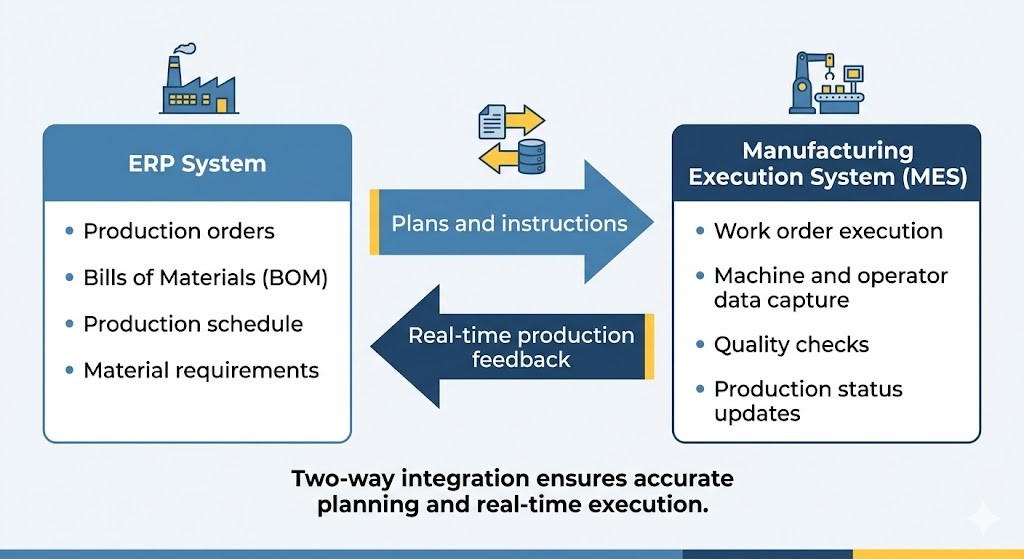
This two-direction flow makes sure that planning bears reality. No more assumptions are used by planners. They would rather change schedules depending on actual performance.
A Manufacturing Execution System or middleware layer is often the interface between ERP and machines in a wide variety of environments. Such technologies as IoT devices and industrial communication standards contribute to this integration.
The outcome is an interconnected system in which decisions are made based on up-to-date information and not on old information reports.
When Should SMEs Consider MES, ERP, or Both?
The appropriate strategy is based on the stage of the business.
Start with ERP if:
- There is limited financial control and visibility of inventory
- There is no structured production planning yet
- Juggling spreadsheets is a common practice in teams
- Employees must manually transfer and handle data among departments
Introduce a manufacturing execution system when:
- Production complexity increases
- Real time tracking of machines becomes necessary
- Delays or inaccuracies are caused by manual updates
Adopt both systems when:
- Operations scale across multiple lines or locations
- End-to-end visibility is required
- Decision making needs to be faster and data-driven
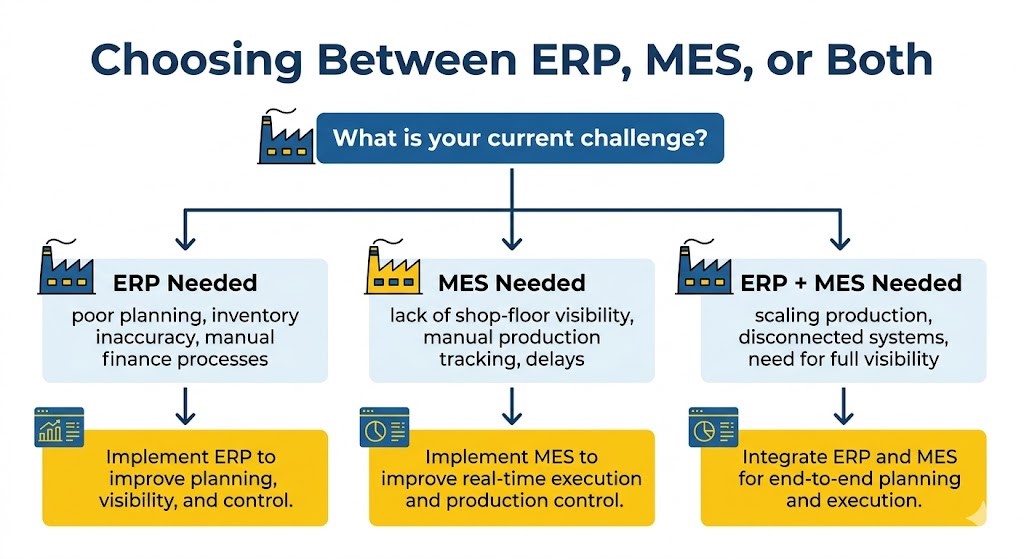
Staged process can be a good idea. ERP can be used by SMEs to start with a solid base and then build on execution capabilities as they expand.
Conclusion: Connecting Planning with Execution
To be effective, manufacturers require control and visibility. ERP systems offer planning, coordination and financial controls. The distributed control environment or execution layer is used to make sure that production is accurate and properly functioning.
Combining ERP with a manufacturing execution system helps businesses to achieve real time insight into operations. This translates to quality of decisions made, increased efficiency and enhanced overall performance.
In the case of SMEs considering the digital transformation, the nature of the attention should be paid to the reduction of the gap between planning and implementation. This process is supported by integrated systems like Synergix ERP that integrates production, inventory, sales, purchasing, HRM, CRM and finance into one system.