



Budgeting is significant to a lot of small and medium sized businesses in the management of cash flow, cost control and future growth. A clear budget assists the company to know where the resources are allocated and how the expenditure is helping the company achieve its business objectives.
The ERP budget planning software is used to solve these problems, as it links budgeting to the accounting and operational data. Under a centralised system, it is easy to manage a budget, monitor spending and financial performance of the business more easily.
This article defines ERP budget planning software, the issues it can address and how it can be used by SMEs to enhance their financial control.
Read more: Financial Reporting Explained: A Practical Guide in 2026
What Is ERP Budget Planning Software?
The ERP budget planning software is a financial management tool of an Enterprise Resource Planning software which assists business to create budget, track expenditure, predict financial results and performance.
As opposed to the old budgetary systems, ERP systems integrate the budgetary system with other business operations. Accounting records, procurement, sales and operational expenses can be directly connected with financial plans. It is through this integration that companies can operate using a consistent and up to date financial information within the organisation.
Practically, ERP budgeting tools assist in supporting several major activities. The finance teams can establish yearly or quarterly budget, allocate funds to departments or projects, and monitor how the actual spending is in comparison with the intended amounts. As the budget is automatically updated with the transactions posted in the ERP system, managers can view the financial performance in real time as opposed to having to wait before they receive the manual reports.
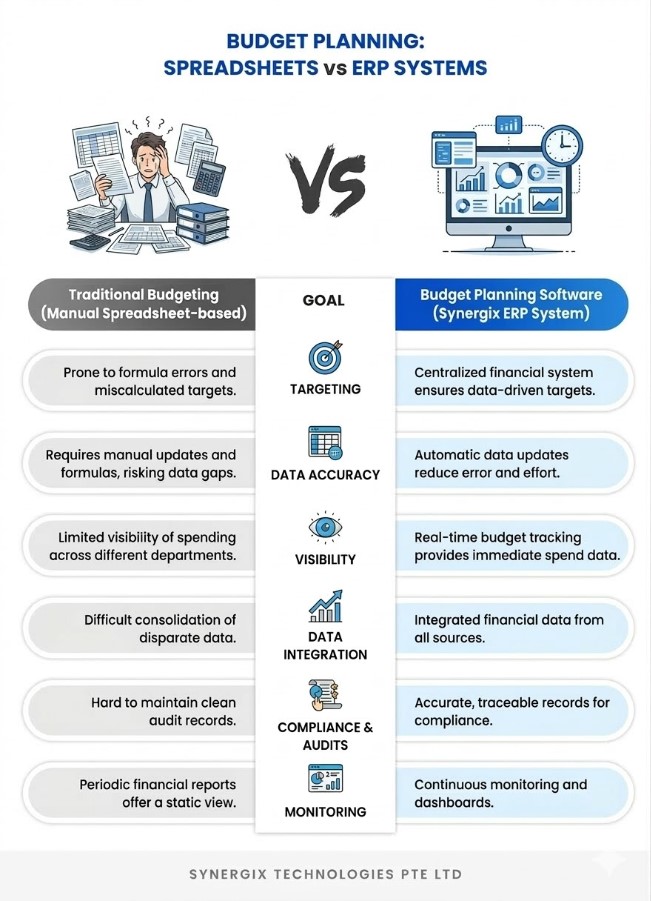
The traditional budgeting systems usually rely on spreadsheets which have to be manually updated and data consolidated. ERP budgeting systems offer centralised platform whereby financial information, financial budgets and financial reports are handled at a single location. This setup enhances transparency and enables decision makers to get to know about financial performance within a shorter time.
ERP budget planning software provides a more organised and dependable process of spending and financial planning compared to the traditional tools to SMEs who desire to have greater control over spending and financial planning.
Common Budgeting Challenges SMEs Face
It is common that budgeting is vital to many SMEs and with the growth of the business, using simple tools to manage budgets may present a challenge. Financial information is distributed in different departments, simple updates are not quick and the decision makers might lack an accurate understanding of the current expenditure.
Fragmented financial data
There are usually spreadsheets or records that are kept by departments. Before the finance teams construct a comprehensive budget report, they have to extract information through various sources. These delays reporting and creates more opportunities of having inconsistent numbers.
Manual budgeting processes
Budgeting in form of a spreadsheet needs to be updated a lot. Financial departments should rewrite the formulae, compress files, and check calculations on a regular basis. They are time consuming and increase the chances of making mistakes. The study of operational spreadsheets discovered that 94 percent of them have errors, and these may influence the calculation involved in financial planning and reporting.
Poor financial transparency
Without integrated systems, managers tend to look at financial outcomes when reports are made ready. It may be too late to rectify overspending by the time the overspending has been discovered.
Limited forecasting capability
Proper forecasting requires sound financial information. Budgeting tools that are not linked to accounting or operational systems cannot be analysed using trends and project the future costs easily.
Due to the constraints, a lot of SMEs shift to ERP budgeting software, which consolidates financial data and provides businesses with more options of planning and tracking budgets.

Key Features and Benefits of ERP Budget Planning Software
ERP budget planning software provides finance departments with a formal system to control budgets and maintain relationship between financial information in the organisation. The integration assists the firms to keep a better track of expenditure and hold more financial control.
Preparation and budget allocation
Budgets and the allocation of funds by finance teams is done within the system to any departments or project or cost center within the organisation. It simplifies the process of planning finances and making sure that the resources are allocated as per business priorities.
Live budget tracking
Since the ERP systems link the budgeting with the accounting and the transaction data, costs are automatically registered and amalgamated with the planned budgets. Managers are able to monitor the progress of spending and find out the areas where the expenses are beyond thinkable in a short time.
Financial forecasting and scenario planning
ERP systems can analyse past financial information to aid in forecasting. Finance teams can estimate revenue and expenses they are likely to make in the future or experiment on various financial scenarios prior to making serious decisions. This assists companies to make investment plans and risk management with a lot of confidence.According to an industry research, approximately fifty percent of companies today rely on ERP data to make predictive analytics and forecasting to make more informed financial decisions.
Automated workflows and approvals
The ERP system can also be used to deal with budget requests and spending approvals. Allocations are reviewed and approved by the managers using the built in workflows and this assists in keeping a good financial control whilst limiting the amount of administration.
Financial dashboards and reporting
The ERP financial management tools have dashboards and reports that overview the budget performance, departmental expenditures, and financial trends. Having this information under a single roof, the leadership teams can revise financial results fast and make more informed decisions.
How ERP Budget Planning Works in Practice
ERP budget planning software is a software that links financial planning and day-to-day business operations. There is no need to have budgets and accounting or purchasing, but all this is handled in the same system. This enables financial plans to remain in line with the real business activity, as well as give the managers a better perspective on spending.
Budgeting process within an ERP system is highly organised in most organisations.
Typical ERP budgeting process:
- Finance team prepares the main budget plan
- Departments submit budget requests
- Management reviews and approves budgets
- Transactions automatically update the budget
- Managers monitor spending and budget variance
- Finance teams adjust forecasts when needed
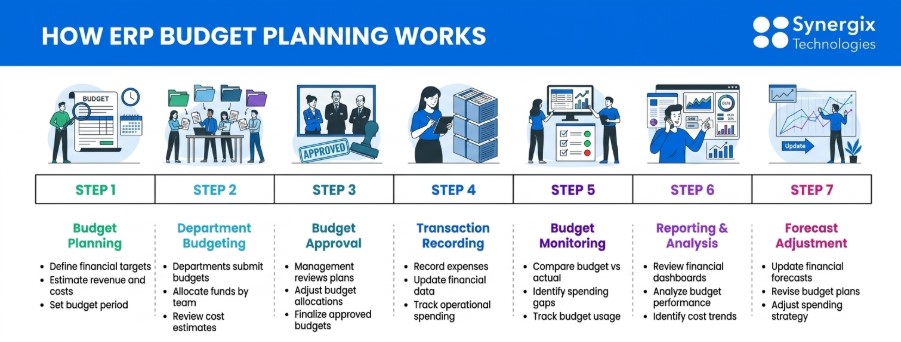
In this process, ERP budgeting software enables businesses to keep track of financial performance unlike when they were only able to do so on periodic basis. This assists managers to be quicker to the changes and be more at ease with company expenditure.
Read more: All-in-One Guide about Financial Management Software
Choosing the Right ERP Budget Planning Software
Selecting the appropriate budget planning software is a critical move to SMEs aiming to have a stronger financial control. Because budgeting is closely related to accounting and purchasing among other financial processes, a lot of businesses are willing to use ERP systems that unify these processes. Studies estimate that ERP adoption among SMEs is expanding at around 10% per year, as companies look for integrated systems to manage finance and operations.
When evaluating ERP budgeting solutions, businesses should focus on a few key factors.
- Financial systems intergration: The budget planning must be linked to accounting and financial records. Automatic update of budgets with transactions on transactions saves finance teams time in data consolidation and makes reports more precise.
- Ease of use: The finance department and managers in various departments should have an easy-to-use system. The budgeting, reports and expenditure monitoring processes should be straightforward enough to allow teams to concentrate on financial planning instead of spending on the administration of the system.
- Flexible budgeting structure: Budgets in business are usually of a departmental, project or cost center. These various structures should be supported by ERP systems in order to ensure that the financial plans used can portray the way the organisation functions.
- Reporting and financial visibility: Clear dashboards and reports enable managers to know the trends of spending, budget utilisation, and overview financial performance more conveniently.
To the SMEs which require a more integrated system of financial management, Synergix Technologies offers ERP solutions, which integrates budgeting and accounting (including purchasing and other business processes) in the system. The management of financial data in a single system will allow companies to control budgets more efficiently and have a better financial control.

Conclusion
SMEs that aim to control expenses, have good cash flow, and plan its future development need to have proper budgeting. Nevertheless, the conventional budgeting systems are usually spreadsheet and manual-based, which restrict financial transparency and predispose them to errors.
ERP budget planning solution is much more structured. When integrating budgeting and accounting and operational data, businesses will be able to generate budgets, monitor real-time spending, and analyse financial performance more accurately.
Key takeaways:
- When the financial information is centralised, budget planning is more credible.
- Budget tracking in real time assists the business in identifying areas where they will overspend in advance.
- Combined reporting and forecasting help in improved financial decision making.
ERP solutions can offer the means through which SMEs can manage their budgets more efficiently in case they want to enhance their financial planning and control. Synergix Technologies are the ERP systems, with the ability to synchronise the budgeting with the primary financial operations, to enable a business have a better understanding of its finances and allow taking a higher quality of decisions.