Synergix
Member of the HCM Consulting Practice at Oracle UK
Performance management plays a key role in how SMEs track progress, align teams, and support employee development. As business operations become more complex, having a clear and structured approach is important to maintain consistency and visibility across the organisation. This blog will explain how an ERP performance management system helps SMEs manage performance in a more structured and efficient way.
- 1 Why SMEs Can’t Rely on Traditional Performance Management Anymore
- 2 What Is an ERP Performance Management System?
- 3 Essential Features of an ERP Performance Management System for SMEs
- 4 Benefits of Using an ERP-Based Performance Management System for SMEs
- 5 How to Successfully Implement an ERP Performance Management System
- 6 Why SMEs Choose SynergixTechnologies for Performance Management
- 7 Conclusion
Why SMEs Can’t Rely on Traditional Performance Management Anymore
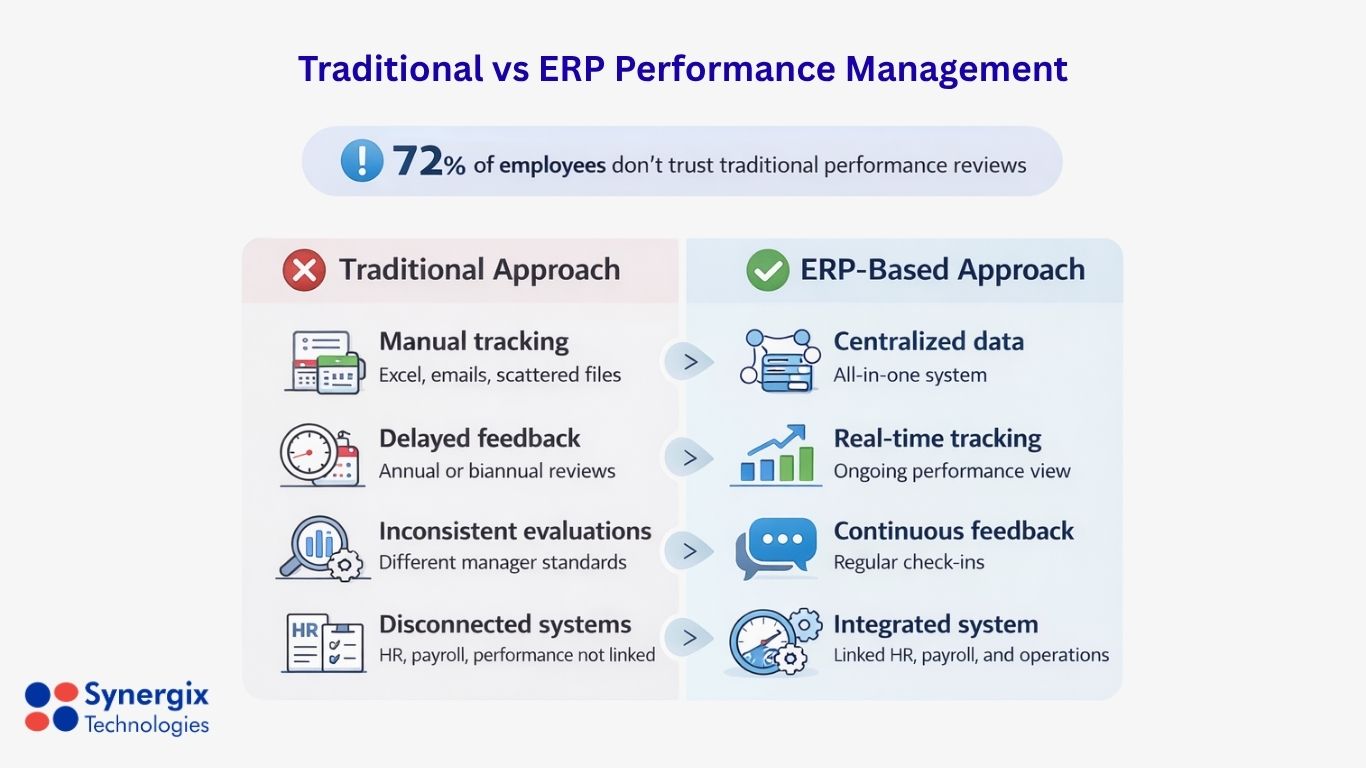
There are a lot of SMEs that continue to use spreadsheets, emails, or simple HR tools to perform employee performance. Although this might be effective in a small scale, it tends to result in inconsistent assessment, slow feedback and less visibility within the teams.
Managers will find it difficult to accurately monitor progress and employees will lack clear goals and frequent feedback. Research have shown that up to 63% of employees say performance reviews do not reflect their actual work, this has an impact on productivity over time and complicates the process of aligning individual performance with the business objectives.
These problems become increasingly harder to handle as companies expand. It requires a more coordinated and organised strategy.
ERP performance management system unites performance tracking, employee data, and HR processes. This enables SMEs to control performance more uniformly and control it more effectively and with reduced manual effort.
What Is an ERP Performance Management System?
An ERP performance management system is a tool in an Enterprise Resource Planning (ERP) system that assists businesses to organise and coordinate the performance of an employee in a systematic and uniform manner. It links performance tracking to other HR data hence everything is handled at a single point.
SMEs can now deal with performance reviews, goals and employee records as a single system with common data and standard procedures instead of dealing with them individually.
The features of a typical ERP performance management system are:
- Goal setting: Define clear objectives for teams and employees
- Constant feedback: Permit the frequent check-ins between employees and managers.
- Performance reviews: Accomplish systematic assessment with respect to a set of criteria.
- Reporting and analysis: Monitor performance and find the improvement points.
With all the information related to the performance stored in a single system, SMEs may enhance accuracy, decrease manual labor, and make superior decisions using the actual data.
Discover more: Synergix Technologies ERP Solutions
Essential Features of an ERP Performance Management System for SMEs
The performance management cycle is structured in an ERP system. Businesses begin by setting clear goals with KPIs or OKRs and aligning the goals with individual employee goals. During the review period, the managers and employees track the progress and ensure frequent feedback with the help of check-ins. Formal evaluations are done at specific periods of time basing on documented performance. These findings are then discussed to see what was strong and what was weak and to inform the planning of developing the employees, like by training or setting new targets. The cycle assists SMEs to manage performance in a coherent and systematic manner.
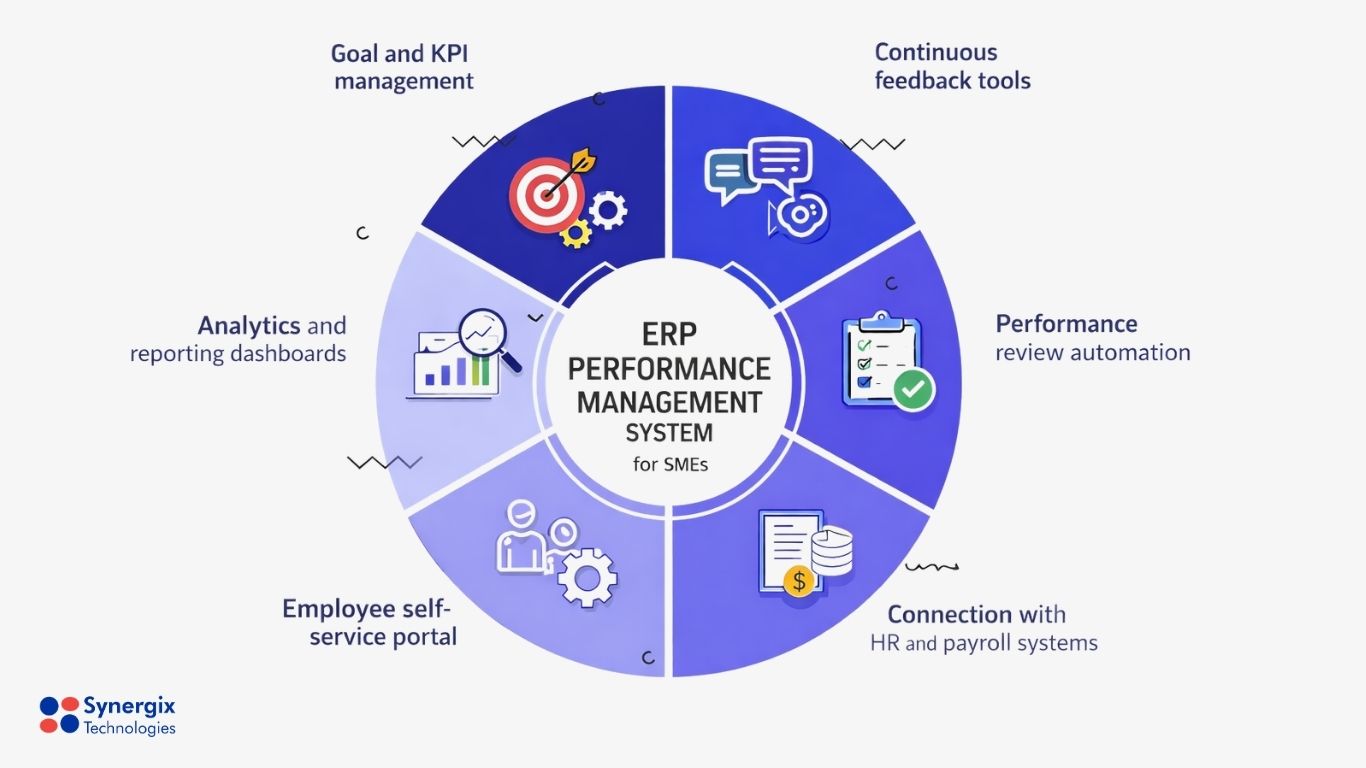
An ERP system must be able to support the above performance management process and has the following features:
- Goal and KPI management: Enables companies to set, allocate and manage both team and individual objectives, making employees concentrate on priorities and enhances alignment throughout the organisation.
- Continuous feedback tool: Provides frequent interaction between employees and managers during the review period. It can assist the SMEs to tackle problems before it becomes a formal review.
- Performance review automation: Favors formal appraisal periods and schedules. It will decrease the amount of manual labor and make the evaluations more regular.
- Analytics and reporting dashboards: Gives insight into performance data, trends and results. It can help managers in making decisions using real data.
- Employee self-service portal: Enables employees to make updates on progress, self-assessment and to manage their own information. It can enhance efficiency and minimises administrative tasks.
- Connection with HR and payroll systems : Relates performance information to other human resource functions like payroll and employee records, ensuring consistency in the data and aids in making improved decisions throughout the business.
Benefits of Using an ERP-Based Performance Management System for SMEs
Performance management system based on ERP assists the SMEs to abandon manual processes and organise performance in a better manner. Linking performance information to other HR functions can enable business to enhance visibility, lessen administrative efforts and ensure that employees are achieving definite objectives. This will provide a more uniform performance management throughout the organisation.
- Enhanced performance and responsibility: There is a clear goal and feedback to employees, and this makes them responsible and focused on their work.
- More coherence between teams: In a manner where personal goals are tied to business goals, then teams pull in the same direction, and this minimises confusion and redundancy.
- Less manual HR workload: Reviews, tracking, and reporting are automated, which eliminates the necessity of manual updates and follow-ups.
- More accurate, data-driven decisions: All the data on performance are captured in a single system, and hence the managers are able to assess the outcomes and make effective decisions.
- Scalable processes for growing SMEs: The system will be able to support increased number of employees and more intricate structures without administrative overhead as the company expands.
According to Performyard, companies focusing on employee strengths see 8.9% higher profitability and 12.5% higher productivity

Read more: Everything You Need to Know about Human Capital Management
How to Successfully Implement an ERP Performance Management System
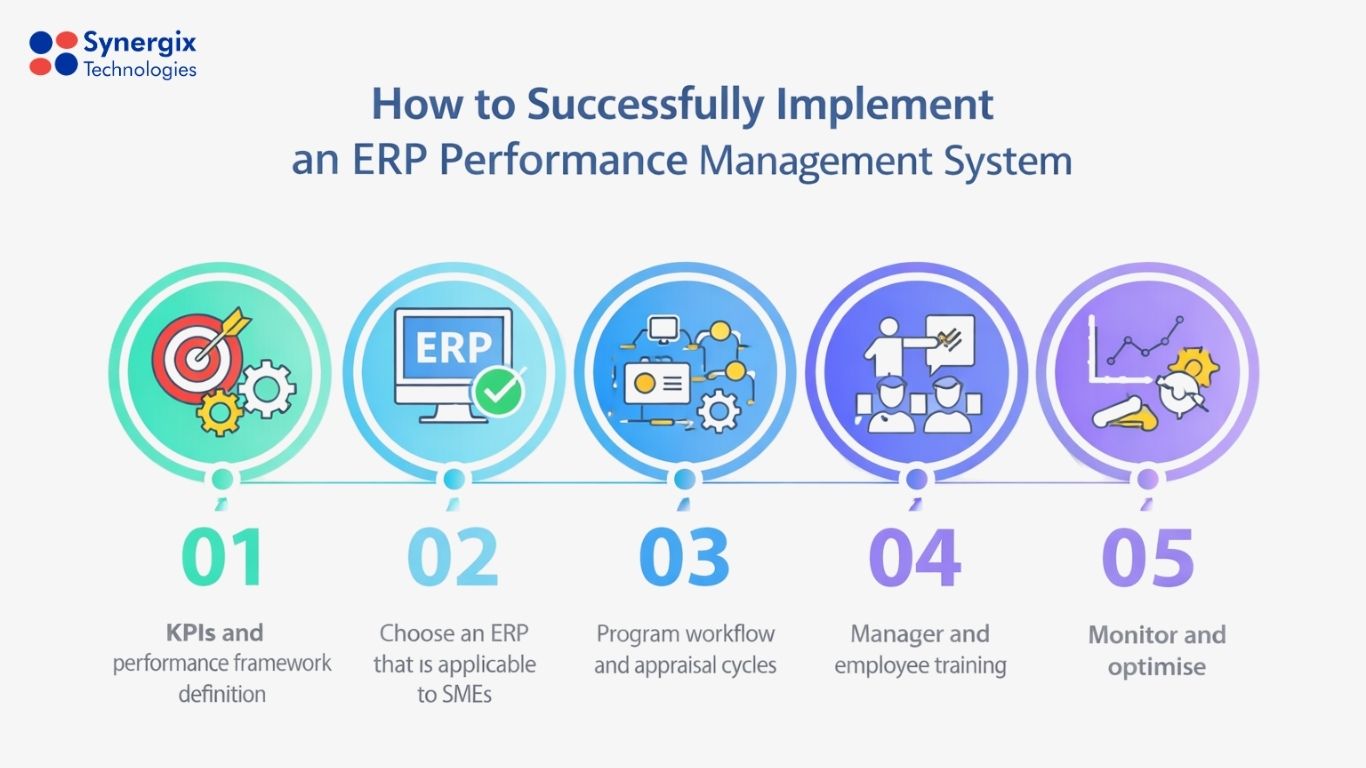
The introduction of a performance management system is not merely about the correct selection of software. SMEs should also set the processes clearly, make sure that the users are aware of the system, and implement it in a manner that suits their operations. Organised strategy is helpful in minimising disturbance and enhancing success chances of adoption within the organisation.
- Step 1: KPIs and performance framework definition
Begin by determining the way of measuring performance. Establish specific KPIs and establish the evaluation methods. - Step 2: Choose an ERP that is applicable to SMEs
Choose a system that fits your business size, industry, and operational needs. - Step 3: Program workflow and appraisal cycles
Establish a schedule of review, approval, and criteria of evaluation according to your company setup. - Step 4: Manager and employee training
Make sure that users know how to set objectives, monitor their progress, and accomplish appraisals in the system. - Step 5: Monitor and optimise
Check the way the system is used and make changes where necessary to enhance efficiency.
Avoid these mistakes:
- Setting unclear or unrealistic KPIs
- Skipping user training
- Making the process too complex
- Not reviewing or updating the system regularly
Why SMEs Choose SynergixTechnologies for Performance Management
In many cases, SMEs require a system that links the performance management with the day to day HR activities. In the case of the ERP system provided by Synergix Technologies, the Human Resource Management (HRM) module allows the management of employee information, performance appraisal, payroll, and workforce in a single system. This saves on the requirement of independent tools and makes sure that all HR and performance processes are harmonised.
With the integration of these functions, SMEs can minimise the manual coordination across the various departments and have more uniform information throughout the organisation. It also enables managers to make decisions made based on a holistic perspective of employee performance as opposed to using different systems or partial information.
Centralised Performance Management and HR
All employee related data, attendance, leaves and performance records are handled within a single system. The inbuilt appraisal system facilitates the set of workflow, multi-tiered reviews, and reminder systems that assist SMEs to conduct their appraisal in a logical and punctual way.
Payroll Integration and Compliance
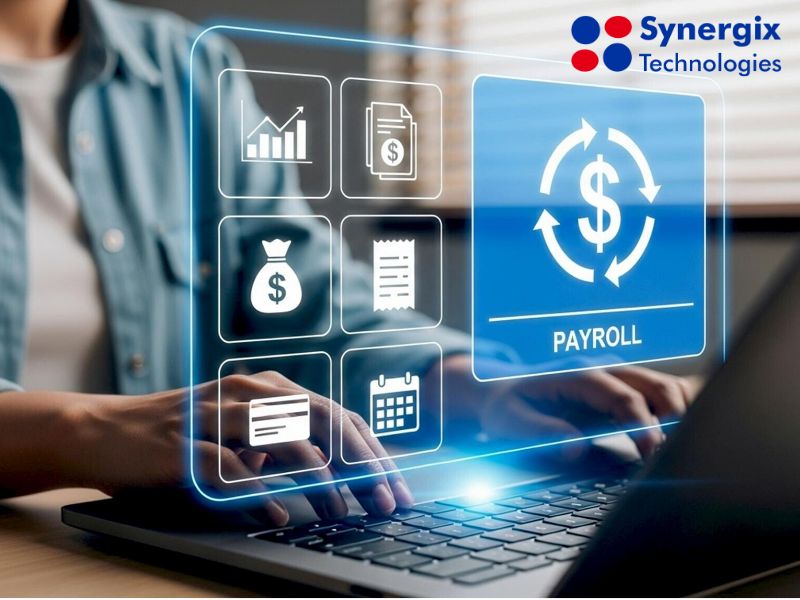
Payroll can be directly linked to performance outcomes such as salary increments and bonuses. Payroll processing and statutory requirements are also facilitated through the system, as it assists the businesses to handle compensation correctly without compromising on compliance.
Tracking Workforce and Costs.
Projects can be attributed to the employee working hours and activities, which provides SMEs with a greater understanding of the cost of labour and the profitability of a project. This will assist the managers to make better decisions on how to allocate resources.
Employee Self-Service and Development
The self-service portal allows employees to handle the leave, claims and self-assessments, and managers to make approvals in the system. Their training and development can also be monitored, and businesses can correlate employee development with performance outcomes.
Conclusion
The management of employee performance is complicated as the SMEs expand. Use of manual processes or isolated systems may result in unequal evaluation, lack of visibility, and unnecessary administrative tasks.
The ERP performance management system is more structured as it links the performance tracking with HR data and business operations. This assists SMEs to become more productive, consistent, and enhance making better decisions on reliable data.
Key Takeaways
- The performance management can be better managed when it is a well-organised process.
- ERP systems connect performance data with HR and payroll, improving accuracy and visibility
- Automation minimises human input and assists in creating consistency during assessments.
- The connection of the performance results to the payroll and projects helps in making more appropriate decisions
- Scalable system will enable SMEs to handle expansion without bearing more administrative cost.
In case you need a more effective approach to controlling the workforce performance, do not overlook how an integrated ERP solution can help your business to develop. You can find out more about the solutions offered by Synergix Technologies or you can be presented with the demonstration of how the system operates in practice.