



For businesses that are spending money on training, R&D, or IP in Singapore, EIS is likely to be one of the most significant tax incentives that you are underutilizing. From being introduced during Budget 2023 to significant enhancement during Budget 2026, EIS rewards companies for their investments in innovation and capabilities by offering a 400% tax deduction or a cash payout of $20,000 per YA.
This is your go-to guide on EIS- what is it, who is it for, what kind of activities qualify, how do I apply, and can I stack EIS with other grants such as PSG or SFEC?
What is Enterprise Innovation Scheme (EIS)?
EIS is a government incentive scheme that is administered by IRAS and currently applies to all YAs from YA2024 to YA2028. It provides businesses with a choice on how to receive their benefit on a qualifying expense:
- 400% Enhanced tax deductions – a $1 investment in a qualifying activity effectively costs you $0.75 (due to the effective reduction in taxable income)
- 20% cash payout of up to $100,000 investment – a $1 investment will get you $0.20 (maximum of $20,000 per YA), which is payable within 3 months after the filing of the YA.
Ultimately, whichever method you choose, there would be substantial savings. A profitable company might stand to save more through tax deductions. While an early-stage company or an investment holding company may find more value in immediate cash payment since they might not have sufficient taxable income to utilize tax deductions fully.
Who is Eligible for Enterprise Innovation Scheme (EIS)?
All businesses in all sectors can apply for EIS. Whether you’re a large company or a small one, and irrespective of your industry, you are eligible to apply. This can be applied to companies, sole proprietorships, partnerships, as well as registered branches or subsidiaries of foreign companies that are in Singapore.
There are two sets of criteria for each method
For 400% Enhanced Tax Deductions: The company must have been carrying out a trade in Singapore and incurred a qualifying expense in that year of assessment.
For 20% Cash Payout: In addition to having incurred a qualifying expense, the company must fulfill the following criteria:
- Have at least 3 full-time local employees (SingCitizen/PR earning $1,400/month and working at least 35 hours/week).
- Have CPF contributions made for the above-mentioned employees for at least six months during the basis period for the YA.
- The company must have been actively operating at the time of the cash payout.
Investment holding companies, charities and businesses that have ceased operations are not eligible for the cash payout.
Why EIS Matters for Singapore Businesses in 2026 and Beyond
It’s a challenging but dynamic economy that every business owner in Singapore is aware of, from global competition to the pressure to digitise, through to the importance of building an educated workforce. EIS was designed to reduce the financial hurdle associated with these activities, which can give a business a crucial advantage.
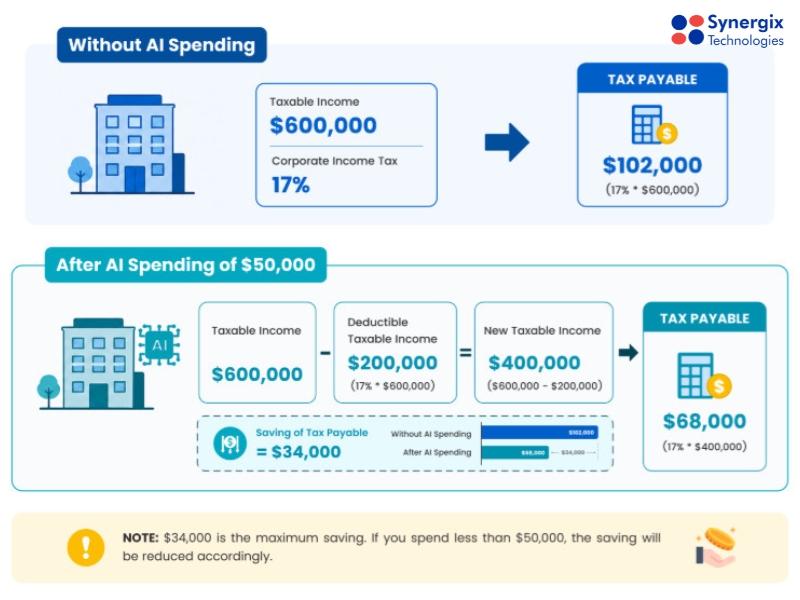
How the 400% EIS tax deduction works: In this example, a $50,000 investment in AI reduces taxable income by $200,000, significantly lowering tax payable.
This means, for example, if your company spends S$100,000 on qualifying R&D in Singapore, it can claim a deduction of 400% (S$400,000). For a business on the 17% corporation tax rate, that’s an actual tax saving of approximately S$68,000 per S$100,000 investment. If a business doesn’t have sufficient tax liability yet, it can opt for a cash payout. Any S$100,000 expenditure can be converted into a S$20,000 cash payout made by IRAS within about 3 months of approval. Budget 2026 also introduced a 40% corporate tax rebate for YA 2026 (capped at S$30,000), and EIS can be used alongside the tax rebate to allow companies to achieve significant tax savings in a given year. EIS is not just for large businesses but open to any company, partnership, and sole proprietorship that is investing in its future. You’re likely losing money if you’re not claiming it.
Grant funding is changing too: EDGE will replace EDG, PSG and MRA from the second half of 2026.
The 6 Qualifying Activities
R&D in Singapore
Innovative or experimental work to develop or improve products, services, or processes. It covers staff costs, consumables, and up to 60% of outsourced R&D fees. Maximum S$400,000 per YA.
IP Registration
Official and professional fees for registering patents, trademarks, and designs, even unsuccessful registrations will qualify as long as you retain ownership of the IP in Singapore for at least one year. Maximum S$400,000 per YA.
IP Acquisition & Licensing
Businesses with group revenue under S$500 million may be eligible for a 400% write-down allowance for IP acquired or licensed (not software or from related parties). Maximum S$400,000 per YA.
Qualifying Training
The most widely accessible area for most companies. This includes course fees and assessment costs for SkillsFuture Singapore (SSG) approved training relevant to your business and delivered in Singapore by SSG-registered providers. Maximum S$400,000 per YA.
Innovation Projects with Institutions
Fees paid to polytechnics, ITE or similar organisations for collaborative innovation projects including R&D, software development or IP activities. Maximum S$50,000 per YA.
AI Expenditure
Budget 2026 introduced AI expenditure as a qualifying category for YA 2027 & YA 2028, at 400% for deductions up to S$50,000 per YA. Unlike other categories, there’s no cash payout option here, just the tax deduction, and specific criteria will be released by IRAS by 30 June 2026. The approved partner list for innovation projects will now include the Advanced Intelligence for Manufacturing (AIMfg) programme.
Remember:
- You cannot use a single expenditure for both a tax deduction and cash payout; once your choice is made, it’s final.
- Claims must be on a net basis, minus any applicable grants or subsidies.
- Only one cash payout application per YA, so combine everything in a single submission.
- Companies with fiscal years 5 May to 30 November 2026 apply for YA 2026 cash payouts, with partnerships and sole proprietorships applying earlier (Feb-April 2026).

How EIS Works with PSG and SFEC
One of the benefits of EIS is its ability to be combined with other government grants. Here’s how it works with the three most common grant schemes:
Productivity Solutions Grant (PSG) co-funds up to 50% of approved digital solutions including ERP systems. While the ERP software licence may not be an EIS-qualifying expenditure, the employee training that supports adoption of a new ERP system is eligible under EIS Activity 4-as long as it’s provided by an SSG-registered provider.
SkillsFuture Enterprise Credit (SFEC) gives an eligible employer up to $10,000 in benefits to offset approved training expenses-paying for up to 90% of their cash outlay. When applying it with EIS, you subtract the grant you receive, then calculate the 400% EIS deduction on the remaining net expenditure on training.
Let’s say you send 5 employees on a training programme that costs $10,000. Your company receives a 90% ($9,000) subsidy from SFEC, so your net expenditure is $1,000. With the 400% EIS deduction applied on this $1,000, your company reduces taxable income by $4,000; you’ve essentially gained $10,000 worth of training at a minimal cost.
If you are implementing an ERP system, you can layer PSG (for software), SFEC (for training), and EIS (for residual training cost deduction) to minimize your actual out-of-pocket investment.
Synergix Technologies has helped Singaporean companies successfully manage this landscape for over 35 years alongside technological transformation. As a PSG pre-approved ERP vendor with a 100% track record of success in assisting hundreds of clients apply for PSG, Synergix is well-positioned to guide your team through the use of EIS for your ERP and digital transformation project.
>>> Read more: Government Grants
Mistakes to Avoid When Applying For EIS
Understanding what not to do is just as important as knowing the rules. Here are the most common pitfalls businesses encounter:
- Claiming on gross spend: Deduct any grant & subsidy before claiming. Failure to deduct PSG or SFEC grants and subsiding before claiming EIS, will result in an audit violation.
- Lack of supporting documents: IRAS can audit your EIS claim after the payout. Retain all invoices, training attendances, CPF statements and project documentation for a minimum of five years.
- Late claim submission: companies cannot receive any extension when applying to claim cash benefit for YA2026, and will have until 30 November 2026.
- Not eligible training: The training claimed must be approved by SSG, aligned to skills framework and be delivered by registered training providers in Singapore. The trainings cannot be a personal development module and training in foreign countries are not valid.
- Disposing IP within one year: If any IP bought through the deduction from EIS are sold within 12 months, IRAS can reclaim back from you the benefits claimed.
What’s new in EIS with Budget 2026?
The 40% Corporate Income Tax rebate (maximum $30,000) announced during the Singapore Budget 2026, is guaranteed minimum $1,500 cash grant per local worker for 2025 companies. The CIT Rebate will be applied after deduction on EIS, thus EIS & CIT Rebate work hand-in-hand to reduce your tax payment.
Including AI spending as eligible expenditure for EIS supports the Singapore Government’s intention to allocate $37 billion into the Research, Innovation and Enterprise 2030 (RIE2030) plan, which signifies more benefits for companies engaged in developing AI capabilities in the next two years.
What to do next?
Audit your current spending and identify which expenses can qualify for EIS.
Choose your benefit structure – Tax deductions for profitable companies and cash grant for companies with cash flow problems or a combination of both.
Ensure your training investments for employees can be qualified through SSG registered training providers.
Combine your grants-strategically link up your PSG, SFEC and EIS to achieve maximum savings for your digital transformation & employee training.
Prepare your company for AI spending claims from YA2027- IRAS is expected to roll out detailed qualifying criteria for AI expenditure on 30 June 2026.
Contact Synergix Technologies for a non-obligation discussion if you’re considering an ERP implementation and wonder how PSG, SFEC & EIS grants can be combined for your business to reap considerable savings.
This is an informative piece, not a tax advice. It should be used as a reference only. Please refer to IRAS’ Enterprise Innovation Scheme e-Tax Guide and/or contact a professional tax advisor for specific tax planning.
References: IRAS Enterprise Innovation Scheme Guide