


Supply chain risk management (SCRM) is the process of planning ahead for disruption: spotting early warning signs, judging which risks matter, and acting before they hit. For Singapore businesses, most disruption starts somewhere you can’t see: a supplier’s supplier, a port two countries away, a tariff announced overnight.
So what can businesses do about it? You can’t stop a shipment being delayed. You can shorten the gap between the problem starting and you finding out. That gap is where the damage sits: express freight to catch up, idle production lines, orders you can’t fill, customers who start looking elsewhere.
Closing it takes two things. A 4-step process and one asset most SMEs already own but rarely use: the delivery, pricing, and stock history already sitting in their own system. This guide covers the risks Singapore businesses face, how to run those steps, and how an ERP supply chain management system turns your own transaction records into early warning signals.
Why Supply Chain Risk Management Matters
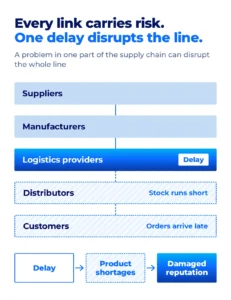
The complexity of the supply chain is the main reason companies manage its risks before anything happens. An end-to-end supply chain involves many internal and external parties: suppliers, manufacturers, logistics providers, distributors, and more. Each link carries its own risks, so a problem in one part can disrupt the whole line. A delay then leads to product shortages, and repeated shortages seriously damage the company’s reputation.
Disruption is also more frequent than most businesses expect. McKinsey Global Institute found that shutdowns lasting a month or more happen every 3.7 years on average, and in some industries these events can erase the majority of a year’s profits over a decade. Singapore is more exposed than most: the country imports more than 90% of its food, and most local manufacturers and distributors depend on materials and goods from overseas.
A supply chain risk management strategy helps businesses keep production on plan, protect cash flow, and avoid the margin loss that delays bring: express freight, idle production lines, and lost orders. Just as important, it prepares teams to act with confidence in a variety of situations instead of reacting under pressure.
What Risks Most Often Disrupt Supply Chains in Singapore?
Most supply chain disruptions start with global forces, such as:
- Politics and conflict: Wars, sanctions and new tariffs can close shipping routes or make goods from one country suddenly more expensive.
- Natural disasters and extreme weather: Storms, floods and earthquakes can shut down ports and factories for days or even weeks.
- Disease outbreaks: An outbreak can halt production and restrict the movement of goods and workers across borders.
- Economic shocks: Sudden swings in energy prices, interest rates and currencies push up costs faster than businesses can adjust their own prices.
- Cyber attacks: An attack on a port, a logistics provider or your own IT systems can stop orders and shipments without warning.
No business can control these forces, but every business can control how exposed it is when one hits.
Supply chain risks in Singapore fall into two groups: internal risks that start inside the business, and external risks that arrive from outside. Most disruptions happen when an external shock meets an internal gap.
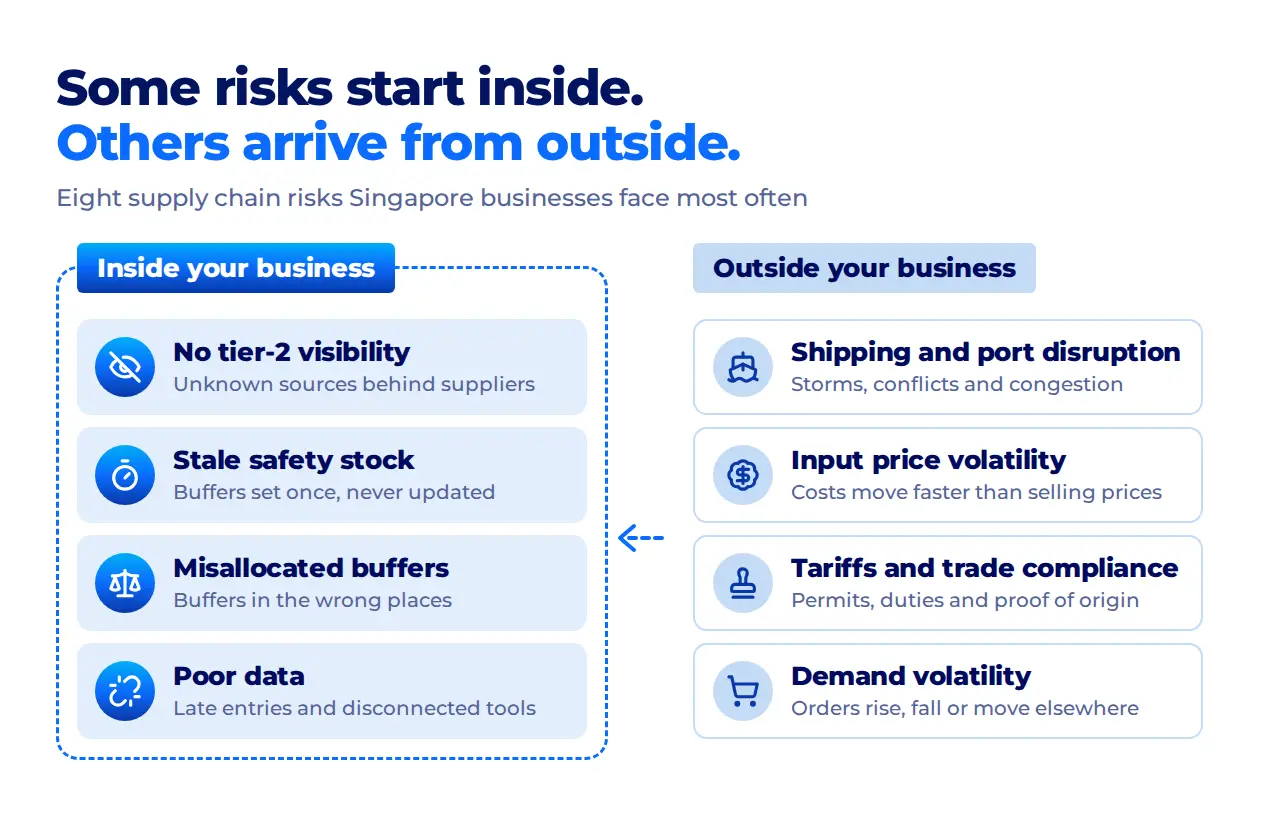
Internal risks
- No tier-2 visibility: You know your suppliers, but not their suppliers. A problem two steps up the chain can cut your supply without warning.
- Stale safety stock settings: Safety stock is often set once and never revisited, so it falls short when lead times grow longer. (How to respond: Review it regularly with inventory control tools, covering lead-time variability, not just demand.)
- Misallocated buffers: Many businesses raise stock evenly across all items, which ties up cash while critical items still run short. Only items where the supplier’s time-to-recover (TTR) is longer than your time-to-survive (TTS) need extra protection.
- Poor data and fragmented systems: Late stock entries make inventory look lower than it is, and separate tools hide the full picture. (How to respond: Record receipts on arrival. Integrating POS with ERP keeps sales and stock data in sync.)
External risks
- Shipping and port disruption: Storms, conflicts and port congestion delay sea freight and add surcharges, storage and demurrage fees.
- Input price volatility: Costs move week to week, while selling prices stay fixed for months. Every increase you can’t pass on cuts your margin.
- Tariffs and trade compliance: Every import needs a customs permit, and wrong declarations mean held goods, fines and delays.
- Demand volatility: Customers order less, more, or elsewhere, so planning from past orders leaves you with excess stock or shortages. (How to respond: Use automated demand forecasting based on current sales data.)
The Core Supply Chain Risk Management Process
Managing supply chain risk comes down to four steps: identify, assess, mitigate, and monitor. Each step depends on the one before it, so a risk missed at the start cannot be fixed by anything that follows. That is why businesses need to identify risks at every stage of the chain, not just at their main suppliers.
1. Identify
Find weak spots before they become problems: items with only one supplier, suppliers that keep delivering late, and materials that share the same country or shipping route. Look beyond your biggest suppliers.
2. Assess
Not every risk needs action. Ask how likely it is and how much it would hurt. If a supplier stopped tomorrow and recovery would take longer than your stock lasts, you need a plan.
3. Mitigate
Line up backup suppliers, hold more stock of critical items, or add price-adjustment terms to contracts. Start early: for regulated goods such as the 33 categories of Controlled Goods, each new model must be registered before it can be sold, so switching suppliers takes time.
4. Monitor
Watch a few signals in your own data: deliveries later than quoted, shipments short of what you ordered, and days of stock left. When a signal moves, go back to step 2.

Main Challenges for Singapore Enterprises
The process above assumes you can see what’s happening upstream. Most Singapore SMEs can’t, for reasons that have little to do with effort.
- Your suppliers won’t open their books. Tier-1 suppliers treat their own sourcing, capacity and costs as commercial information. Ask who supplies them and you usually get a polite non-answer.
- Small buyers go to the back of the queue. When a supplier rations output during a shortage, volume decides who gets served. If you represent 2% of their order book, you find out late and you wait longest.
- Transhipment hides delays. Goods bound for Singapore often change vessels along the way. Your supplier’s ETA reflects when they shipped, not what happened at an intermediate port, so the first sign of trouble is often the container that doesn’t arrive.
- Paperwork breaks quietly. If a supplier switches their own source country, your preferential tariff claim under an ASEAN trade agreement can stop being valid without anyone telling you. For the 33 categories of Controlled Goods, every new model needs its own registration before it can be sold, so a supplier change is a lead time, not a decision.
- Buffer stock competes with payroll. Holding more of everything is the obvious answer and the one most SMEs can’t afford. Cash tied up in slow-moving stock is cash not available for anything else.
Here’s the part that changes the picture: You are not going to get your suppliers to share what they know, and you don’t need them to. Every purchase order you raise and every delivery you receive, is already a measurement of that supplier: whether it arrived when promised, whether the quantity matched, what the price did since last time. Most SMEs capture all of it and look at none of it, because purchasing sits in one system, stock in another, and invoices in a third. Nobody compares what was planned against what actually happened.
How Technology Helps: Using Synergix ERP to Manage Supply Chain Risk
You can’t control every shipping delay, but you can control how early you see it coming. Synergix ERP covers this across three solutions: Trading & Distribution Management for sales, purchasing and goods receiving; Inventory Management for stock levels and reorder alerts; and Manufacturing Management for material planning. Risk signals then come from one set of data instead of separate spreadsheets.
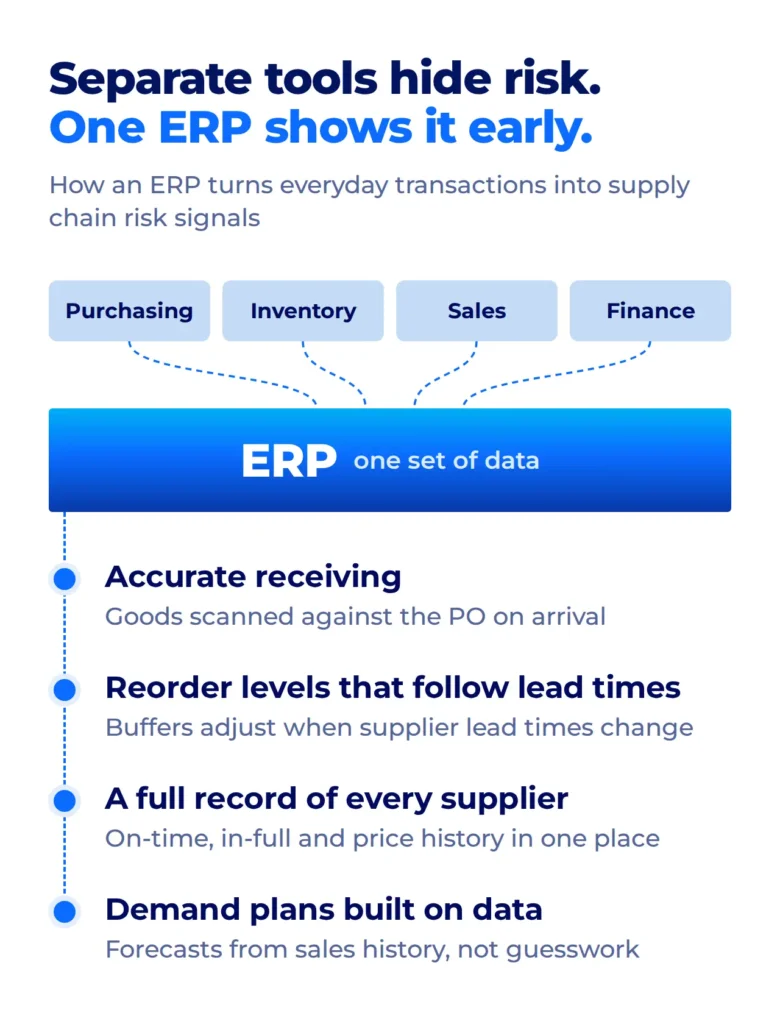
- Accurate data from the moment goods arrive: With Synergix ERP barcode tracking, staff scan incoming goods and Synergix ERP checks them against the purchase order straight away. If a supplier delivers 48 units instead of 50, you know on the day, not weeks later. One Singapore logistics company improved inventory accuracy by 40% after putting a warehouse management system in place.
- Reorder levels that reflect real lead times: An automated stock management system suggests reorder levels and purchase orders based on lead time, safety stock and consumption trends, so your buffers move when supplier lead times move. Stock statuses such as in transit, reserved and on hold for QC show what you can actually use today.
- A clear record of supplier performance and origin: With purchase orders, goods receipts and supplier invoices in one system, you can see how often each supplier delivers on time, whether orders arrive in full, and how prices have moved. Batch or serial number tracking and a country-of-origin field add the traceability you need for recalls and customs paperwork.
- Demand plans built on data, not memory: Historical sales data and dashboards help you spot changes in customer demand early. Synergix distribution planning ERP turns that history into forecasts, so purchasing, warehouse and sales plan from the same numbers.
Because we develop the system ourselves, the signals you watch can be shaped around how your business actually buys, without putting future upgrades at risk. That matters more in supply chain than almost anywhere else, since no two distributors or manufacturers define a late delivery the same way.
Spectrama Marine & Industrial Supplies reports roughly a 70% productivity improvement after moving certification records, delivery orders and tax invoices into one system. Yong Fong Engineering & Construction reports approximately 60% after connecting project and finance.
Want to see what your own supplier data would look like in one place? Talk to our team for a free demo.