



Financial accounting reports what already happened. For project firms, that is a problem, because profit is made or lost job by job, and every job has a point after which an overrun can only be absorbed. A report arriving at period close describes decisions nobody can change. The accounts are correct. They are also late.
Project accounting closes that gap. It changes the question management asks from “How much profit have we made?” to “Are we still on track to make the profit we planned?”
What Is Project Accounting?
Project accounting manages the profitability of each individual job or project by tracking budget, cost, revenue and cash flow continuously, and adjusting them while the work is still in progress.
Four components sit inside it:
- Budgeting: A baseline and a forecast for labour, materials, equipment, subcontract and overhead, set per project rather than per department.
- Cost tracking: Actual spend recorded against that baseline, plus committed cost and forecast cost at completion, measured as variance in real time.
- Revenue recognition: Revenue matched to work performed rather than to the handover date, usually by percentage of completion.
- Billing: Contract-specific payment structures, whether milestone billing, progressive claim or time and materials, each with its own retention and certification rules.
How It Differs From General Accounting
| Financial accounting | Project accounting | |
|---|---|---|
| Who reads it | Shareholders, lenders, IRAS, auditors | The project manager, commercial manager, directors |
| What it produces | Statutory accounts and tax returns | Cost reports, budget variance, forecast margin per job |
| How often | Annually, to ACRA and IRAS | Whenever a decision needs it, typically monthly |
| What it is for | Reporting the company’s position to outsiders | Planning, controlling and evaluating work in progress |
| What it covers | The whole entity, under SFRS(I) | No external rulebook of its own, though its cost-to-complete estimate feeds statutory revenue recognition |
| What it counts | Money only | Money plus hours worked, quantities issued, percentage complete |
| Who checks it | Independent auditors | Nobody directly, though its outputs are audited through the accounts |
These are not alternatives. General accounting is a statutory obligation and cannot be dropped. Project accounting is a management layer running alongside it, drawing on the same transactions but cutting them by job rather than by company.
The row that matters most is cost captured. General accounting cannot record committed cost, because a commitment is not an accounting event. It is a contractual one, and it moves the margin long before an invoice exists. This is also where a project costing management solution differs from a standalone planning tool: the cost consequence of a schedule decision lands in the same place as the schedule.
The Gap Between Spending Money and Seeing It
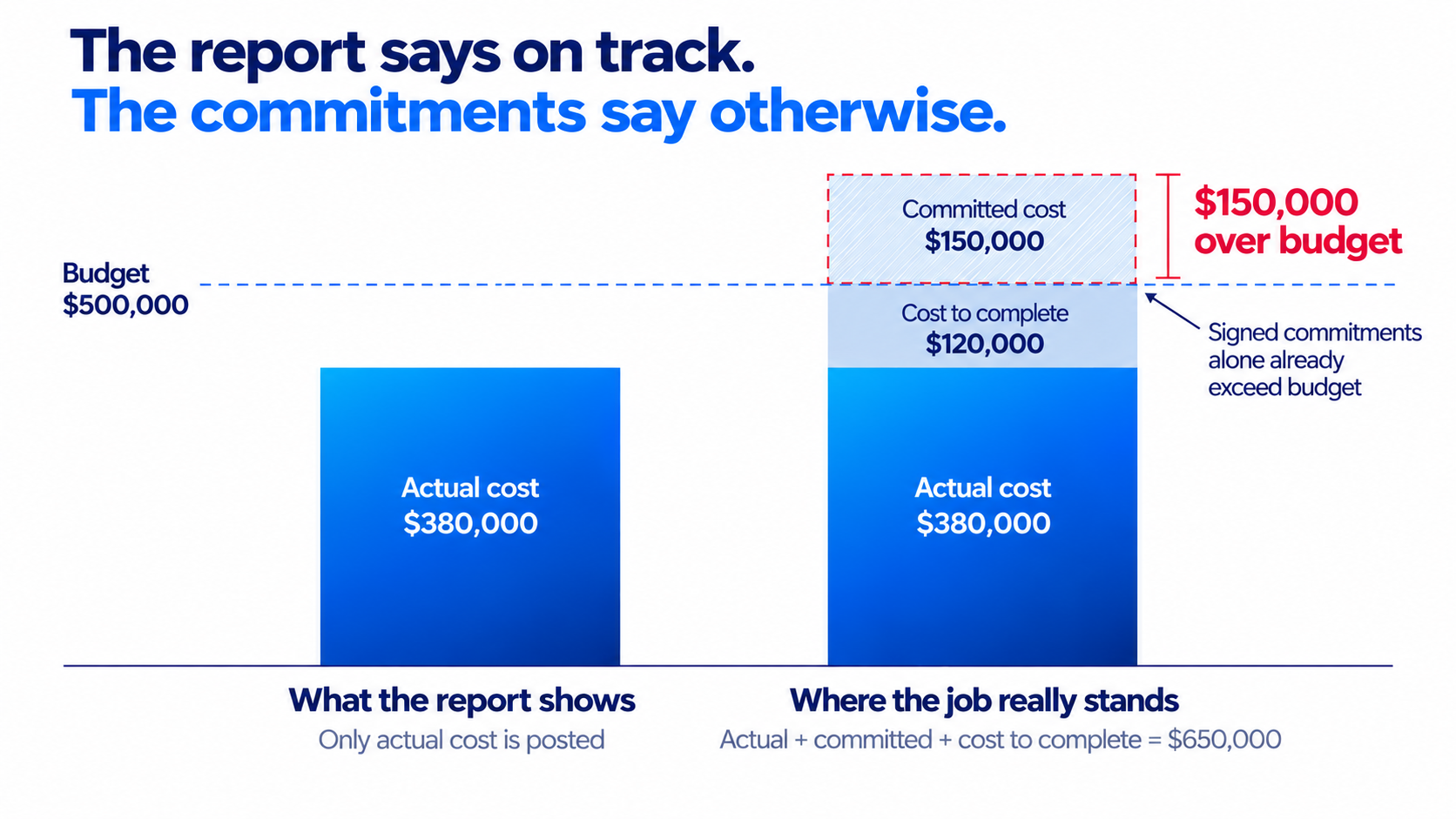
Actual cost tells you what has been posted. Profitability is shaped by decisions already made but not yet through the accounting cycle:
- A PO is approved, but the supplier has not invoiced
- A subcontractor is engaged, but has not claimed
- Extra hours are worked, but timesheets are unprocessed
- Additional work is underway, but unbilled
A project becomes financially committed before the cost appears in the accounts. Add the expected cost of the remaining scope and the total can sit well above budget while the report still reads as on track.
Margin also rarely falls on its own. Productivity drops and the same scope needs more hours. The programme slips and equipment stays on hire. Procurement turns urgent and the negotiating position weakens. Accounting sees the financial effect. The cause sits upstream in project management, which is the argument for running project delivery on a project-based ERP rather than on separate operational and financial systems.
6 Things Project Accounting Needs to Catch Problem Early
Contractors already have a name for this. It is called cost value reconciliation: compare what a job has earned against what it has cost and what it will still cost, then read the margin that falls out.
RICS, the international professional body for chartered surveyors, describes it as a project’s internal profit and loss statement. Quantity surveyors run it monthly, timed to the valuation cycle.
The inputs
- Break the budget into parts small enough to manage. One tender figure tells you nothing when costs move, because you know the total is wrong but not which part caused it. Split the job into pieces small enough for one person to be responsible for, each with its own budget and code, and put labour, materials, equipment and subcontract on separate lines. The test: would a site supervisor recognise the breakdown? If it only makes sense to finance, cost will not get recorded against it properly.
- Record what has been promised, not just what has been paid. Most firms skip this, and it is the step that changes the picture fastest. An approved purchase order is money the company owes, even with no invoice yet. A subcontract award commits the whole package the day it is signed. A job can look profitable on invoices alone and already be losing money once signed commitments are counted. Approval is also the last moment a commitment can be reconsidered, so the budget check has to sit there, not in a report read weeks later.
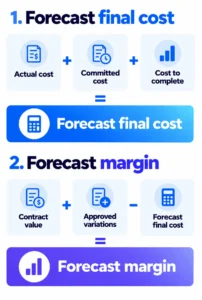
- Keep an estimate of what the rest will cost. Everything else is a fact or a sum. This one is a judgement about work that has not happened, and it decides the answer. Work it through with the site team rather than off a spreadsheet, because they know what is left. Monthly is the norm, fortnightly on fast or risky jobs.
The reconciliation
- Report the margin the job will finish on, not the one it shows today. Compare that to the margin the job was tendered at. The gap is the whole point. Keep variations visible on both sides, revenue and cost. Netting them into one figure hides both. Revenue recognised against amount billed is a separate cash question, which is where WIP reporting comes in.
- Agree in advance what level of slippage triggers a response. Cost management calls these control thresholds: a percentage of deviation, agreed before the job starts, above which someone has to act. Without one, every variance gets discussed and none gets escalated. Name who gets the alert and what they do about it.
- Act early. Caught early, an overrun has answers: resequence the work, change procurement before the package is bought, put the claim together while everyone remembers the circumstances, go back to the client about scope before it is built. Caught late, it can only be absorbed. The work is done, the package is bought, and the claim has turned into an argument because nobody kept the paperwork.
Nothing about the overrun changed. Only the number of answers changed, and it fell to one.
Why Project Accounting Is Hard Without an Integrated ERP
Each of those six depends on information held somewhere else. Budget with estimating, commitments with procurement, hours with payroll, progress on site, billing and the ledger with finance.
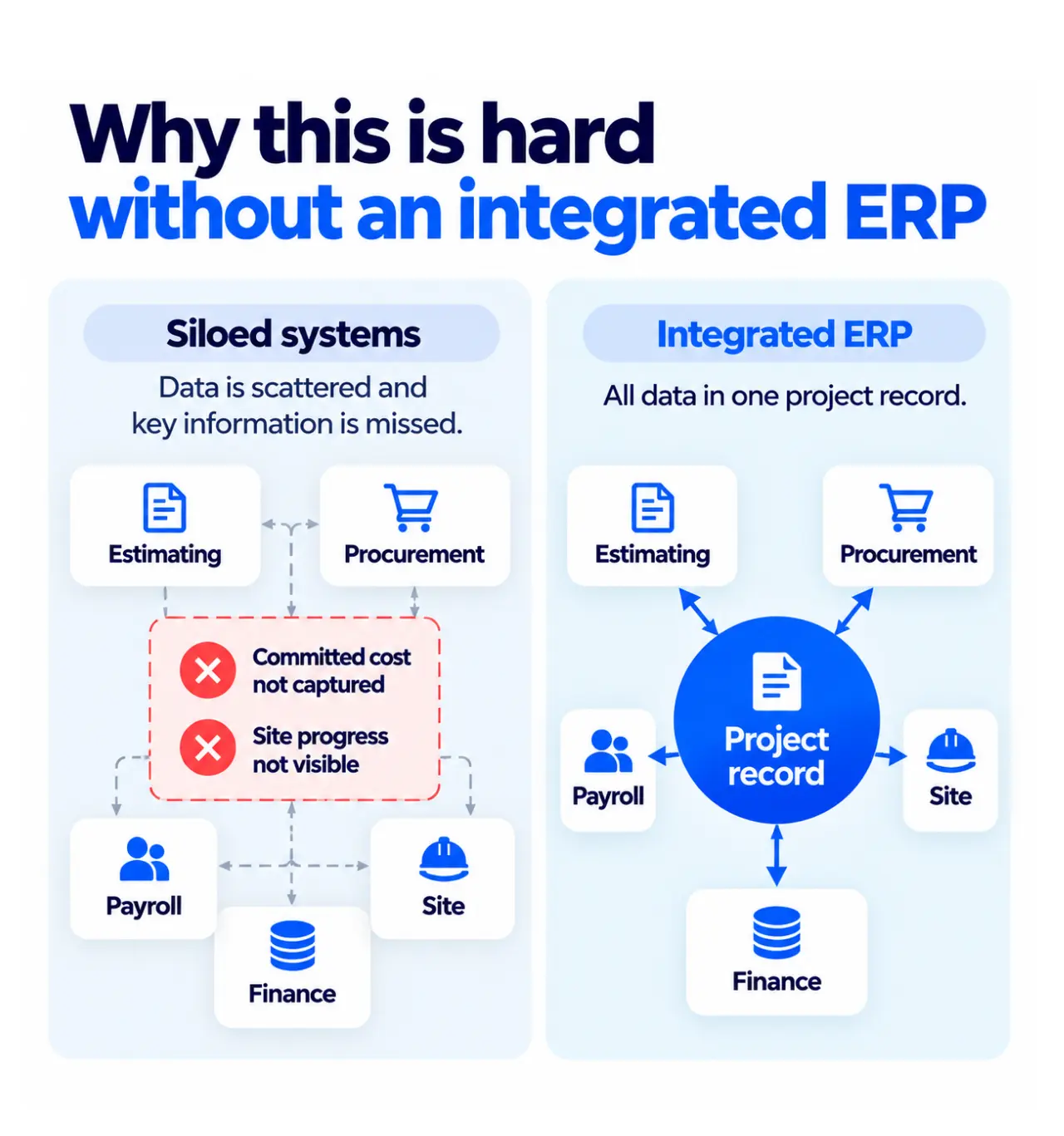
Two suffer worst when those are separate systems. Committed cost falls between departments: procurement files the purchase order and moves on, finance ignores it until an invoice arrives, and the project carries the exposure in between. Cost to complete depends on site progress, which often never reaches the accounting system at all.
There is a timing problem on top. The forecast is only as current as its slowest input. Five accurate figures and one that is six weeks old give a number that is wrong in a way nobody can spot.
How Synergix Does It
Synergix ERP runs the whole cycle on one project record, from project quotation through to project accounting, with information flowing between head office and site.
Project Quotation, Project Order Module – Break budget into manageable parts
Unlimited phases and sub-phases in the Job Scope and BQ, with contract amount, costing sheet and margin tracked at the lowest sub-phase level. The confirmed quotation auto-generates the Project Order with the Job Scope attached.
Procurement, Purchase Order Module – Record commitments at approval
POs are tagged to a project and checked against budget before approval, with budget usage shown at the approval screen. On the mobile PMR approval, the approver sees approved budget, remaining balance, cost impact and price variance against the last PO.
Manpower Cost to Project, Inventory Management, Operation Asset Module – Capture every cost reaching the project
Timesheet hours allocate salary, OT, allowances and deductions to the exact project, with non-timesheet staff split by preset percentage. Stock issued to a job captures its cost and runs a budget check, and returned stock reduces the cost again. Equipment depreciation is computed from actual delivery and return dates, so idle plant keeps costing the job.
Project Cost/Budget, Project Gantt Chart Module – Maintain cost to complete
Forecast vs Actual holds monthly forecast claims and costs against actual, with gross profit to date and an S-curve of revenue against cost. Completion rolls up automatically from the lowest Gantt task.
Project Order, Customer Claim Module – Keep billing and variations visible
Contract and variation amounts are tracked separately. Billing runs by project or by progressive claim, with retention computed progressively and held against the maximum. Variation revisions stay on record.
Widgets and Dashboard Module – Raise alerts when thresholds are reached
Variance thresholds trigger email and dashboard alerts on cost deviation, routed by role, with drill-down from an all-project summary to individual transactions.
Project Accounting, Financial Management Module – Consolidate numbers for the auditor
Cost posts to WIP and revenue to Unearned Revenue, then transfers through Project Recognition. Overheads allocate to projects, and invoicing runs through InvoiceNow.
What management gets is a live chain rather than a monthly reconstruction: Original budget → Actual cost → Committed cost → Forecast cost → Forecast margin
Where This Meets Singapore Reporting Rules
Under SFRS(I) 15, revenue on many project contracts is recognised by cost incurred against total expected cost, what most firms call percentage of completion. That total includes cost to complete, so the estimate the project manager uses to judge margin also drives reported revenue and the year-end WIP balance.
Synergix Project Recognition is built to support SFRS(I) 15 compliant recognition, and cost-to-complete revisions feed straight into it, so the auditor reviews the same position the project team has worked from all year.
Project costing sits alongside procurement, inventory and finance in Synergix Project Costing Management. Our consultants can walk through how committed cost and cost to complete would be captured against a real project structure and cost categories.