



ERP for professional services puts project management, resource scheduling, project accounting and client records together in one place. It is built for firms whose product is expertise and billable time instead of something physical. Architecture practices work this way, so do engineering consultancies and the design side of marine engineering.
The gap between this and a manufacturing system is wider than a feature list makes it look.
Fee-based Firms Vs. Product Businesses
Stock is what a distributor’s system is organised around. Goods come in, they sit somewhere, they get sold, and each of those movements leaves a document behind it. Count what is on the shelves and you have a reasonable idea of the position.
There are no shelves in an architecture or engineering practice. What gets sold there is time, and time is consumed whether or not somebody writes it down anywhere.
So what happens is that the reporting chain runs the other way round. Revenue gets fixed early as an agreed fee, cost then builds up quietly across the months that follow, and margin is whatever survives the two.
That is the reason project profitability is the figure design firms find hardest to state, and it is also why a system organised around inventory will never produce it for them.
4 Areas That Decide Whether the Software Earns Its Keep
Resource scheduling
Matching people to work sounds like an administrative detail right up until two deadlines land on the same week. What is needed is visibility of who is qualified, who is free and who has already been promised elsewhere, and it has to exist before a job is accepted rather than after.
Firms that run this from a shared spreadsheet tend to find the clash in the week it matters.
Timesheets and where the hours went
This is the hardest of the four, mostly because timesheet discipline is a habit rather than a software feature.
What a system can do is give two honest methods:
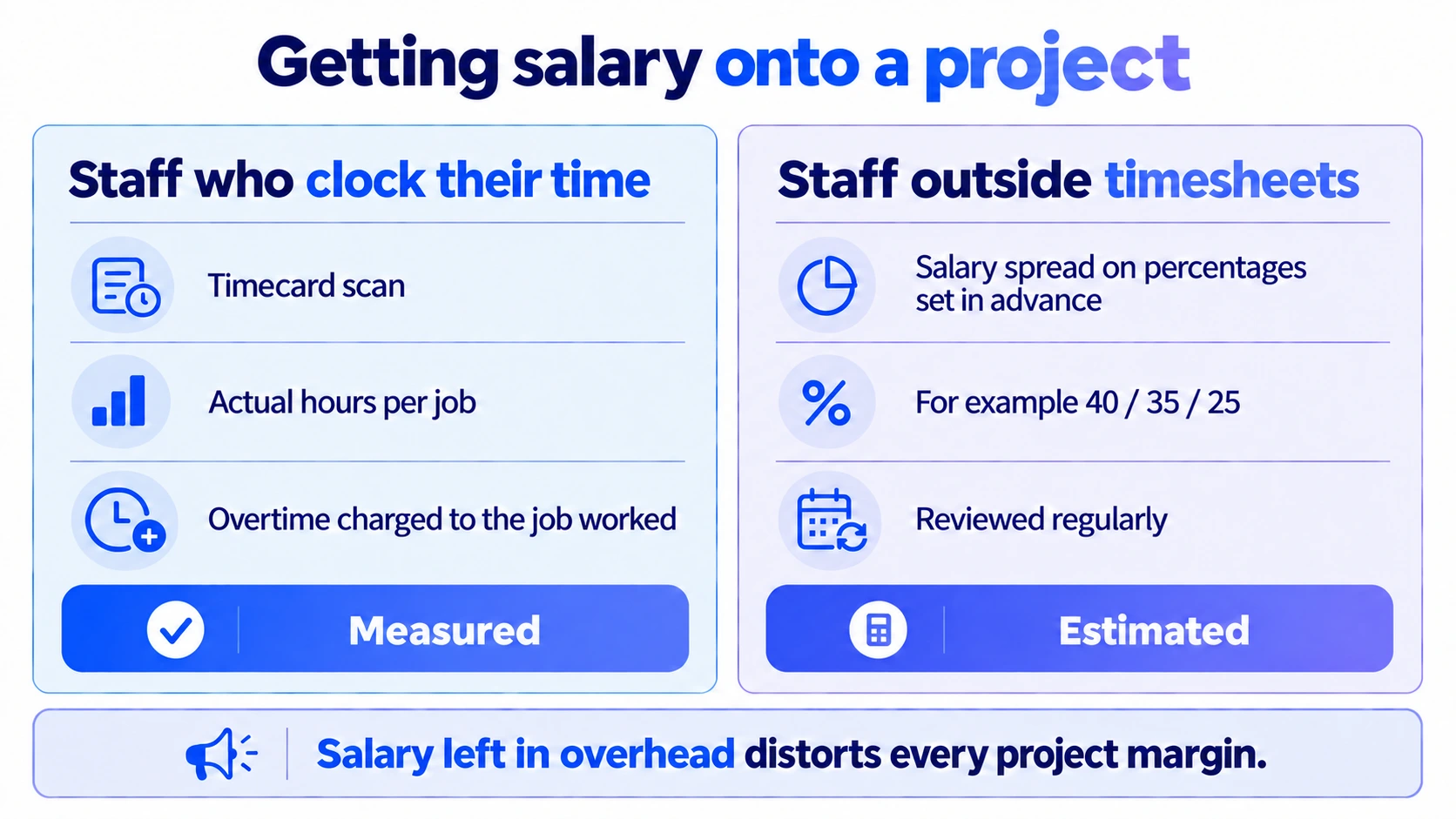
- Staff who clock their time record actual hours against each project, and payroll components follow from that, with basic salary proportioned across normal working hours while overtime and lateness go to whichever project was worked on.
- For the staff who sit outside timesheets, their salary cost gets spread across projects using percentages that are set in advance. The second method is an estimate and it needs reviewing whenever somebody’s workload shifts.
Deco-Base Enterprise, a Singapore contractor that has been a Synergix client since 2013, describes the shift in roughly these terms. What moving from manual attendance records to timecard scanning changed for them was that a single entry now updates the project cost and the payroll calculation together, and the firm puts its productivity improvement down to that.
Project accounting and progress billing
There is almost no design project that finishes on the fee it started with. Extra scope turns up, part of it gets charged and part of it gets absorbed because somebody wants to keep the client onside.
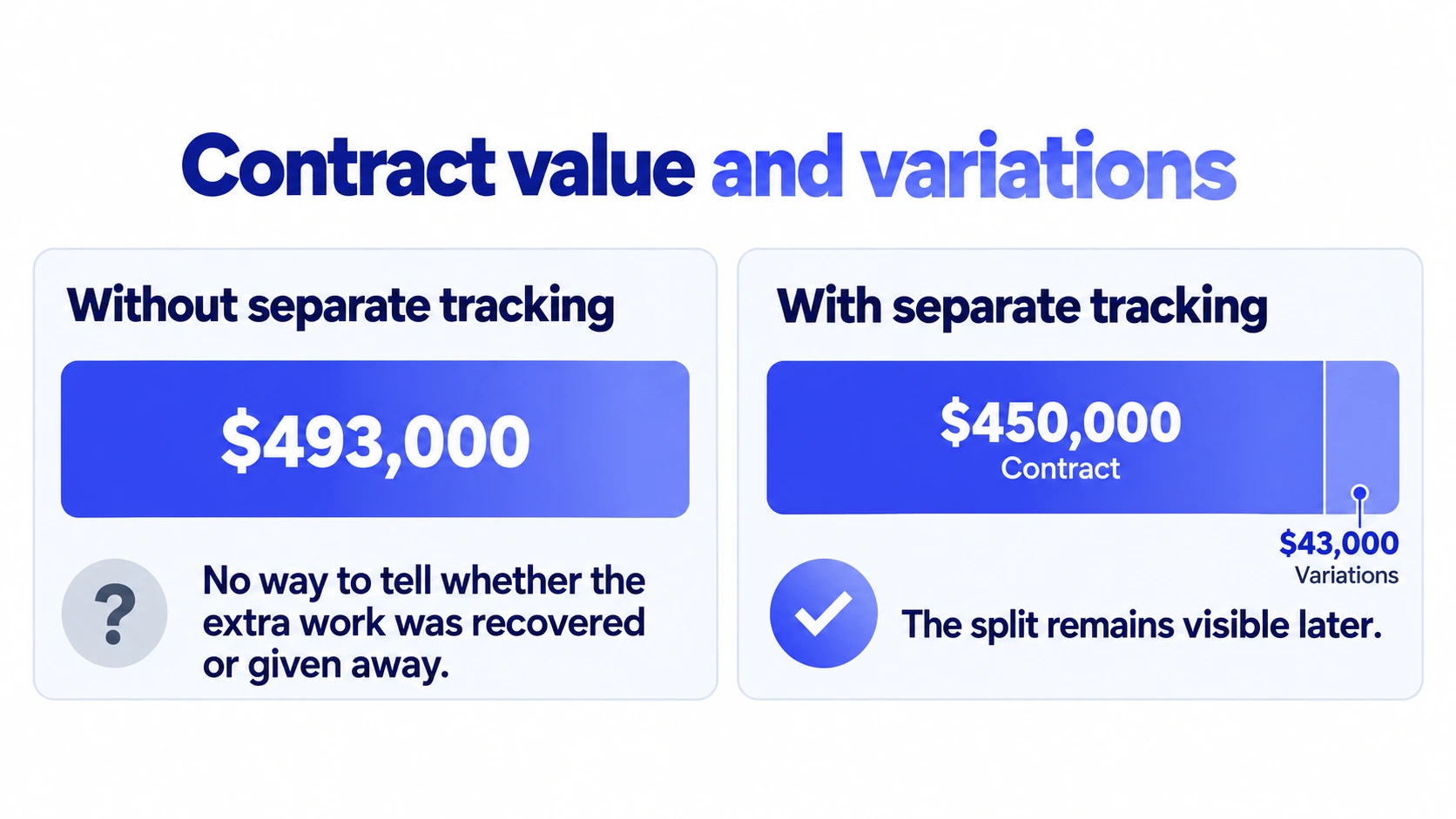
If the system just overwrites the contract value every time this happens, then the firm has lost the ability to answer the question that matters later on, which is whether the extra work was recovered or given away.
Synergix project costing holds the original contract amount and the variation order amounts as two separate figures rather than one. Quotations carry phases and sub-phases, with value, cost and margin worked out at the lowest sub-phase, and that is what makes it visible which parts of a job have been subsidising the others.
Billing splits the same way. Invoicing by project suits some practices, claiming progressively against milestones suits others, and most firms run a mixture.
Profit analytics
Reporting after the fact is an expensive habit. Budget thresholds that raise an alert when costs start drifting, together with budget usage shown at the moment somebody approves a purchase rather than in next month’s report, are what move a firm from explaining overruns to catching them while they are still small.
Forecast against actual, plotted as an S-curve, does the same job at project level. Dashboards are only ever as good as whatever data is feeding them, which takes the whole thing back round to timesheets.
What The Benchmark Numbers Suggest About Utilisation
Utilisation is the metric most practices watch, and it is measured at least three different ways, which is the first problem with it.
PSMJ Resources’ 2026 AE Financial Performance Benchmark, which surveys North American architecture and engineering firms, put median labour utilisation at 57.5%. Other 2026 benchmarks of architecture firms report figures above 70% and above 80%. The spread is definitional rather than performance: some surveys measure firm-wide direct labour as a share of total labour, others measure an individual’s billable share of hours worked. Two practices running identically can report 57% and 82%.
The second problem is what sits alongside it. That same PSMJ dataset recorded a median operating profit margin on net revenue of 20.5%, the highest in the survey’s history, as reported by Building Design + Construction.
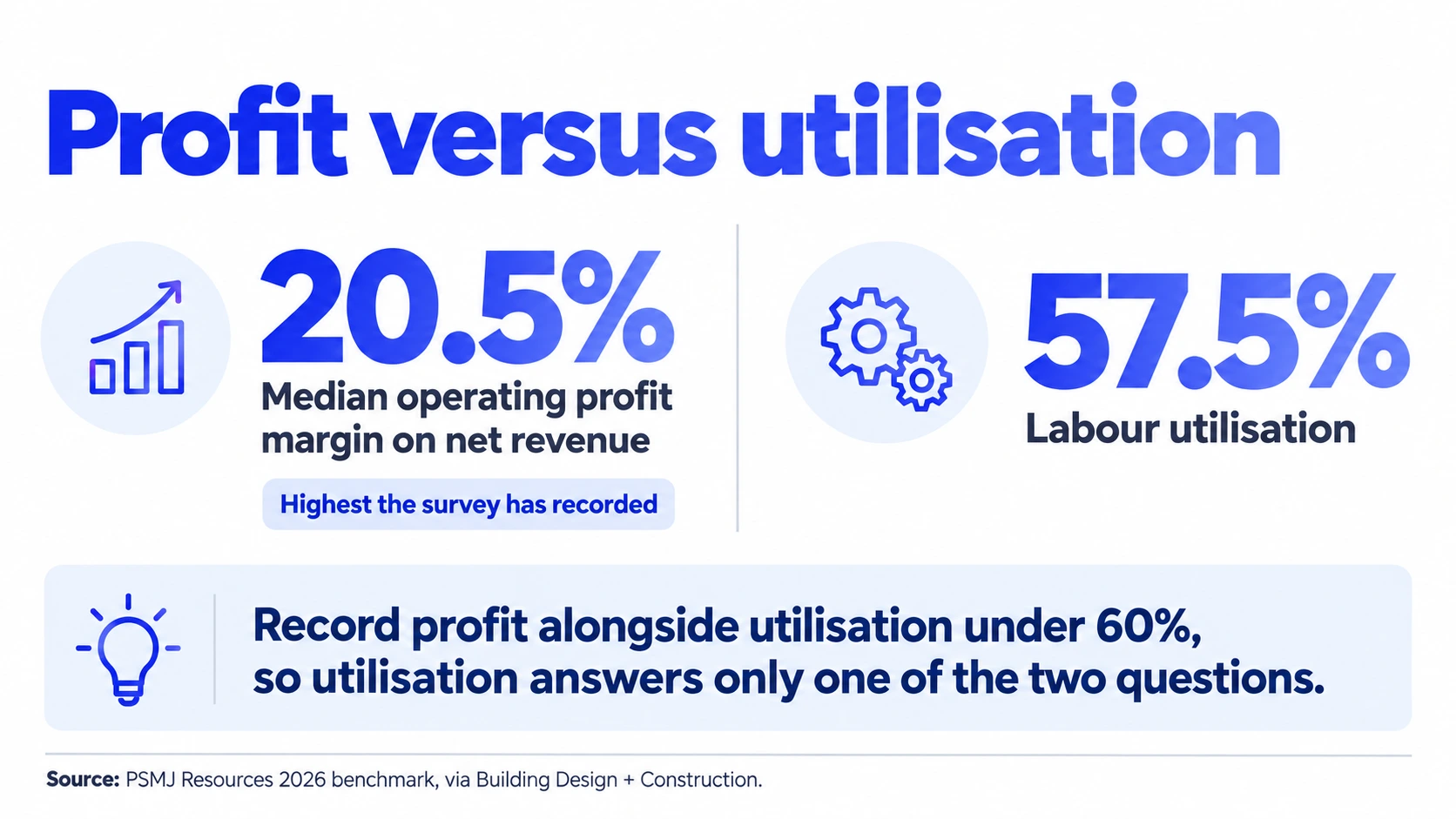
Record margin and utilisation under 60% in the same dataset says that how busy the people are and whether the work actually paid are two separate questions. A system reporting utilisation on its own answers only the first.
Margin by project and by phase answers the second, so that is the report to ask for during a demo.
What This Looks Like In A Project-based Firm
Prime Structures Engineering provides building envelope solutions across Asia, and its work takes in design as well as build. The firm has been running Synergix since 2013, with modules covering project costing and budgeting, finance and purchasing, and progressive claims for customers and subcontractors alike.
What the firm’s Financial Controller picks out of all that is visibility of project expenditure, and of whether a budget has gone over, together with the reduction in duplicated data and in the errors that come from it.
That is a smaller claim than most vendor case studies reach for, and it sits a good deal closer to what the software is doing. A design consultancy carries a different cost base from a design-and-build contractor, so the useful thing for a practice evaluating this is to ask what the reporting looks like when almost the entire cost sitting under a project is salary.
What Does Not Transfer from Construction ERP
A good deal of project-based ERP grew up serving contractors, and it then gets sold across to design firms without much adjustment.
Site management, subcontractor certification, materials and plant, retention and defects liability tracking are all carried by contractor systems, and a design practice has very little use for any of it. Those modules are in the Synergix construction solution because contractors genuinely do need them, and a practice ought to be scoped without them.
The overlap that exists turns out to be narrower than most vendors suggest. Quotation and fee structure, variation tracking, cost to project, progress billing and reporting. That is the part which is worth paying for.
To discuss how any of these maps onto a specific practice, speak to the Synergix team.