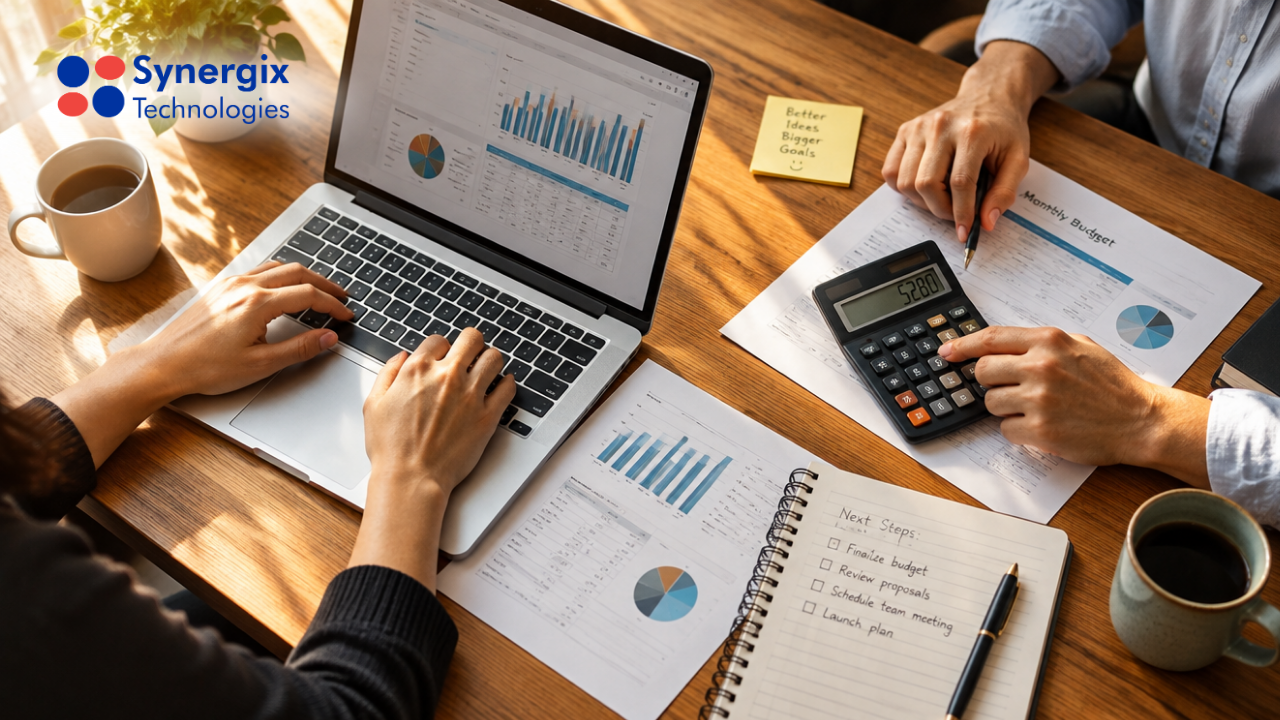




Fixed asset accounting software helps maintain the company’s asset register, calculate depreciation, record additions and disposals, and support fixed asset accounting and reporting. It can be a standalone app or as part of an ERP system.
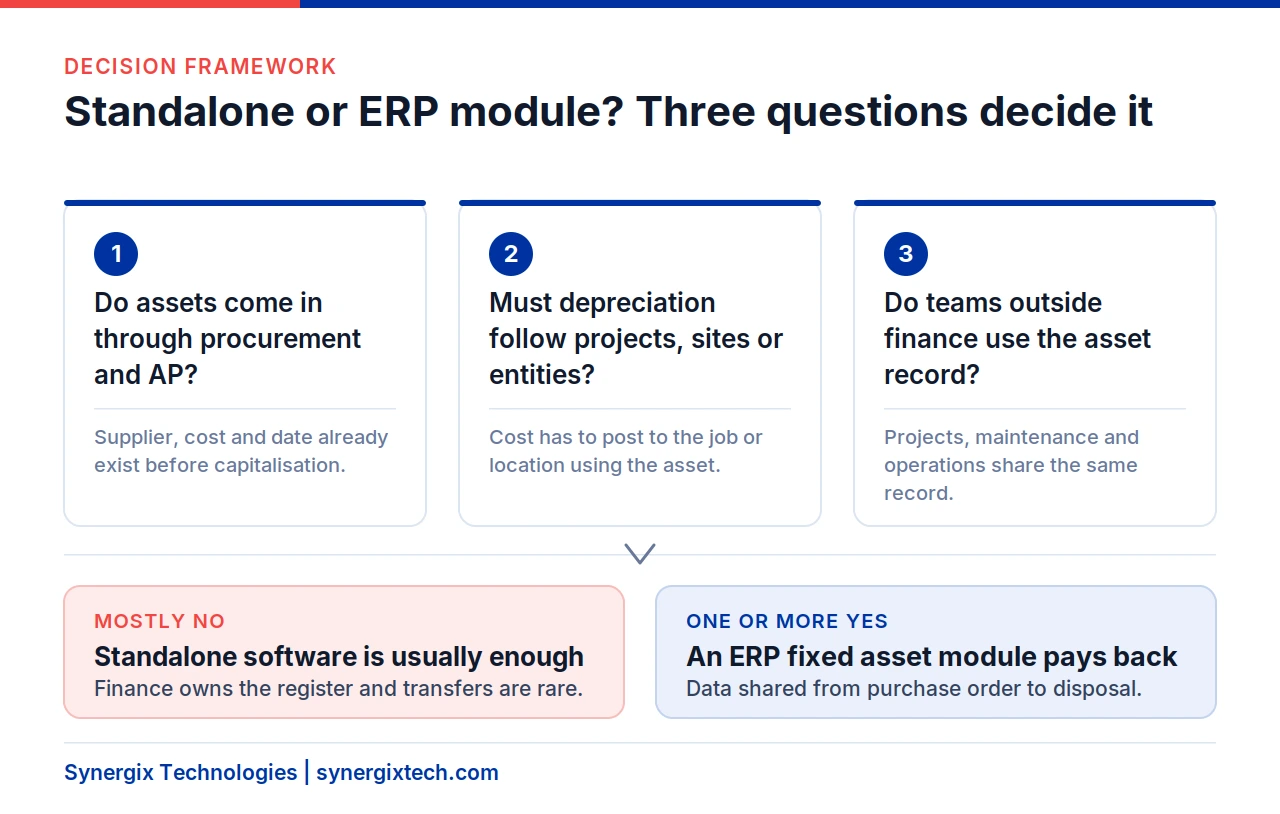
In most cases, a stand-alone fixed asset system will be adequate for Singapore SMEs if the asset base is simple and not dependent on purchasing, projects and operations. The more useful an ERP with a fixed asset module is, the greater the need for the asset acquisition, depreciation, transfers and disposal processes to share data with procurement, accounts payable, projects and the general ledger.
In this blog, we will discuss which option is best suited for businesses of all sizes in Singapore, from small to large. The choice depends more on where your asset data originates and the destination the data needs to go.
Overview
For small or stable asset bases, where most assets are laptops, office equipment or other administrative assets, and the financial structure is fairly simple, standalone fixed asset software is often the more suitable option. If a business has only a single company, limited asset transactions and no need to track the depreciation of assets related to any project, then the business may not benefit from an ERP system when it comes to fixed asset accounting. In that case, the need for accounting can be satisfied with a simple application, without the necessity of implementing an ERP system and without the need for a change of organisation.
The ERP fixed asset module becomes more attractive as the assets are integrated into broader business activities. The asset record is linked to a number of processes prior to the capitalisation of the asset, and after disposal through the same finance process, if the asset is purchased via the procurement process, assigned to a project, moved to another location, and then ultimately disposed of through the same finance process. Maintaining these processes in one system can minimise duplicate entry, enhance traceability and eliminate some of the reconciliation time that can be present at month-end.
For instance, a company of 20 professionals which has to deal with 80 laptops might find a standalone system just fine.
On the other hand, construction, manufacturing, engineering or rental companies that have hundreds of assets in operation across multiple sites and projects will typically benefit from integration.
In these settings, it’s not simply the actual cost of the software that matters, but the frequency with which finance and operations must recreate, transfer, or reconcile the same information.
What Does Fixed Asset Accounting Software Do?
The simplest definition of a fixed asset accounting software is that it keeps a complete financial record of each asset throughout its life. This includes recording:
- Asset code
- Asset description
- Acquisition date
- Supplier
- Original cost
- Asset category
- Depreciation method
- Useful life
- Accumulated depreciation
- Net book value
- Asset location
- Asset additions
- Asset improvements and disposal data
- History of transactions and related supporting documents
Sometimes it is not enough for Singapore companies to manage accounting depreciation.
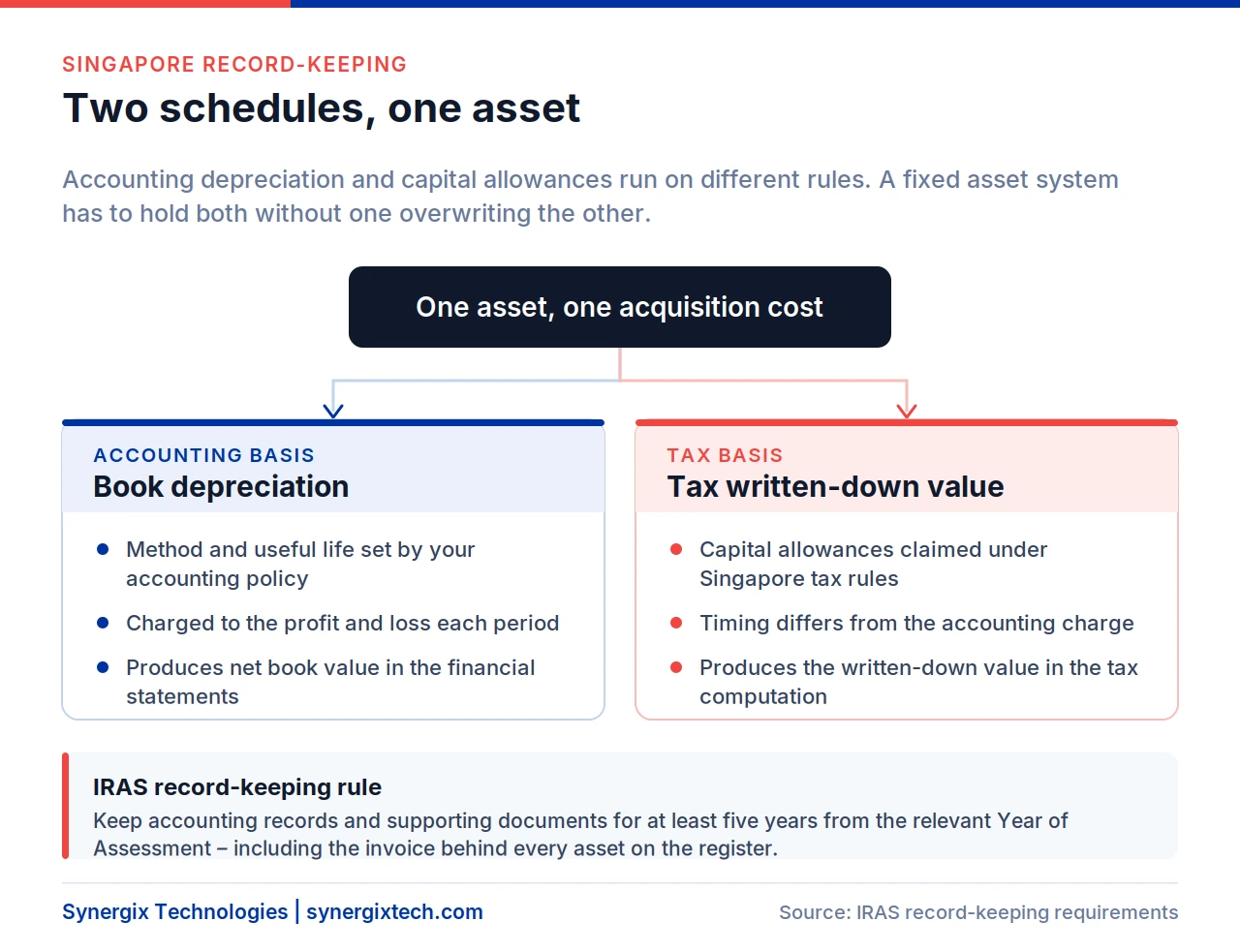
The value of an asset may also need to be carried to allow for capital allowances calculations and tax support, thus having two values at the same time in the finance department. The book value is based on the company’s accounting treatment, and the tax written-down value is based on the capital allowances accrued under the Singapore tax rules.
These two schedules should thus be kept separately and not be compelled in a single depreciation basis. A good fixed asset system should enable finance to determine accounting depreciation without erasing the tax schedule and vice versa. In effect, the business has now created a second asset register, which will need to be controlled, reconciled and passed over when staff changes, and will need to be kept in Excel.
Singapore Record-Keeping Requirements for Fixed Assets
Singapore companies are required by IRAS to retain relevant accounting records and supporting transaction documents for at least five years from the relevant Year of Assessment. For fixed assets, this means the register should not simply show the final depreciation or capital allowance figure; finance should also be able to trace the asset back to its acquisition and the records supporting that transaction. A well-maintained asset record therefore needs both numerical accuracy and a clear audit trail.
Accounting depreciation and capital allowances are subject to different rules.
This becomes particularly important when a company is asked to substantiate an expense, capital allowance claim or other tax treatment. If the register contains only a description and a current value but cannot be linked back to the original supplier invoice, acquisition date or transaction history, responding to an IRAS query becomes more difficult. The practical value of good fixed asset software is therefore not only that it calculates depreciation correctly, but that it helps preserve the evidence behind those calculations.
Companies should also consider how records are handled when assets are disposed of. The disposal value, gain or loss, tax treatment and supporting sales records should remain connected to the original asset rather than being recorded only as a separate journal entry. That continuity makes it easier to explain the full lifecycle of the asset if the transaction is reviewed later.
See the IRAS record-keeping requirements.
Full Comparison: Standalone Fixed Asset Accounting Software vs ERP Fixed Asset Module
Standalone Fixed Asset Software
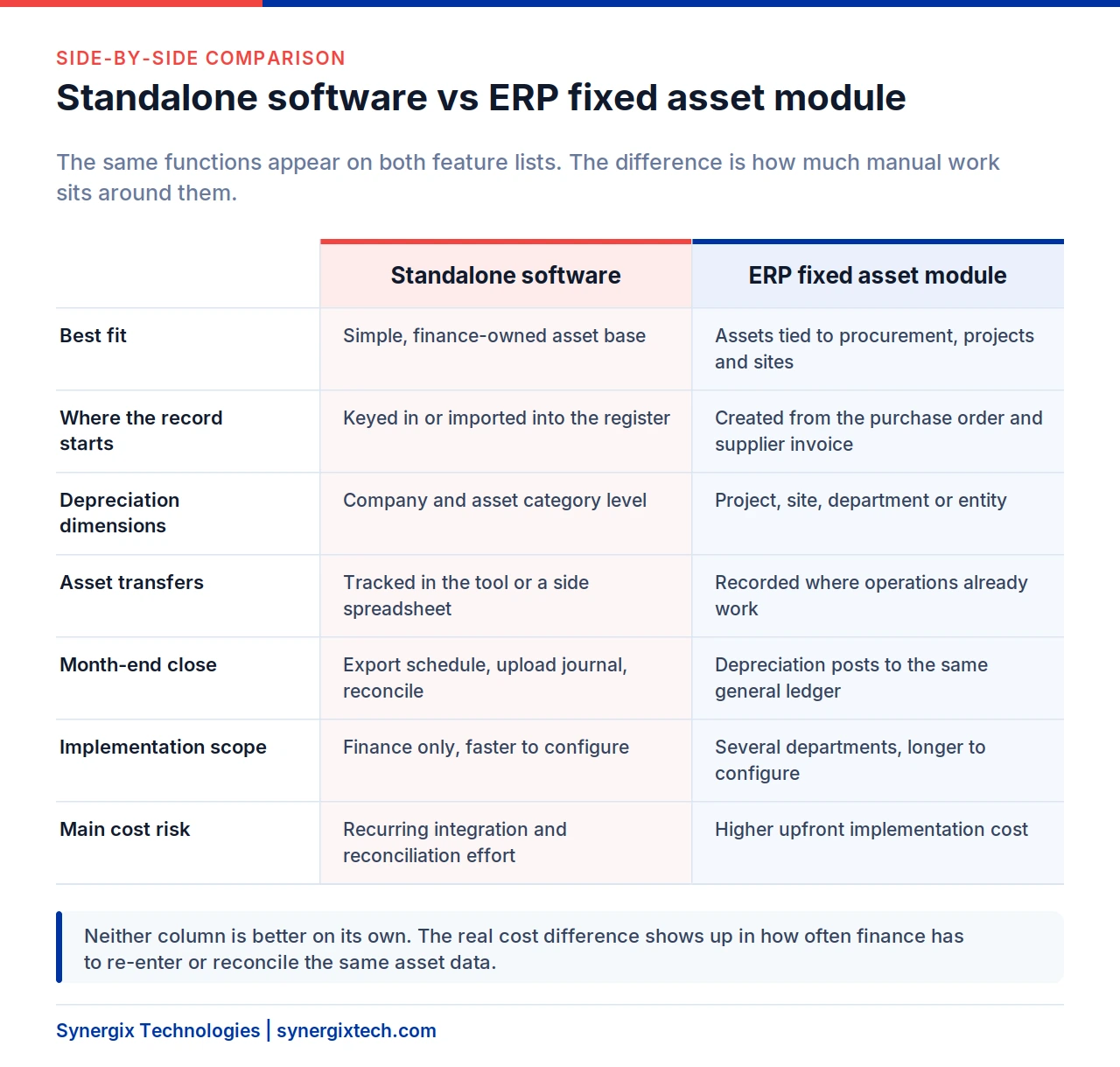
The standalone fixed asset accounting software is best suited in situations where the asset register is mostly a finance responsibility and is not closely linked to broader operational processes. A professional services company with one entity, where the company received most of its assets from existing hardware and office equipment, and where there is minimal asset transfer and no project-based depreciation will likely not require the wider functionality of an ERP. This is where having a dedicated system can help when you don’t want to add to the scope of the project.
The lower implementation footprint may be a plus as well. Fewer departments and workflows are involved, making configuration, migration and testing often a finance-only effort. Such a lower level of integration can be more beneficial for a company that is focused on replacing an Excel register with a controlled system.
If the only part that needs improvement in the process is fixed assets, then standalone fixed asset accounting software may cost less in up-front costs. This does not mean that it’s necessarily less expensive in the long term; there is a cost associated with integrations, imports, reconciliation and future migration. If they are not as extensive, however, a focused product might still be the most practical solution for functionality, cost and implementation.
Read more: Everything You Need to Know about Accounting Software for SMEs
It is equally significant to realise that the word “stand-alone” does not imply “manual”. Specific dedicated products may be able to receive information from the accounting or procurement systems via APIs, connectors or file imports, thereby minimising the need for re-entry. So it’s not whether the software’s standalone or not, it’s how well it can be connected to the systems that are already creating the asset data.
ERP Fixed Asset Module
If an asset is involved in multiple business processes in the lead-up and after the time of capitalisation, then the case for an ERP fixed asset module increases.
For instance, if the manufacturing equipment is purchased, it might initiate as a purchase requisition, turn into a purchase order, be received at a site, be included on a supplier’s invoice, be capitalised and depreciated against a cost centre, and then transferred to another site.
Each time a system initiates an activity with another system, it presents another opportunity for data to be imported and/or reconciled with the other system, which can lead to further inconsistencies.
An important benefit of ERP is that an asset can be created from AP and not from a separate register. Much of the data needed to capitalise may already be in the system if the equipment has been purchased via a Purchase Order, and the supplier has already issued an invoice. Recycling such data can result in fewer duplicate entries and help to track the asset back to the transaction that created it.
ERP can also be useful when depreciation is required based on financial aspects like projects, sites, departments, or business units. If the ERP allows for these structures, then the same dimensions that are used for the other finances can be applied to the fixed asset and will be applied to the depreciation of postings. It can be very helpful for operational companies to know the value of an asset and where that value is being spent as well.
This is also the case for asset transfers and month-end close. An integrated ERP system can track the movement of a machine between locations or business units and not have to rely on a separate spreadsheet or an operations list. Depreciation can then be posted to the same financial environment, which means that there is no need to upload journals from a different application and then reconcile the figures later.
Read more: ERP Asset Management Software for Better Control
These capabilities should be tested, not assumed! While there is often overlap in areas, such as multi-entity consolidation, project allocation, mobile scanning, and maintenance history and intercompany transfers, there are significant differences in the ERP products. The intent of ERP is not just to integrate a fixed asset into a larger system, but to eliminate any meaningful gaps in data flow.
FAQs: Before You Decide
The best way to reduce the options is to know where fixed asset data flows in the business currently. The misnomer of feature lists is that two products can both support depreciation, disposals and reporting and generate vastly different workloads around these functions. These five questions show the integration and control issues that are more likely to impact the finance team following go-live.
1. Where does the asset data originate?
Most assets start in procurement/AP and the information has already been captured before the asset register is developed. If so, an integrated workflow can be used to avoid re-entry of supplier data, cost data, date and transaction data. If assets are bought infrequently, and are necessarily recorded manually, that integration might be less relevant.
2. Who needs the asset information after acquisition?
If it’s mostly financial, a single register might suffice. Project managers, operations, maintenance and management may also have access to the same asset data, which can create a new data silo. The more departments rely on the asset record, the more it becomes a valuable common data source.
3. Does depreciation need to follow projects, sites or business units?
For many operational companies, the actual total depreciation on a monthly basis may not be sufficient. That cost could also be needed for accounting purposes by management who must allocate that cost to the project, department or location where the asset is used. If these dimensions are already set up in the ERP, having the asset in the same structure will make posting and reporting easier.
4. How much reconciliation happens at month-end?
However, if integration into the general ledger is reliable and easily controlled, a separate asset system can be a very effective solution. The problem occurs when there is repeated exporting of schedules, uploading of journals, comparing of totals, and investigating of differences between two systems. It is important to look at those manual steps, as well as the licence price, to get a better idea of the cost of operation than what you’ll see in your license price comparison.
5. Can the system maintain book and tax schedules independently?
In the case of Singapore businesses, it should be illustrated using specific capital allowance scenarios instead of merely being answered with a yes or no. The software should track accounting depreciation and tax written-down values separately, be able to keep track of the history of each schedule, and deal with disposals appropriately. If a separate spreadsheet is still required to finish the tax calculation, then this reliance should be included in the software assessment.
What About Implementation Cost and PSG?
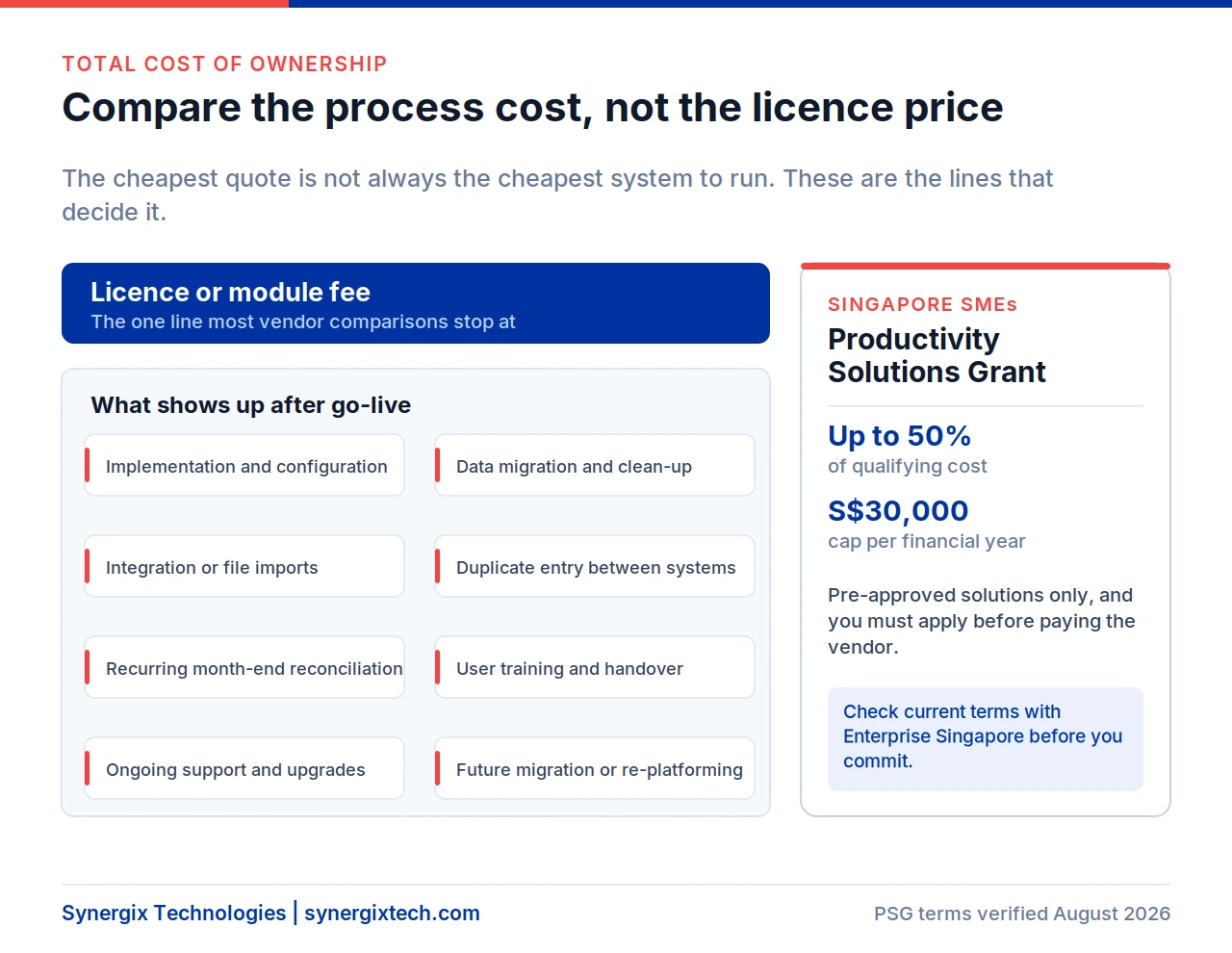
It’s important to remember that software price should not be viewed alone, as the lowest licence cost does not necessarily equate to the lowest total cost of ownership. The cost of a standalone system may be lower when bought, but will need integration, import, and a need for recurring reconciliation, whereas an ERP module might be more expensive to implement but will share master data, workflows, and the finance module with the rest of the organisation. It is important to understand, therefore, that the comparison is not the subscription price or module price, but the cost of running the whole process.
Singapore SMEs are also eligible to submit a proposal for support under the
Productivity Solutions Grant.
PSG currently offers up to 50% funding of eligible costs (up to a maximum of $30,000 per year), and the conditions of the programme will apply. Any business needs to ensure that the solution and scope of implementation are eligible, and not all ERP or fixed asset products are suitable.
While grant support may enhance the business case, it should not be a primary factor in decision-making between different systems. A subsidised product with considerable manual effort can be more expensive to run than a more integrated product. Process fit, controls, and long-term data flow should be considered first, and available funding should be secondary.
Ensure that the requirements are the most current ones with Enterprise Singapore.
Conclusion
The decision between fixed asset accounting software and an ERP module depends on the degree of integration of fixed assets with other business functions. Standalone software is a good choice for a relatively simple asset base, where integration needs are minimal, and finance controls the process. It starts to make sense if the assets are sourced from the procurement system, impact projects or sites, traverse the organisation, and must be constantly compared with the same general ledger.
Businesses should consider performing a test before choosing a system, to determine if all assets can be traced to the originating transaction, if book depreciation and Singapore tax capital allowances can be maintained separately, and the amount of manual reconciliation that will be required after the implementation.
Fixed Asset Management is part of Synergix Financial Management, which also includes Accounts Payable, Accounts Receivable, General Ledger and Bank Book modules.
Transferring asset data from purchasing, finance, projects and operations into a shared ERP system can help to minimise duplicate input and provide improved audit logs from acquisition to disposal.
Get your free demo →