



Synergix
Business Development Consultant

With the growth of manufacturing operations, the control of Product information is becoming difficult from various departments. ERP Product Lifecycle Management Software can integrate product development, inventory management, procurement and production processes in a single system, improving visibility and lowering operational errors. ERP Product Lifecycle Management Software integrates product development, inventory, procurement and production processes and enhances visibility and reduces operational errors.
In this article, we’ll explore the operation of ERP-integrated PLM software and how it can help manufacturing SMEs become more efficient in their daily activities.
- 1 Why Manufacturers Need ERP Product Lifecycle Management Software
- 2 What Is ERP Product Lifecycle Management Software?
- 3 The Five Stages of Product Development
- 4 Main Product Lifecycle Workflows in ERP Systems
- 5 Advantages of ERP PLM (Product Lifecycle Management Software) to companies
- 6 Overcoming PLM Challenges
- 7 The Future of Product Lifecycle Management Technology
- 8 Why Synergix Technologies Can Supports SME Manufacturing Growth
Why Manufacturers Need ERP Product Lifecycle Management Software
Today manufacturers have much more to deal with than just production. Product information flows through various departments from engineering, procurement through inventory, production planning, sales, and finance. With these teams using unconnected systems or legacy spreadsheets, even minor inaccuracies can impact costs, delivery times, and product quality.
For example, while the engineering team is updating a product specification, procurement may be still ordering materials based on an older bill of materials (BOM). Production teams could also be operating on a set of product information that is out-of-date, resulting in delays, waste of materials or rework on the shop floor.
When businesses scale their product lines, operations become more complex, managing product data manually becomes much more challenging. They spend a lot more time checking revisions, updating documents, and solving communication issues between departments.
This is where ERP Product Lifecycle Management Software become essential. Product development linked to operational workflows allows companies to manage product data, stock, procurement, production planning and product approvals in a single system. It provides departments with a single source of information and minimises the mistakes that can occur with disjointed processes.
In the eyes of manufacturers, the aim is to optimise the management of products and to make sure that the product changes are communicated throughout the business without any delays or confusion.
>>> Read more: How ERP Enables Smart Manufacturing for Singapore SMEs 2026
What Is ERP Product Lifecycle Management Software?
Product Lifecycle Management (PLM) is a process for managing product information from the planning and design stage, through manufacturing and updates, to replacement or withdrawal from the marketplace.
With PLM software, companies can manage and organise:
- product specifications
- engineering documents
- bill of materials (BOM)
- product revisions
- approval workflows
- collaborative efforts across departments in the context of the product.
In contrast, Enterprise Resource Planning (ERP) software is more concerned with operational and business processes like:
- inventory management
- procurement
- production planning
- finance
- Storage operations
- sales and order management
Embedding PLM in an ERP system can then feed product information directly into operational workflows. This reduces the need for manual data entry and allows departments to work from the same current data.
>>> Read more: Manufacturing Execution System vs ERP Explained – Synergix Technologies ERP System
For instance, if a product change is accepted, the ERP system can automatically adjust ordering needs, stock planning and production planning. This decreases the chances of teams operating with out-of-date product information.
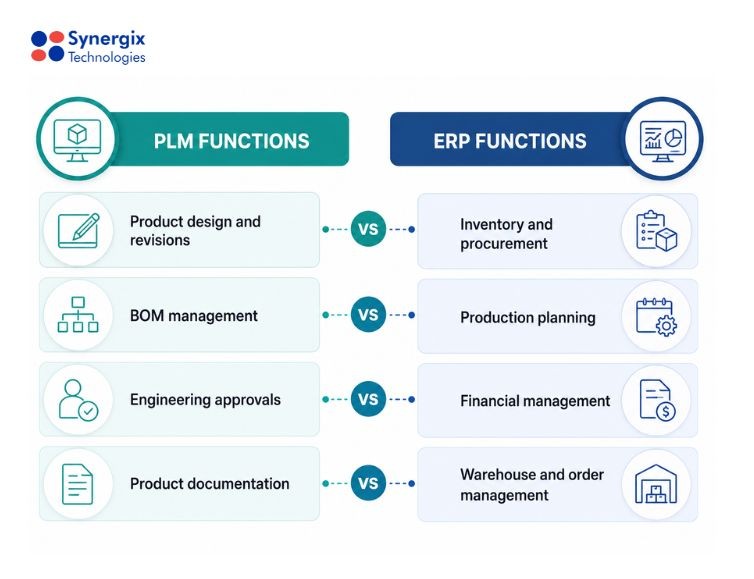
More useful to SMEs is an ERP-integrated PLM software than using many software systems. This allows companies to build products and manage day-to-day operations from a single location, rather than hopping across a range of separate platforms. It allows teams to adapt to changes more quickly and improve control over the whole departments.
The Five Stages of Product Development
Product Life Management (PLM) is the complete lifecycle of a product, from development, manufacturing, support to the management of the product. Most manufacturers pass through 5 stages, although the stages vary from industry to industry: Product planning, Product design, Production, Product support, and End-of-life management.
ERP Product Lifecycle Management Software (PLM) combines data and processes in one system through every phase. Throughout the entire life cycle, departments can remain in sync with product changes, bill of materials updates, inventory planning, procurement needs, and production schedules to ensure accurate product information and improved operational visibility.
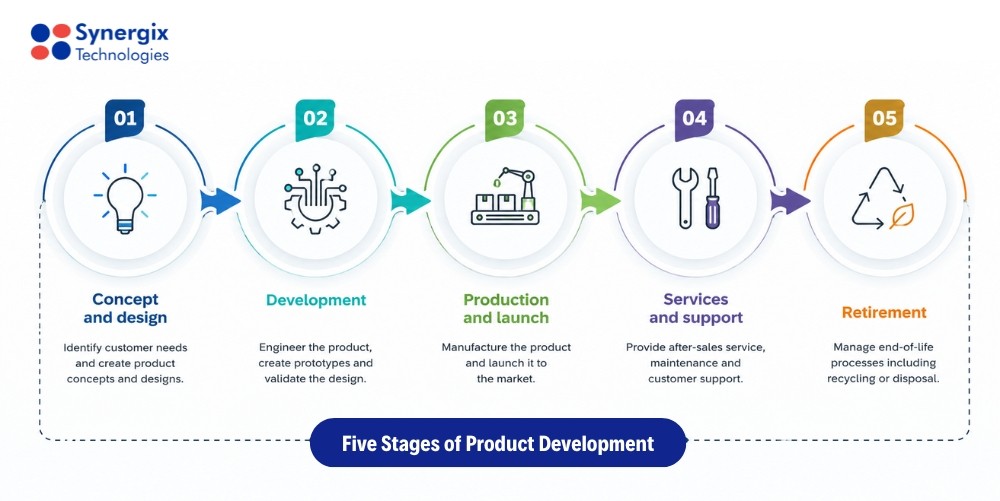
5 stages of product development
Main Product Lifecycle Workflows in ERP Systems
Manufacturers can use ERP-Integrated PLM software for optimizing product information and operational workflows in a single system. This reduces departmental delays and/or manual data changes, and simplifies the departmental workflow.
BOM & Product Data Management
Bill of materials (BOMs) consist of parts, materials and instructions used to make a product. If BOMs are kept in separate systems or spreadsheets, version control may be difficult, especially when specifications for products are subject to frequent change.
PLM software integrated with ERP draws product data into one central place, so everyone in engineering, procurement, inventory and production can see the changes. This benefits businesses:
- reduce manufacturing errors
- improve inventory accuracy
- Remove duplicate products records
- Have greater control of product revisions.
>>> Read more: Production Management Software for Manufacturing SMEs
Engineering Change and Approval Process
Product changes can occur for many reasons including customer needs, changes in suppliers, and improvements in the manufacturing process. If the workflow isn’t well-organised, departments can be alerted at different times which can cause communication issues.
ERP Product Life Cycle Management Software standardises engineering change workflows by centrally tracking and approving changes. Once approved, the updated information is available to other departments to help teams be on the same page during the product life cycle.
Control of Inventory, Production and Purchasing
Product changes immediately impact procurement, inventory planning and production planning. The businesses benefit from improved coordination of these workflows with integrated ERP-PLM workflows.
Integrated PLM software with ERP supports businesses in numerous ways, such as:
- align procurement with updated BOMs
- improve inventory planning
- Keep production plans on track
- Minimise material waste due to obsolete product information
This provides manufacturers with greater visibility throughout the day-to-day operations and enables teams to be more agile in reacting to product changes.
Advantages of ERP PLM (Product Lifecycle Management Software) to companies
In an ERP connected environment, product data management can have a positive impact on operational effectiveness and cross-departmental coordination of SMEs. Teams can collaborate using the same information, across the business, instead of having to use multiple systems and manually update information.
Faster Product Updates & Approvals
If engineering changes are handled in ERP workflows, then changes will be more streamlined to move between departments. New information is delivered to procurement, inventory and production teams in real-time, eliminating delays in manual communication or duplicate approvals.
This enables businesses to reduce response times as there is a possibility of modification of product specification or production requirements.
Better Coordination Between Departments
A variety of teams frequently share the same product data in manufacturing workflows. The ERP-integrated PLM software enables departments to access the same information from a single source.
This improves co-ordination among multiple processes, such as engineering, inventory, production, finance…
As a result, organisations can prevent communication breakdowns and operational errors that result from conflicting records.
Reduced Operational Costs
The integration of product lifecycle workflows and operational planning can improve the accuracy of procurement, inventory and production thus improving business performance. It helps to reduce material waste and improve resource planning in the long run.
Improved Product Visibility & Control
Businesses gain greater visibility over the whole product life cycle by having ERP Product Lifecycle Management Software.
Organisations can prevent communication failures and operational errors due to conflicting records by closely monitoring product revisions, approval history, BOM updates, inventory requirements and changes in production planning.

Overcoming PLM Challenges
There is considerable product data, cross-department coordination and frequent product revisions that can be associated with managing product lifecycle processes. If there is no structured system, manufacturers could experience issues with engineering changes tracking over the course of the product’s life, inconsistent product records, limited visibility across departments, and slower product approval.
Other workflows, such as procurement planning, production scheduling, inventory management and product quality, can be adversely impacted by disconnected workflows. The use of separate systems or manual updates makes it harder to keep the information accurate and up-to-date throughout the organisation.
ERP-integrated PLM solutions can help solve these problems by consolidating and linking product data with the operational workflows. Having all departments see the same product will help them to get better revision control, keep more accurate product data and provide better product coordination throughout the product lifecycle.
The Future of Product Lifecycle Management Technology
The demand to deliver improved products as soon as possible, and whilst satisfying ever increasing sustainability obligations is still growing. This is changing, however, with the evolution of PLM technology, and for companies with an ERP system, the two are increasingly connected.
- By incorporating IoT, engineers can observe properties in real-world use and make changes to those products that are deployed. In ERP, this data is seamlessly integrated into the procurement, manufacturing, and service flows, establishing a direct connection between product design and business processes. According to McKinsey research, the value of the IoT in the world could reach $5.5T to $12.6T by 2030.
- Sustainability is becoming a core part of product development rather than an afterthought. New PLM technologies are now incorporating environmental considerations into the design process, and with a connection to ERP, can be applied throughout the sourcing, manufacturing and logistics.
- Cloud-based PLM is transforming product lifecycle management into a business size affair. For companies already running cloud ERP, it means that both can share data and infrastructure, making integration a breeze and enabling collaboration among teams and departments that are spread apart.
- Digital twins are virtual representations of real products that have real-time updating using real data. They can be linked to ERP, with which companies can simulate performance and find problems before investing in expensive changes in production. The digital twin market is expected to reach a value exceeding $250 billion by 2032 from a value of approximately $13 billion in 2023, where adoption of digital twin has provided the digital companies with measurable cost and emissions reduction.
The common theme across all of these developments is integration. PLM is most useful when it can be integrated with the financial, operational and supply chain data that exists in your ERP system.

Why Synergix Technologies Can Supports SME Manufacturing Growth
Manufacturing SMEs require more than a stand-alone product information management software. They require integrated workflows which enhance coordination between the procurement, inventory, production, financial and sales processes.
Synergix Technologies offers ERP solutions that streamline business processes throughout these workflows in one centralised system. Operational processes can be linked to product lifecycle management (PLM) functions to enhance visibility between different departments and reduce manual processes and duplicated data.
Integrated modules for inventory, procurement, finances and manufacturing operations help businesses better control product information and day-to-day operations as they grow. Workflows integrated with ERP can benefit small and medium-sized enterprises to optimise their processes, minimise operational mistakes and help the business to grow in the future in the face of increasing complexity in their operations.
Contact Synergix Technologies to discuss how PLM integrated ERP workflows can help run your manufacturing business.




![Guide to Expense Management Software featured image 1 - Guide to Expense Management Software in Singapore ([year])](https://www.synergixtech.com/wp-content/uploads/2026/04/Guide-to-Expense-Management-Software-featured-image-1.jpeg "Guide to Expense Management Software in Singapore ([year])")


