



One of the most operationally intensive sectors in the world is wholesale distribution. With hundreds and, in some cases, thousands of SKUs to manage, warehouses to co-ordinate, a web of supplier relationships that are hard to estimate, and margins that are likely to leave very little ground to be given away, distributors have a set of problems all of their own with which no off-the-shelf software can deal.
The difference between a business that succeeds and one that fails to keep up may be an Enterprise Resource Planning (ERP) software that is specifically created to cater to the requirements of a wholesale distribution business. This guide examines the difference between ERP in wholesale distribution, the reasons why it is important, and how to select the appropriate ERP for your business.
What Makes Wholesale Distribution Unique?
Not every industry is made the same, and wholesale distribution is a complex one that differs from manufacturing or retailing. To comprehend the degree of importance of ERP in this industry, one must first comprehend the operating environment that distributors are in on an everyday basis.
High SKU Volume
An average wholesale distributor deals with thousands of SKUs, each of product category, brand, and variation. In the absence of a systematic system, it is practically impossible to monitor the stock levels, reorders, and the movement of products.
Multi-Warehouse Operations
The distributors usually have several warehouse locations, which may be in different regions or countries. Real-time stock visibility in all locations is needed to avoid stockouts in one location when another location has excess inventory.
Bulk and Tier Pricing
Very seldom is wholesale pricing simple. The distributors deal with tier pricing, volume margin, price lists tailored to specific customers, and promotional prices. Handling them manually generates mistakes, discrepancies, and missing revenues.
Supplier Variability and Lead Times
The distributors rely on the suppliers whose lead times, quality, and price may vary. Keeping an eye on the performance of suppliers and scheduling purchases as a result is crucial in keeping the services at the level they were before.
Narrow Margins and Cash Flow Pressure
The nature of wholesale distribution is usually on low margins, and margin visibility – on the product and customer level – is a must. Meanwhile, working on credit conditions with suppliers and customers provides continuous pressure on the cash flow, which requires real-time financial information.
Credit Terms and Accounts Receivable
The day-to-day operational reality that distributors have to contend with is the management of credit limits to hundreds of customers, collections on time, and avoidance of orders being shipped to an over-credit customer.
Why Generic ERP Fails Distribution Businesses
Numerous companies commit the error of installing a generic ERP, which is used in manufacturing or retail, and attempting to modify it to their distribution processes. The outcomes are nearly never satisfactory.
- Inventory shallowness: Generic ERP systems do not often have the depth of inventory that distributors require; batch tracking, serial number tracking, stock aging, multi-location visibility, and barcode scanning.
- Lack of seasonal demand predictions: Seasonal demand cannot be predicted, product movement patterns cannot be tracked, and reorder point optimisation cannot be done automatically unless distribution-specific analytics is implemented.
- Lack of weak pricing control: A generic ERP might be unable to accommodate the multi-tier, flexible pricing models in use by wholesale distributors to control margins and customer relationships.
- Isolated warehouse operations: The absence of interconnection between purchasing, warehousing, order processing, and logistics results in data being copied several times, orders being scheduled, and mistakes being increased.
- Poor financial integration: Generic systems do not tend to offer a real-time product or customer-level margin tracking, necessary to a margin-sensitive business.
The conclusion is obvious: the distribution businesses require an ERP that is designed, or highly configured, to the manner in which they are operated.

Core Features of ERP for Wholesale Distribution
A successful wholesale distribution ERP should consider the whole operation process of the company, from procurement to delivery and financial reporting. This is what to expect in every critical area.
Advanced Inventory Management
The inventory is the bloodline of any distribution business. Your ERP must provide:
- Multi-warehouse inventory visibility and control.
- Tracking of lot numbers, batch numbers and serial numbers.
- Stock aging is used to determine slow-moving or obsolete inventory.
- Auto reorder quantities (doing historical analysis and lead time).
- Barcode scanning to facilitate proper receiving, picking, and shipping.
- Stock reservation to set inventory to maintain the sales order.
Procurement and Supplier Management
Efficient procurement is essential in ensuring that there are not too many stocks and that the stocks are not over-invested. Key capabilities include:
- Supplier supply (lead time, quality, price stability) monitoring.
- Purchase order and purchase requisition management.
- Back-to-back ordering: The purchase orders are generated automatically based on the sales orders.
- The international suppliers’ multi-currency purchasing.
- Goods received with automated e-mail notification and proclamations.
Order Management
Between the time a customer has placed an order and the time when it gets delivered and invoiced, nothing should fall through the cracks with your ERP:
- Full item, quantity, and price visibility in sales order processing.
- Credit limit control orders at shipping time prevents orders to over-credit customers.
- Backorder control and tracking of fulfillments.
- An elastic pricing system consists of several price lists for a customer.
- Field sales Mobile sales order capture, with field offline capability.
Warehouse and Logistics Integration
At the warehouse, the battle of operational efficiency is won or lost. ERP should be able to interface with warehouse operations:
- Selection and loading working process.
- Scheduling of delivery and optimisation of routes.
- Cargo management and delivery.
- Sales order- warehouse preparation- delivery- invoice flow of information.
Financial and Margin Control
In a business that is sensitive to margins, real-time financial visibility is not an option:
- Product, order, and customer live cost tracking.
- Analysis of product line, customer, and business unit profitability.
- Multi-currency and multi-company accounting.
- Approval matrix of quotation- margin controlled or deal value controlled.
- Visibility of cash flows and management of accounts receivable.
Demand Forecasting and Analytics
Decision-making based on data has made the difference between high-performing distributors and those that only respond to issues instead of stopping them:
- Trend analysis and patterns of sales based on history.
- Demand forecast models for stock optimisation.
- Planning and seasonality tracking.
- Ad hoc business analytics as well as 500+ standard reports.
- Configurable operational real-time dashboards.
Customer Relationship Management
Customer retention is equal to customer acquisition. CRM should be included in the distribution ERP to:
- Monitor sales leads, opportunities, and stages of the pipeline.
- Get full customer order history to do precise quoting and relationship management.
- Track warranty due dates and services.
- Oversee activities of the campaign and customer engagement.
How ERP for Wholesale Distribution Connects the Entire Workflow
The most potent and, at the same time, the most misconceived feature of distribution ERP is the way in which it integrates all the business components into one and the same stream. That will work in practice like this:
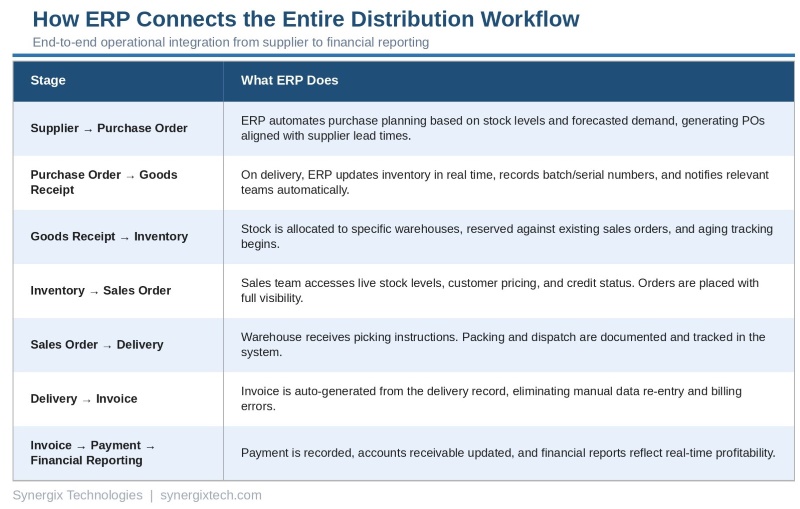
The outcome: there is no duplicate of data, real-time visibility at all levels, and correct margin tracking between purchase and payment.
Real-World Scenario: SME Distributor Before and After ERP
To create a picture of the actual implications of distribution ERP, discuss the following example of a medium distributor:
The Business
- 3 warehouse locations
- 2,000+ active SKUs
- 50+ suppliers
- Regional customer base with varying credit terms
Before ERP
- Stock that was handled through spreadsheets – manual and intermittent updating.
- Constant stock-out in one warehouse and too much stock in another.
- Quoting using old price lists, which causes erosion of margins by the sales team.
- Costs incurred by the finance team resolving invoices by the end of the month.
- No visibility of which products or customers were the most profitable.
- Failure to make decisions on business in time was due to delayed financial reporting.
After ERP Implementation
- Inventory live balance on all 3 warehouses – accessible to all departments.
- Stockouts were eliminated by automated reorder alerts.
- Sales group is gaining access to live prices and customer credit for each order.
- Back-to-back ordering saved more than 60% of the procurement efforts that were done manually.
- Product and customer margin visibility helped make smarter pricing choices.
- Decreased days and increased hours to close the end of every month.
- Approximately 20 percent overall operations productivity improvement.
This is not a hypothetical outcome. It represents the literal change that combined ERP brings to distribution companies – and is a reflection of what Synergix ERP customers such as Han (S) Pte have gone through. Ltd, whose CFO noted:
“Synergix ERP has significantly enhanced our productivity and efficiency, making it an asset to our organisation. Transitioning to cloud-based Synergix ERP has resulted in an estimated productivity gain of approximately 20%.” — Bruce Lee, CFO, Han’s (S) Pte. Ltd
KPIs That Distribution ERP Should Help You Improve
If your ERP is working, you should see measurable improvement in these key distribution metrics:
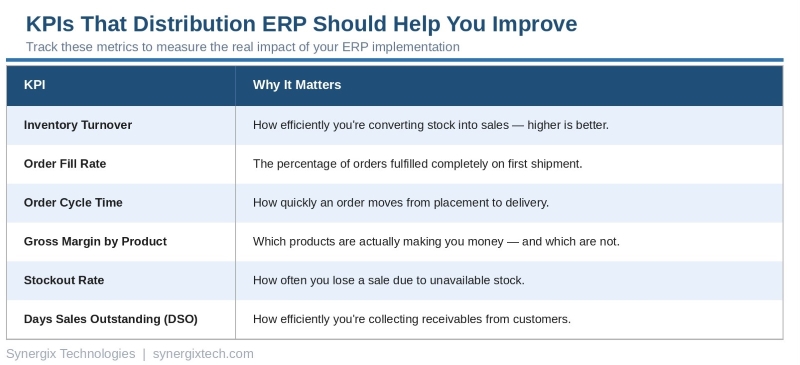
A well-implemented distribution ERP gives you the real-time data to track all of these metrics — and to act on them before small problems become costly ones.
How to Choose the Right ERP for Wholesale Distribution?
One of the most significant business choices to be made by a distributor is the ERP selection. The following is an effective guide to consider when considering your choices:
- Industry-Specific Functionality: Create distribution-based systems, not manufacturing or retail-based. Question vendors: What is the number of distribution businesses that are operational on your system? Which distribution-specific modules do you have?
- Scalability: Your ERP must expand with your business – support more SKUs, more warehouses, more users, and more transactions without necessarily changing your system.
- Integration Capability: Find an ERP that integrates with your other tools: e-commerce sites, logistics services, barcode readers, and reporting applications.
- Implementation Support: Implementation of good software is as good as the software itself. Consider the supplier history, management strategy, and the provision of post-implementation services. A generalist will be much less effective in configuring the system than a vendor who is well familiar with your industry.
- Cost Transparency: Know the entire cost of ownership: licensing, implementation, training, customisation and ongoing support. ERP projects are very likely to have hidden expenses. Work with vendors who are frank about the whole picture.
- Local Compliance: Make sure that the ERP is able to accommodate the local regulatory and tax requirements such as GST, multi-currency, and industry-specific reporting requirements applicable to your market.
- User Adoption and Ease of Use: The mightiest ERP is useless when your team does not intend to use it. Review the user interface, training, and how the vendor manages change.
Read more: 7 Steps of a Successful ERP Implementation Process
Why Synergix Technologies Is Built for Distribution Businesses
Synergix Technologies has been associated with decades of experience in working with wholesale distribution businesses in the area and Singapore in particular. Our ERP for wholesale distribution is not constructed out of an existing generic platform and retrofitted to the operational realities of distribution.
Purpose-Built for Distribution
Synergix ERP encompasses the entire distribution process: sourcing, stocking, selling, and analysing all on one platform, which belongs to the same system. Each of the modules is designed to be interoperable, so there are no longer data silos and manual workarounds that mar the disconnected systems.
Deep Inventory and Procurement Capability
Synergix provides a distributor with the inventory and procurement control tools that they require to operate efficiently, whether it be multi-warehouse stock management, batch/serial tracking, automated back-to-back ordering, and supplier performance monitoring.
Flexible Pricing and Sales Management
Synergix allows a variety of price lists to customers, step pricing, promotional pricing, and credit limit controls – providing the sales teams with capabilities of accurately quoting and securing margins on every sale.
Real-Time Financial Integration
Due to the fact that the Synergix ERP accounting module is integrated with all the other modules, such as purchasing to delivery, the finance departments are provided with real-time access to all the transactions. The close of the month is accelerated, and margin power is effective.
Proven Track Record
Synergix has successfully implemented ERP solutions for companies including Union Energy, PDS International, Ocean Healthcare, and Han’s (S) Pte. Ltd — businesses with complex distribution and supply chain requirements. We have a long list of testimonials from many wholesale distribution companies to prove that our solutions work, not just fictional talk.
SME-Friendly Scalability
Synergix is designed for SMEs who need enterprise-grade functionality without enterprise-grade complexity. The system is configurable and customisable to match your specific business processes — and scales with you as you grow.
Cloud-Based and Mobile-Ready
Synergix ERP operates in a cloud-based environment, enabling remote access from any device. Field sales teams can capture orders offline via the mobile sales app and sync automatically when connected — ensuring no order is ever missed.

Conclusion: ERP Is Not Optional for Wholesale Distributors
Wholesale distribution is a complex business that is margin-sensitive. Days when the use of spreadsheets and unintegrated systems could support the industry demands are long gone.
Wholesale distribution ERP is not software, but it is the operating platform that links your procurement, inventory, sales, logistics, and finance into one real-time picture of your business. It is what enables you to make decisions faster, guards margins, serves customers in a better way, and scales with confidence.
Whether your distribution business requires ERP is no longer an issue. Whether you are using the right one – whether it is really built to suit the manner of your working– is the question.
When you are willing to see how Synergix ERP can transform the way your wholesale distribution business works, call our team today. We appreciate distribution – and we are here to assist you in developing a more efficient, profitable, and scalable business.