


Operating modern logistics is becoming more under pressure. They can expect faster deliveries, accurate updates on the shipment, and reliable service from customers. Meanwhile, the cost of transportation, fuel, and the complexity of coordination are still increasing. Deliveries are still often handled on spreadsheets, by phone and via disjointed systems, which makes it difficult for many SMEs to have a view of the operation.
A transportation management system is used to plan, schedule and track deliveries in an efficient manner. But its usefulness comes into light when the system is integrated with ERP software. This link provides visibility all the way from sales order creation to delivery, and invoicing. Businesses have enhanced visibility and control of logistics, stock and financial information in one environment.
This article covers how a transportation management system works, how it integrates with ERP, the business value delivered to manufacturers and distributors, and some factors SMEs should consider before implementing a TMS.
What Is a Transportation Management System?
A transportation management system (TMS) is a software that is used to manage and optimise delivery operations. It allows one to plan, coordinate, track, cost and monitor transportation performance from one platform.
Common functions include:
- Route planning and optimisation
- Delivery scheduling
- Carrier & driver co-ordination
- Real time shipment tracking
- Freight cost calculation
- Proof of successful delivery
- Reports and analytics on logistics.
The main intention is to make delivery more efficient and reduce the manual coordination in operations. Rather than using two different spreadsheets or messaging updates, logistics can be managed through a single, streamlined workflow.
The main emphasis of a transportation management system is on transport execution. On the other hand, ERP systems handle wider business processes like sales, inventory, procurement, warehouse operations and finance. Combined, these two systems lend greater visibility to companies throughout the supply chain.
Why Standalone Logistics Processes Create Problems
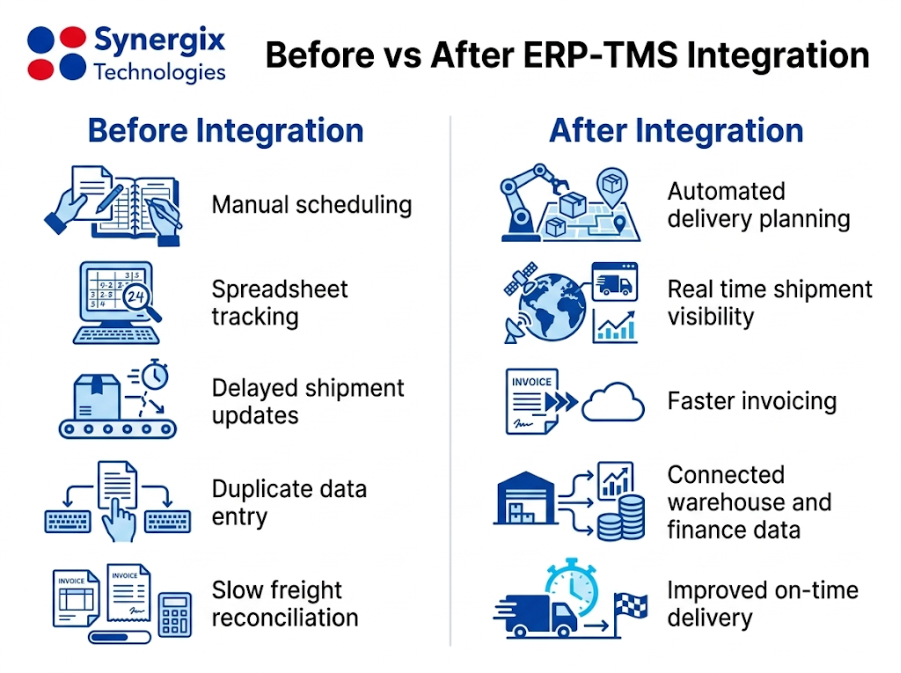
A lot of SMEs still use disjointed processes to manage logistics. Sales teams can manually enter shipment requests, and warehouse staff follow their own schedule, and finances teams are not notified about shipments until much later. This leads to an inter-department delay and inconsistencies.
Manual coordination often leads to several operational problems:
- Duplicate data entry across different systems
- Delayed updates for shipments
- Inaccurate freight costing
- Challenges in tracking delivery performance
- Lack of visibility into deliveries
- Human errors due to manual conversations
These problems become harder to manage as delivery volumes increase. Information is spread out, and customer service representatives can be swamped with shipping questions. Also, the freight charges may not be accurately reconcilable by finance departments.
Logistics processes that are not connected slow down processes, which further lowers customer confidence. This is one of the reasons why growing businesses are incorporating TMS functionalities into ERP platforms to have a more connected workflow.

How ERP and Transportation Management System Work Together
ERP and Transportation systems are two different levels, but when synced together, they are much more effective. Integration allows data to be shared across departments without having to manually update it.
In general, ERP shares information on:
- Sales orders
- Delivery schedules
- Customer information
- Inventory availability
- Shipment priorities
The transportation management system then handles delivery execution, and provides operational information back into the ERP world, including:
- Delivery status updates
- Freight charges
- Shipment completion records
- Proof of delivery information
- Exceptions and delays to delivery
This results in visibility throughout the entire fulfilment process from order to warehouse to delivery.
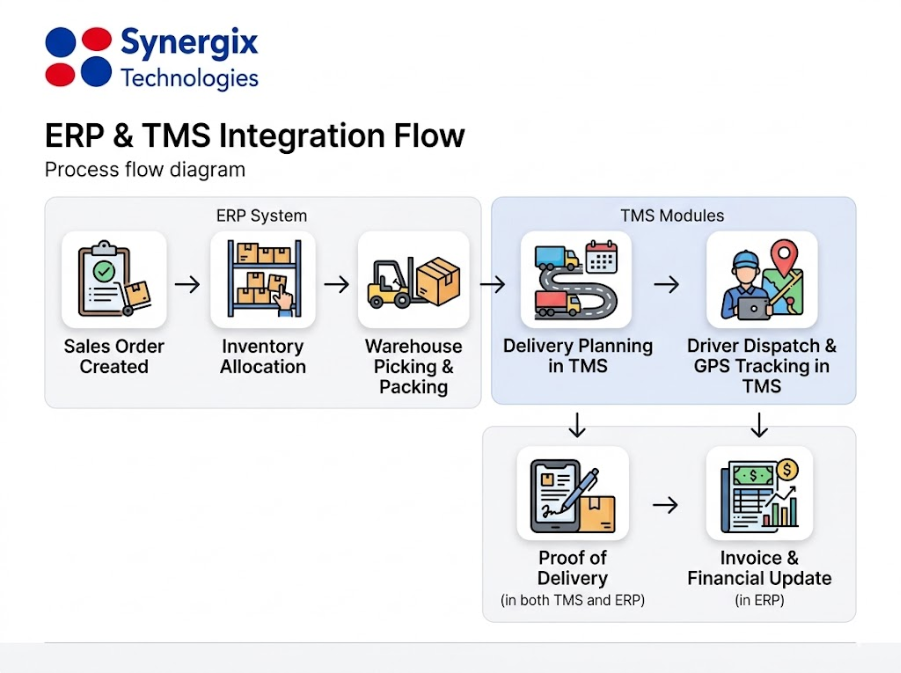
For instance, after a sales order is confirmed in ERP, shipment planning will start automatically within the transportation platform. The accurate delivery schedule is given to the delivery teams, and the products are prepared in the warehouse based on the real-time delivery information. Costs of freight and delivery completed information can also be accessed by finance departments without the need to wait for manual reporting.
Today’s integrations incorporate state-of-the-art technology such as APIs, mobile delivery applications, barcode scanning devices and GPS tracking.
Read more: What’s Logistics ERP and How It Boosts Your Supply Chain
Business Benefits of TMS–ERP Integration
Logistics integration with ERP systems provides tangible benefits to SMEs and manufacturers in terms of operational improvements. Businesses no longer have to deal with transport management in isolation from inventory and finance; instead, they can have a unified environment that allows information to flow more accurately between departments.
Better Delivery Visibility
Teams don’t need to rely on manual updates to track the shipment movements; instead they can do this in real time. Customer success operators are more responsive as delivery information is right at their fingertips.
Quicker Order Fulfilment
Automation minimises delays between sales confirmation, warehouse preparations and delivery schedule. Orders go through the fulfilment process more smoothly.
Improved Freight Cost Control
With integrated systems, it’s easier to see transportation costs. There is a more accurate analysis of freight cost by customer, route or delivery type.
Reduced Manual Work
With automatic communication between systems, duplication of data entry is significantly reduced. This not only saves administrative workload but also helps to ensure a minimum of operational errors.
Stronger Customer Experience
It also makes delivery timelines more precise, and issues are resolved more quickly. Precise, up-to-date updates ensure service reliability and trust.
Better Business Reporting
ERP unifies logistics, operational and financial information on a single dashboard. Managers have more visibility of the delivery performance, freight growth and operational effectiveness.
Key Considerations Before Implementation
These are a few practical considerations that businesses need to consider when integrating TMS with ERP. Technology is not the key aspect of a successful project; process alignment and operational readiness are also necessary.
System Compatibility
The ERP system and transportation system should be compatible to ensure seamless integration. Use APIs, middleware and common communication protocols to facilitate seamless data transfer between systems.
Data Accuracy
Bad master data can cause operational issues in no time. Before the implementation process starts, customer addresses, delivery routes, inventory records and freight rates should be standardised.
Mobile and Real-Time Access
Warehouse teams, drivers and planners frequently need to access shipment information using a mobile device. The system should be evaluated for the ability to provide live updates via mobile apps or handheld devices for businesses.
Scalability
The solution should be able to scale with the business. When companies expand or grow, there is a need for flexibility, whether in the delivery fleet, in warehouses or in the operational areas.
User Training and Change Management
It’s necessary to provide clear training to help employees adjust to new workflows. The users of information, such as logistics teams, warehouse operators, and finance users, should be aware of the flow of information throughout the connected system.
Vendor Support and Local Expertise
Long term success is largely dependent on implementation support. Before investing, SMEs need to consider the vendor’s responsiveness, the ability to provide services in their area, and their experience in the industry.
Many of these integration problems can be streamlined using ERP platforms that are made for logistics and distribution platforms. The systems like Synergix ERP enable businesses to integrate transportation, warehouse, inventory, sales and finance in a single platform.
Read more: ERP Implementation Approaches for Singapore SMEs
Connecting Operations in the Real World
A Singapore distributor has been expanding their sales and were used to plan deliveries between their warehouse and transport team by working with a spreadsheet. The timestamps of shipments were frequently delayed, leading to delays in customer service and incorrect freight costing.
With the integration of transportation workflow with ERP, delivery schedules were now directly linked with sales orders and availability. Shippers could update status of shipments using mobile devices, and finance folks could now access freight information for quicker reconciliation.
The company was able to achieve a considerable reduction in the time required for coordination of deliveries within a couple of months and enhance on time delivery. Furthermore, managers were provided with improved visibility of logistics costs and operational problems, thanks to the integrated dashboards.
This is just one example of the industry. Companies that invest in data sharing technologies claim they have improved visibility of their operations and have more efficient fulfilment processes along their logistics. Companies that invest in data sharing technologies report improved visibility of their operations, and more efficient fulfilment processes across their logistics. (Source: Deloitte https://www.deloitte.com/us/en/insights/industry/transportation/connected-supply-chain.html )
Key Takeaways
- With the help of the transportation management systems, planning, tracking and coordination of delivery becomes better.
- ERP integration connects logistics and inventory, sales, warehouse and finance.
- Real-time visibility enables businesses to minimise delays and enhance customer service.
- Automation minimises and avoids manual administration and man-made errors.
- Connectivity enables expansion and better management of operations.
Conclusion and Next Steps
As logistics performance has a greater impact on customer satisfaction, efficiency and profitability, it has become a key factor in customer experience. Companies that remain with disconnected delivery processes are still suffering from visibility challenges, manual coordination and delayed decisions.
An ERP system with a transportation management system (TMS) can help create a more connected operating environment. The information shared by teams of sales, warehouse, logistics and finance improves the fulfilment rate, freight control and reporting accuracy in businesses.
Logistics integration is part of the overall digitalisation plan of SMEs and cannot be a stand-alone project. A connected platform enables businesses to scale with greater confidence and confidence, whilst keeping service quality and operational discipline.
For businesses considering more intelligent operations, ERP software solutions, such as Synergix ERP, for instance, may not be out of the discussion. It incorporates transportation, warehouse, stock, finance, CRM, HR and sales workflows into a single system. Contact Synergix Technologies for a consultation or system walkthrough for your operational needs.