



There are two types of costs in every project budget, and mixing them is one of the quickest ways to lose margin. Understanding the difference between direct and indirect costs allows the project manager, QS or finance manager to submit a tender at the correct amount, monitor actual cost burn against budget, and report variance with facts rather than guesswork. It matters most in project-based industries such as construction, M&E and trading, where dozens of subcontractor claims, material deliveries and shared overhead lines run in parallel on a single job.
This article covers what each cost type is, why the split decides a project’s true profitability, and how teams can track both without anyone manually updating a spreadsheet.
What Is Direct Cost in Project Management?
A direct cost is a cost tied to the production of goods or providing a service. Direct costs move with the scope of work: order more material or put more hours on site, and the figure rises.
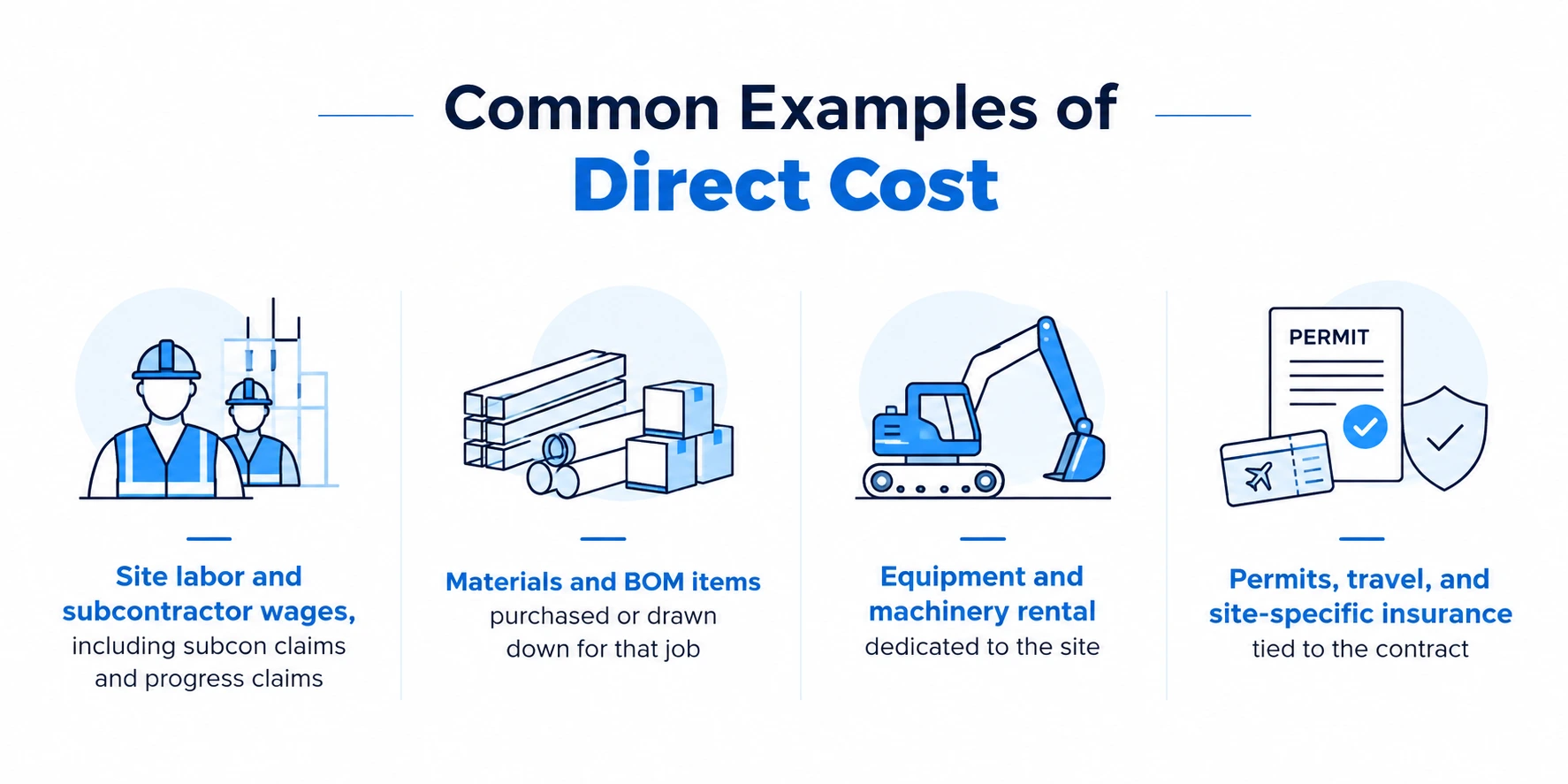
Common examples of direct cost
- Wages for site labour and subcontractors, including subcontractor and progress claims
- Materials and Bill of Materials (BOM) items ordered or requested for that job
- Equipment and machinery assigned to that site
- Travel permits, work permits and site-specific insurance for the contract
 Because direct cost moves with the scope of work, it is the line a quantity surveyor checks first when a variation order lands, since a change in scope usually moves this cost before anything else.
What Is Indirect Cost in Project Management?
Wall Street Prep describes indirect cost as “the general expenses related to operational functions”. Even though indirect costs bring significant value to a business as a whole, these costs cannot be assigned to the creation of a single product.
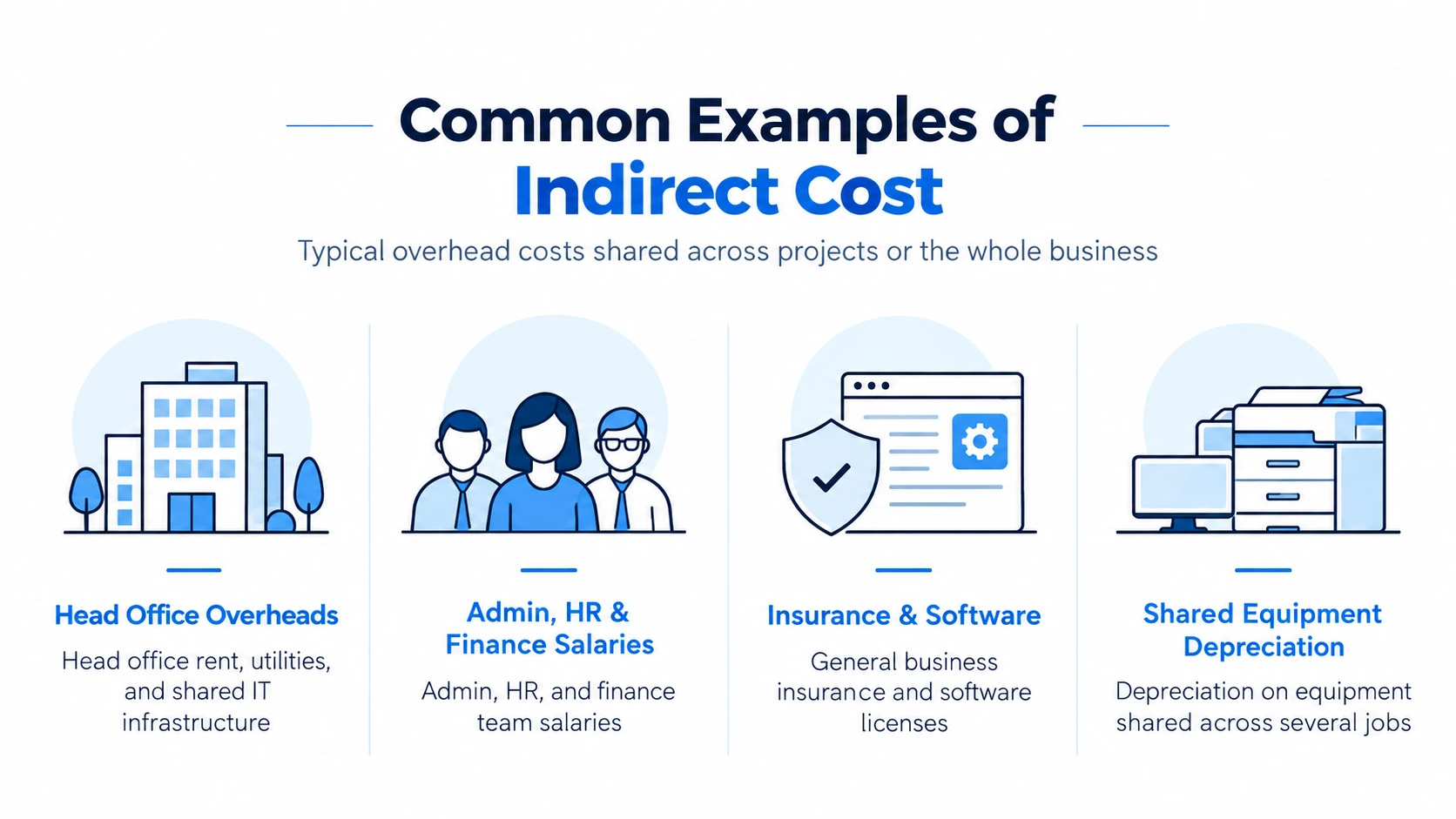
Common examples of indirect cost
- Head office rent, utilities and shared IT facilities
- Admin, HR and finance team salaries
- General business insurance and software licences
- Depreciation of equipment used across more than one job
Direct cost usually arrives on a single invoice. Indirect cost does not. It is spread across the projects using it, based on a chosen allocation base, normally direct labour hours or direct material cost, and reconciled against the accounting module at period end.
Read more: How to select a good project costing management tool for SMEs
Key Difference Between Direct and Indirect Cost in Project Management
| Direct cost | Indirect cost | |
|---|---|---|
| Traceability | Identified with one project | Shared across several projects |
| Behaviour | Changes with scope and progress | Relatively stable period to period |
| Where it reports | Cost of work done | Overhead or G&A |
| How it is tendered | Priced item by item | Added as a percentage |
Why the Distinction Affects Project Profitability
A tender can look like a good deal on paper and turn into a loss once the indirect cost is understated. This happens most often on fixed-margin bids, where the contractor prices the direct costs sensibly but adds an overhead percentage that does not reflect what it actually costs to run the business over that project’s life.
GA Construction, a building and construction company in Singapore, ran into this before standardising its cost data entry. Inconsistent entry and scattered control points across jobs slowed the team down, and centralising the data on one system is what the firm credits with its productivity improvement.
See how we have helped construction businesses digitalise

Tracking Direct and Indirect Cost: Excel vs Accounting Software vs ERP
Separating direct cost from indirect cost is where the difference between manual tracking, standalone accounting software and a full ERP system becomes visible.
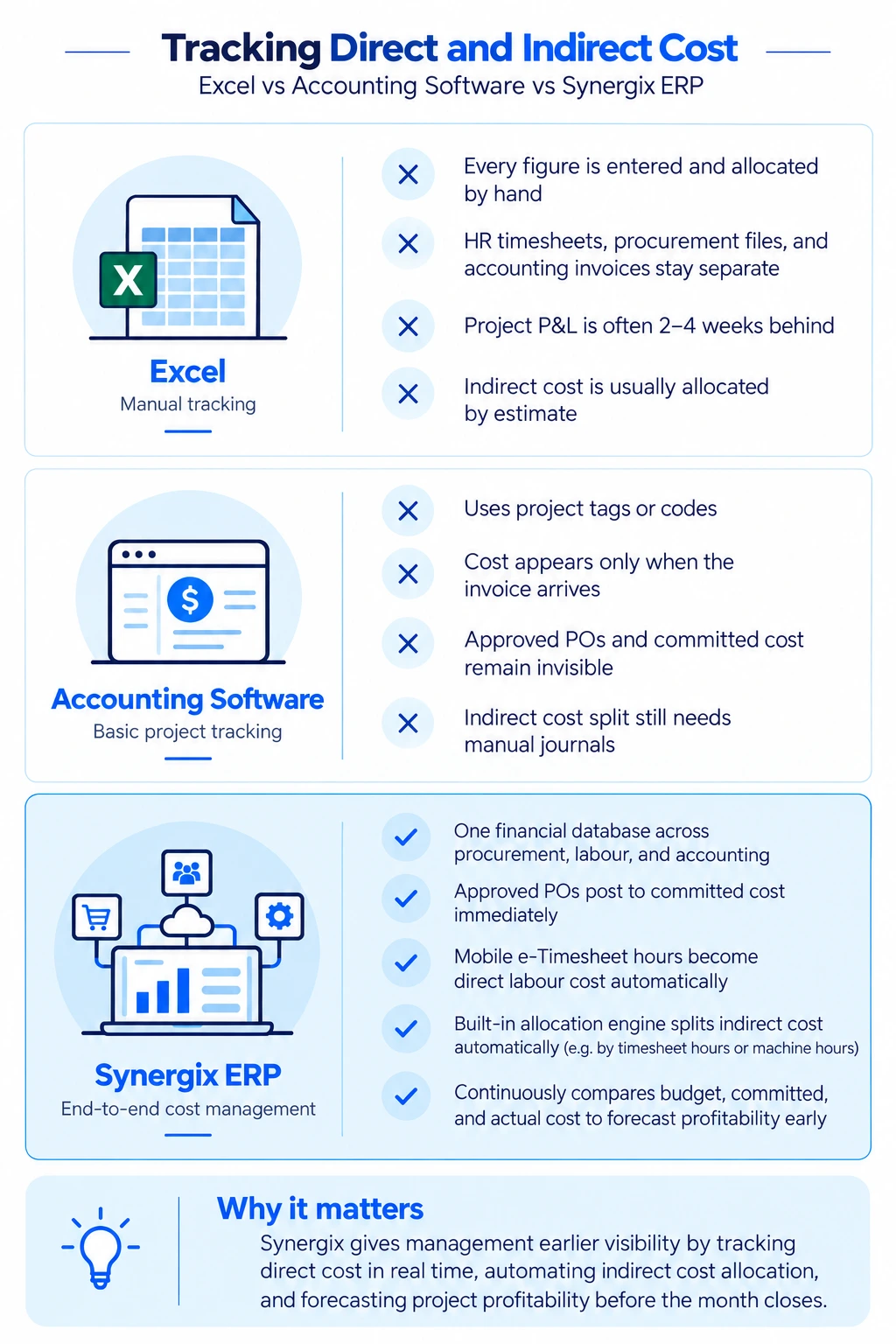
Excel and manual tracking
Every figure is entered, shared and allocated by hand, usually with SUMIFS or VLOOKUP. Site labour sits in an HR timesheet, material purchases in a procurement file, and indirect invoices in the accounting file, with no automatic link between them.
Management typically asks for a project P&L two to four weeks after the numbers were produced, and indirect costs such as office utilities and equipment depreciation become an estimate by the time they are allocated.
Standalone accounting software
These platforms improve matters by tagging each transaction with a project code. The limitation is that they only see a cost once an invoice arrives.
An approved but unbilled purchase order stays invisible, which is the committed cost.
Indirect cost fares no better: there is no allocation engine, so someone splits the cost manually and posts the journal entry.
What Synergix ERP does differently
Synergix runs the whole cost cycle on one database, which closes both gaps.
- Capturing direct cost in real time. When procurement raises a purchase order (PO), the system requires a project code. Once the PO is approved, the amount posts to that project’s committed cost and flags a budget overrun before any invoice arrives. Labour works the same way: hours logged through the mobile timesheet on site convert into that project’s direct cost, with pay calculated automatically and little or no re-entry from HR.
- Automating indirect cost allocation. Instead of a spreadsheet formula, indirect cost runs through a built-in allocation engine. A monthly cost such as the Foreign Worker Levy is split across projects based on each site’s actual timesheet hours, and equipment depreciation is allocated by machine hours logged.
- Cost-to-complete evaluation. As everything feeds one system, Synergix continuously compares estimated budget, committed cost and actual cost, and projects remaining profitability at any point in the month, early enough for the team to act before a job turns unprofitable.
Key Takeaways
Direct and indirect cost can look like bookkeeping terminology until a tender that appeared healthy on paper turns out to lose money in delivery. What prevents that is a cost structure set before the project starts, applied consistently across every project, and monitored closely enough to catch drift early.
In construction, M&E and trading businesses, that works best when direct cost, indirect cost, billing and analytics sit in one system rather than three.
Book a demo to see how Synergix Project Costing Management handles it, before the next tender goes out the door.