


5 types of payroll systems: manual spreadsheets, standalone payroll software, HR management systems with payroll built in, outsourced payroll services, and ERP systems with payroll included. The right choice depends less on headcount than on how complicated your workforce is and how closely labour costs need to connect to the rest of your accounts.
This guide covers what each type does, where each one stops working, and the Singapore compliance requirements every option has to satisfy. If payroll data also needs to flow into your general ledger and project costs, our ERP financial management overview explains how that connection works.
1. Manual Payroll (Spreadsheets and Calculators)
How it works: Salaries, deductions and CPF are calculated in Excel or Google Sheets, then paid through internet banking. Payslips are produced from a template.
Best for: Businesses with fewer than roughly five employees, fixed salaries, and no shift or overtime complexity.
Where it breaks: Rate tables change and spreadsheets do not.
When CPF rates or ceilings are revised, every formula referencing the old figure has to be found and corrected. One stale cell produces an underpayment that repeats silently every month. Spreadsheets also have no audit trail, which makes error investigation slow and fraud harder to detect. We covered this pattern in detail in our article on common payroll problems.
Real cost: Nominally free. The actual cost shows up as finance staff hours and rectification work.
2. Standalone Payroll Software
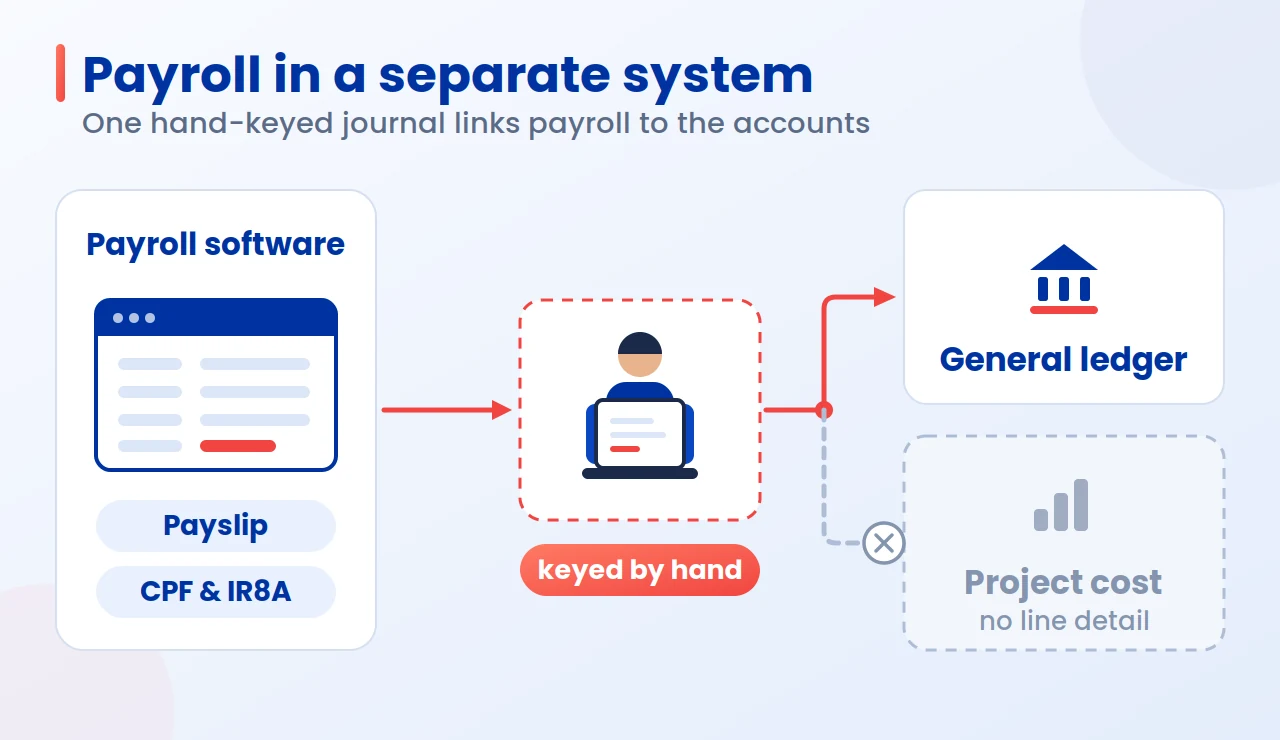
How it works: A dedicated application, usually cloud-based and subscription-priced, that calculates pay, generates payslips, produces the CPF submission file and supports IR8A submission to IRAS. Singapore-focused products maintain CPF and IRAS rate tables for you.
Best for: Businesses of roughly 5 to 100 employees with straightforward pay structures and no strong need to connect payroll to operational data.
Where it breaks: Payroll becomes a silo. Salary cost sits in one system and the general ledger in another, so someone posts a monthly journal by hand. For businesses that need labour cost allocated to jobs, projects or production orders, that posting is a summary figure with no detail behind it. Reconciling payroll to accounts becomes a recurring month-end task instead of an automatic result.
Real cost: Per-employee monthly subscription, plus setup and the ongoing manual bridge to accounting.
3. HR Management System (HRMS or HCM) With Payroll
How it works: A broader HR platform where payroll runs on the same employee record as leave, claims, attendance, appraisals and onboarding. Leave balances and timesheets feed the pay run directly.
Best for: Growing companies, usually 50 employees upward, where HR administration itself is the bottleneck and the workforce is office-based.
Where it breaks: The integration is strong on the HR side and thin on the finance side. Leave and attendance flow in cleanly, but the connection to the general ledger, to purchase costs, or to project budgets is still an interface rather than a shared database. HRMS platforms are also generally built around salaried office workers, so site allowances, trade rates and multi-project labour allocation often need workarounds.
Real cost: Higher per-user subscription, longer implementation, and you are paying for recruitment and performance features whether or not you use them.
4. ERP with Payroll Built In
How it works: Payroll runs inside the same system as finance, inventory, project costing and operations. Timesheets captured at a site or on a production floor are tagged to a project or job code, feed the pay calculation, and post straight to both the general ledger and the relevant cost centre. CPF and IRAS outputs are generated from the same employee master record.
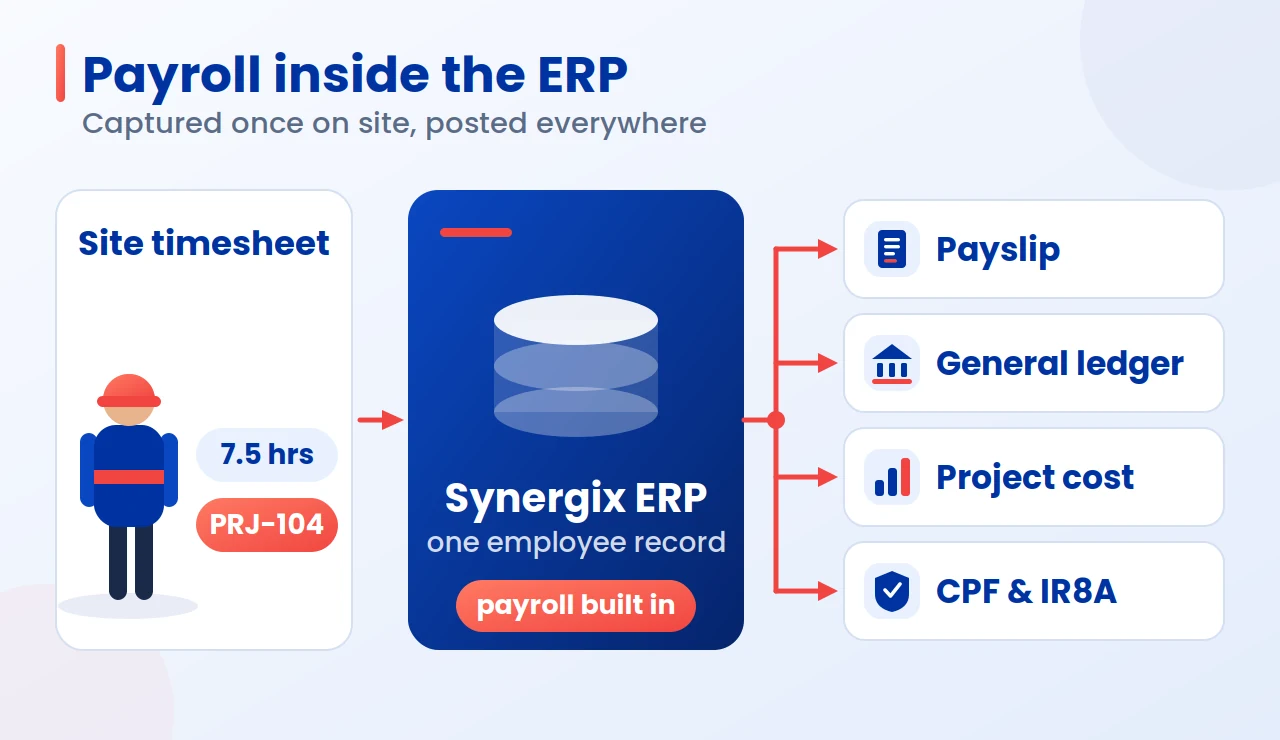
One capture point, one database, four destinations.
Best for: Project-based and labour-intensive businesses where labour is a major cost of sale rather than an overhead. Construction, marine engineering, manufacturing, field service and facilities businesses sit squarely here.
Where it breaks: ERP is a larger commitment than payroll software and is not worth implementing for payroll alone. If your only problem is that payroll is slow and inventory, costing and finance are already working fine, a dedicated payroll product is the more proportionate choice.
Real cost: Quote-based on scope rather than per-employee pricing. Singapore SMEs can offset part of the cost through EDGE grant support for business systems.
Read more: What is ERP and its importance in modern business
5. Outsourced Payroll Services
How it works: A payroll bureau, accounting firm or corporate services provider processes payroll on your behalf. You submit changes each month; they calculate, file CPF, submit IR8A and often handle the bank file.
Best for: Companies with no in-house HR or finance function, foreign companies newly incorporated in Singapore, and businesses that want compliance risk sitting with a specialist.
Where it breaks: Responsibility can be delegated; liability cannot. The employer remains legally accountable for correct and timely CPF contributions and IR8A filings. Outsourcing also creates a turnaround delay on every change, and payroll data lives outside your systems, so finance cannot query it directly. Reporting means requesting a report.
Real cost: Per-employee monthly fee that scales with headcount, plus charges for off-cycle runs and year-end filing.
Comparison: Types of Payroll Systems At A Glance
| Typical fit | Link to finance and operations | Limitation | |
|---|---|---|---|
| Manual spreadsheet | Under 5 employees | None | No audit trail, errors repeat silently |
| Standalone payroll software | 5 to 100, simple pay structures | Manual journal or file export | Payroll data isolated from accounts |
| HRMS with payroll | 50+, office-based workforce | Strong to HR, weak to finance | Poor fit for site and trade labour |
| ERP with payroll | Project-based, labour-intensive | Native, same database | Larger scope than payroll alone |
| Outsourced payroll | No internal HR or finance team | None, data held externally | Delay on changes, limited visibility |
When Payroll Is Not Your Problem
Finance teams often arrive at a payroll system search after a specific failure: a CPF underpayment, a missed filing, a payslip dispute. But payroll is frequently the symptom rather than the cause.
A construction firm that cannot tell which project a worker’s hours belong to does not have a payroll problem. It has a time capture problem, and payroll is simply where the consequence becomes visible. Replacing the payroll system will produce correct payslips and still leave project margins unknown.
The diagnostic question: when you ask “what did labour cost us on Project X last month”, how long does the answer take? If it requires exporting payroll data and matching it against a timesheet file by hand, the gap is between systems, not inside the payroll one. Our guide on managing small business payroll walks through the process side of this.
Singapore Compliance Requirements Your System Must Handle
Whichever type you select, verify it handles the following. These are the areas where payroll systems configured for other markets most often fall short.
- CPF Ordinary Wage ceiling: From 1 January 2026 the CPF Ordinary Wage ceiling is S$8,000 per month. The annual Additional Wage ceiling remains S$102,000 minus the year’s CPF-subject Ordinary Wages. Confirm both figures are current in your system.
- Age-banded CPF rates: Contribution rates for workers aged 55 to 65 rose on 1 January 2026, with further increases scheduled for 1 January 2027. A system that applies the right ceiling but stale age-band rates will still under-contribute.
- CPF payment timing: CPF contributions are due on the last day of the calendar month, and enforcement action follows if payment is not made by the 14th of the following month, including late payment interest.
- Auto-Inclusion Scheme submission: Employers with five or more employees must submit employment income information to IRAS by 1 March. Check that your system exports in an IRAS-accepted format.
- Itemised payslips: Employees covered by the Employment Act must receive an itemised payslip showing basic pay, allowances, deductions, overtime and net pay. The system should generate these automatically.
- Skills Development Levy: Payable alongside CPF for employees rendering services in Singapore, including foreign employees. Confirm it is calculated in the same run rather than tracked separately.
Switching Payroll Systems: What To Plan For
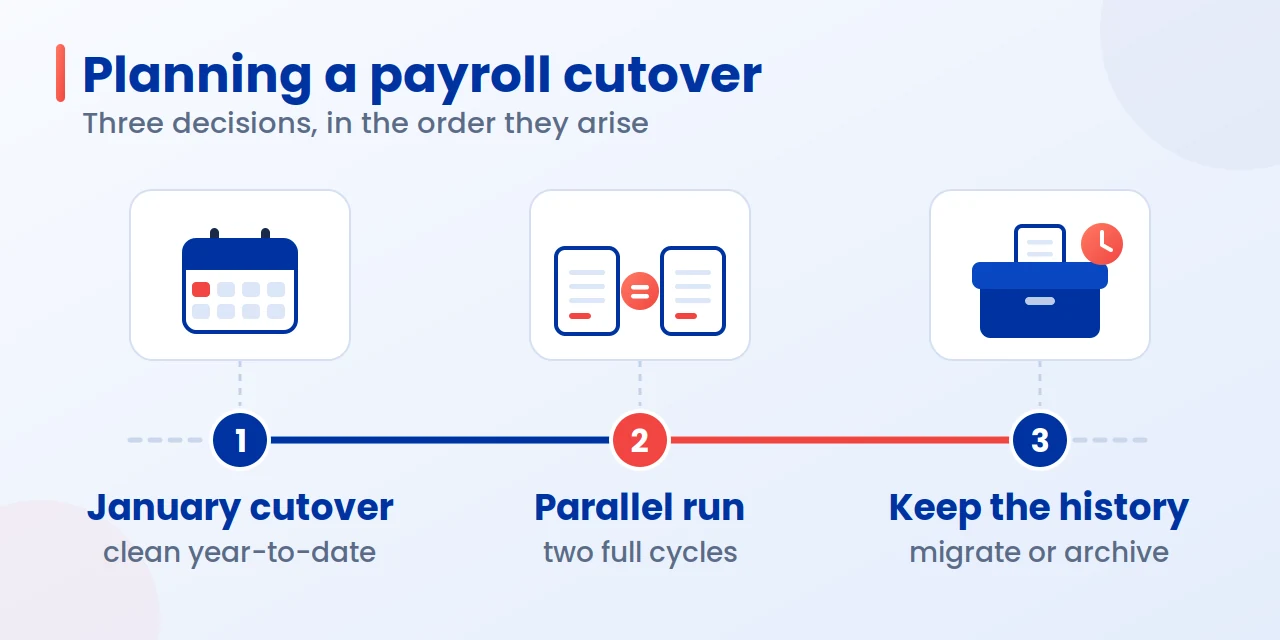
Three practical points, in the order they usually cause trouble.
- Time the cutover to the calendar year. Moving in January means year-to-date figures start clean and IR8A reporting comes from a single source. A mid-year switch requires merging two sets of records for the annual submission.
- Run parallel for at least two cycles. Process the same month in both the old and new system and compare gross, net, CPF and SDL line by line. Differences almost always surface in allowances, pro-rated pay and overtime rules rather than in base salary.
- Decide where historical data lives. Employment records must be retained. Confirm whether you are migrating history into the new system or archiving it, and make sure someone can still retrieve a 2023 payslip when asked.
Choosing A System That Fits How Your Business Runs
No matter what type of payroll system you choose, it is not a ladder you climb by headcount. Workforce complexity and cost structure matter more than employee count.
Synergix ERP includes payroll within the same system as financial management, project costing and operations. Timesheets captured on site or on the production floor carry the project code through to both the payslip and the job cost, and CPF files and IR8A records are generated from the same employee data.
For construction, marine engineering, manufacturing and service businesses, that connection is usually the reason payroll was being reviewed in the first place.
Our consultants have been implementing ERP for Singapore SMEs for more than 35 years. If you want to work through whether an integrated system fits your situation, or whether payroll software would serve you better, we will give you a straight answer either way.
Request a demo to see how payroll, costing and finance connect in one system.