


Warehouse automation is changing how businesses manage operations, inventory, and customer orders. For small and medium-sized enterprises, it is a real opportunity to work smarter, cut costs, and be more efficient. Yet many companies are still unable to connect automation investments to quantifiable business outcomes.
This article explores how SMEs can evaluate, implement, and measure the return on investment (ROI) from warehouse automation. It decomposed the critical steps to recognise areas of improvement, establish specific performance measures, and track results. It is aimed at assisting business executives to move past the generalised ideas and take specific actions yielding tangible operational and financial rewards.
What Is Warehouse Automation
Warehouse automation involves the utilisation of tools such as robotics, conveyors, automated picking systems, and software integration (ERP or WMS) that work together to reduce manual effort, errors, and inefficiencies. It is not just about technology, but it is about the payback of the technology.
ROI is important since the investment must save costs, generate throughput gains, or improve quality in a measurable manner.
Research shows that warehouse automation can deliver payback in under 24 months and ROI exceeding 250%.
Learn more: The Difference between WMS and ERP System
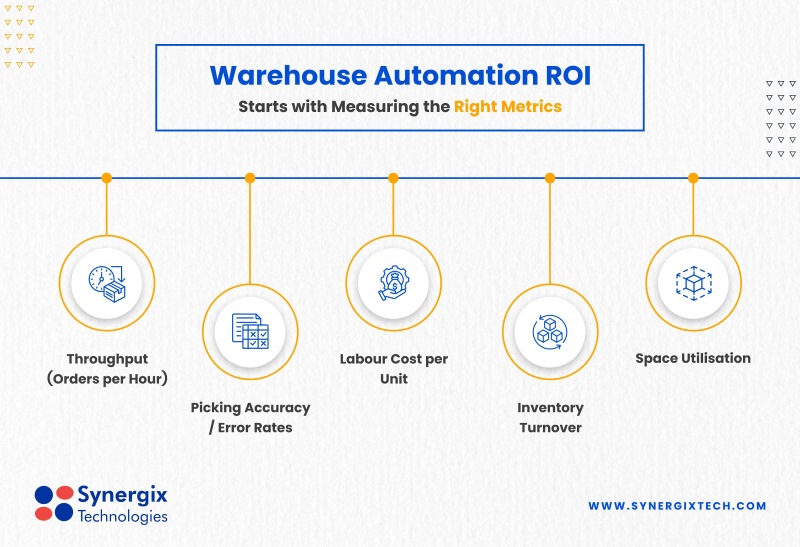
Key Metrics to Monitor
You must be aware of where you are before you can invest, and where you would like to be. The following are some of the important metrics to measure as your yardstick:
- Throughput (orders per hour): Which number of orders does your team work with at the moment? What’s the realistic target?
- Picking accuracy/error rates: Mistakes are time and money wasters. Monitor the rates of mistakes and their consequences.
- Labour cost per unit: Determine the cost of labour that is incurred in every unit or order. This should be minimised through automation.
- Inventory turnover: How fast does inventory move? When a company turns around quicker, it is often more resourceful.
- Utilisation of space: How well do you use your warehouse space? Existence of bottlenecks or underutilised zones?
The value of measuring these provides a baseline to compare the performance of the process after automation and be able to calculate ROI.
Practical Steps SMEs Should Take for Warehouse Automation
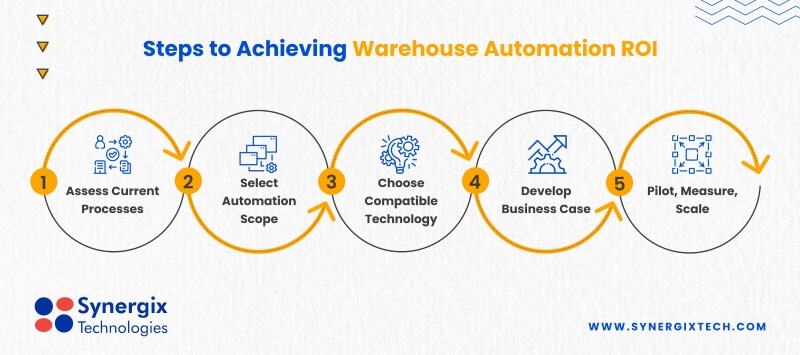
Assess Current Processes
Understanding your current workflows is important. Visualise every view of the workflow, starting with goods delivery to shipment orders, and find the potential bottlenecks. Focus on manual repetitive processes that escalate labour expenses or make them prone to errors. This is the first review that lays the basis of a good automation plan.
Select Appropriate Scopes of Automation
Automation is not necessarily a zero-or-one choice. Other SMEs have begun with particular functions, such as barcode scanning or automated picking, and progressed to larger systems.
The trick here is to adapt the project scope to your business size, budget, and business priorities. A gradual or hybrid strategy would often give quicker and more secure returns.
Choose Compatible Technology and Integrations
The technology you are appraising should integrate well with those that you already have in place.
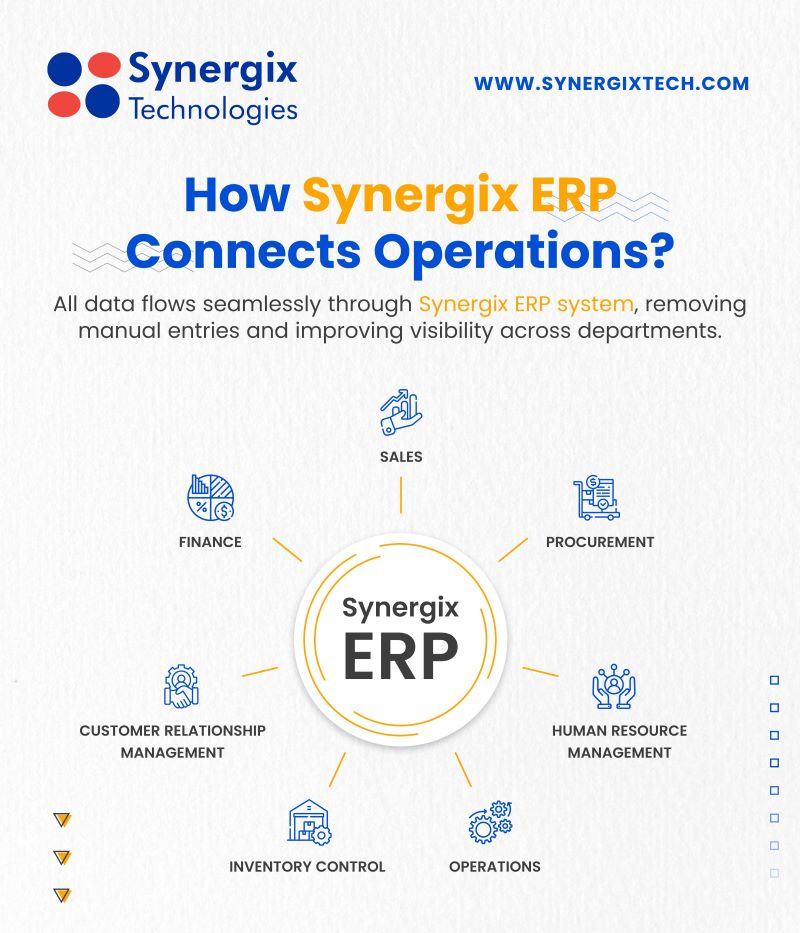
A successful automation project is based on integration. Synergix ERP system also integrates the activities of the warehouses with the top-down and bottom-up flows of the sales orders to the financial reconciliation and ensures that all operations are compatible among the different departments. This connection will remove any duplication of data, as well as reduce operational manual errors and increase cooperation among the warehouse, procurement, and accounting departments.
ERP system, being an open system, also accommodates third-party integration like IoT sensors, conveyor, ASRS systems, and so on to enable the SMEs to scale their operations whilst remaining efficient.
Dependable vendor support, scalability, and well-established local service are also pertinent issues to promote long-term success.
Learn more: How ERP Makes an Impact on Consolidation Warehouse Management
Develop Business Case and Secure Funding
An effective business case is one that incorporates a well-defined cost analysis and anticipated savings. Find the potential ROI by taking into consideration the less labour, fewer mistakes, and shortened fulfilment time.
In Singapore, companies may also consider local productivity grants, which will subsidise automation. This funding will bring digital transformation to more SMEs.
Pilot, Measure, and Scale
Start with a pilot project that will allow testing your assumptions. Gather information, analyse performance, and make changes as necessary. Ensure measurements by use of dashboards and real-time analytics.
When you start seeing the results, automate the process of every activity in the warehouse and keep producing similar results.
Common Pitfalls and How to Avoid Them
While warehouse automation brings clear benefits, certain pitfalls can reduce its effectiveness.
- Over-engineering: Select solutions that meet your needs instead of systems that are complex and not easy to maintain.
- Absence of change management: The staff should be trained and participate in the transition.
- Poor data quality: Automation requires good data, clean and checked information prior to introducing it.
- Underestimating hidden costs: In any given budget, integration, maintenance, and upgrade costs should be included.
These problems are to be avoided to assist SMEs in the implementation process being smoother and returning on investment faster. Synergix ERP solution has good support in implementation and user training so that the transition can be successfully made.
The availability of a modular design enables the company to begin with a few modules to serve as Inventory and Warehouse Management and gradually add other modules such as Finance or Sales. The gradual process also assists companies in realising profitability sooner and with minimal disturbance.

Fong Lee Metal Industries: Real Results with Synergix ERP
One of our clients, Fong Lee Metal Industries Pte Ltd, achieved remarkable improvements after implementing the Synergix ERP system.
In Fong Lee Metal Industries Pte Ltd’s testimonial, the company reported that order visibility became much clearer and faster, while searching and viewing records, such as purchase orders and quality reports, became effortless.
Most notably, their Manufacturing Execution System (MES) was successfully integrated with Synergix ERP through an API, allowing smooth data sharing across departments.
Since adopting the system, employee productivity increased by 30%, supported by comprehensive training and responsive technical assistance from the Synergix team. The company also commended Synergix for its flexibility in integrating with other applications and tailoring functions to fit its operational needs.
This case demonstrates how an integrated ERP platform like Synergix can serve as the backbone of warehouse and process automation by linking people, data, and machines for measurable ROI.
Key Takeaways & Conclusion
- Measure what matters. ROI starts with the knowledge of what you are doing and what measurements you need to take.
- Start small, scale smart. Automation of pilots in any category before rolling out through your warehouse.
- Integrate technology into business objectives. The optimal automation favours your workforce, operations, and overall strategy.
Warehouse automation helps SMEs stay competitive, efficient, and ready for growth. It relies on proper objectives, proper data, and proper implementation to succeed. Check out what you are already doing and see what you can improve, and take measurements of what you do so that you can make future moves.
Synergix ERP facilitates the operations of SMEs to support end-to-end operations on a single platform. It can assist businesses in making decisions and scaling with real-time dashboards, mobile accessibility, and automation equipment compatibility.
Contact Synergix Technologies to have a free consultation and learn how your company can be faster, smarter, and more profitably operated with better automation brought about by ERP.