



Warehouse management is the day-to-day control of goods inside a facility: receiving, put-away, storage, picking and packing, and dispatch. Done well, what the system says you hold matches what sits on the shelf, and orders leave complete and on time.
Most Singapore SME warehouses fail at the same point: the system figure and the shelf figure disagree. This guide reveals practices to close that gap and when to move off spreadsheets. To see how these map to software, start with our supply chain management module.
5 Stages of Warehouse Management
Warehouse management runs as a loop, not a sequence. Goods arrive, get stored, get picked, leave, and the loop only stays accurate if someone reviews it. Most SME warehouses have all 5 stages working and one weak link that undoes the rest.
| Stage | What usually goes wrong |
|---|---|
| Receiving | Goods accepted without checking against the purchase order. Short or damaged deliveries surface weeks later, at invoice stage. |
| Put-away | Stock goes wherever there is space. Only the person who put it away knows where it went. |
| Storage | Fast movers stored at the back. Lot numbers, serial numbers and expiry dates not captured, so recalls and warranty claims become manual searches. |
| Picking and packing | Paper pick lists. Errors discovered by the customer rather than before the box is sealed. |
| Dispatch | Delivery order details keyed again into the accounting system, introducing a second version of the same number. |
| Review | Nobody can state last month’s picking error rate. |
The five stages of warehouse management
Why Warehouse Space Costs Keep Rising in Singapore
Most warehouse advice assumes you can take more space when volume grows. In Singapore that assumption does not hold, and it changes which fixes are worth doing.
- As at Q2 2026, JTC recorded industrial occupancy at 89.1%, with rentals up 0.5% for the quarter and 2.1% over the year.
- The all-industrial rental index has risen a cumulative 26.5% since its trough in Q3 2020.
- Prime logistics space is tighter again: CBRE put occupancy in that segment at 95.8% as at Q1 2026.
Read those together and the conclusion is straightforward. Space costs more every quarter, and the better-specified space is close to full. For an SME on a three-year lease, the only variable you can control is how much throughput you get from the floor you already occupy.
If you are running more than one facility, the arithmetic changes again, because duplicate safety stock across sites is often the largest hidden cost.
Read more: How ERP supports consolidation warehouse management
Signs Your Warehouse Management Is Not Working
- Your last stock count differed from the system by more than 5%.
- Only one or two staff can locate items quickly. When they take leave, picking time roughly doubles.
- You cannot produce a lot number, serial number or expiry date on request.
- Purchase orders get raised when someone notices an empty shelf.
- Goods are signed for without counting them against the purchase order.
- Stock take requires closing the warehouse. You lose one or two days of dispatch capacity.
- You do not know what percentage of your racking is occupied.
- The same stock movement is keyed into the warehouse record and the accounting record.
6 Practices That Fix These Problems
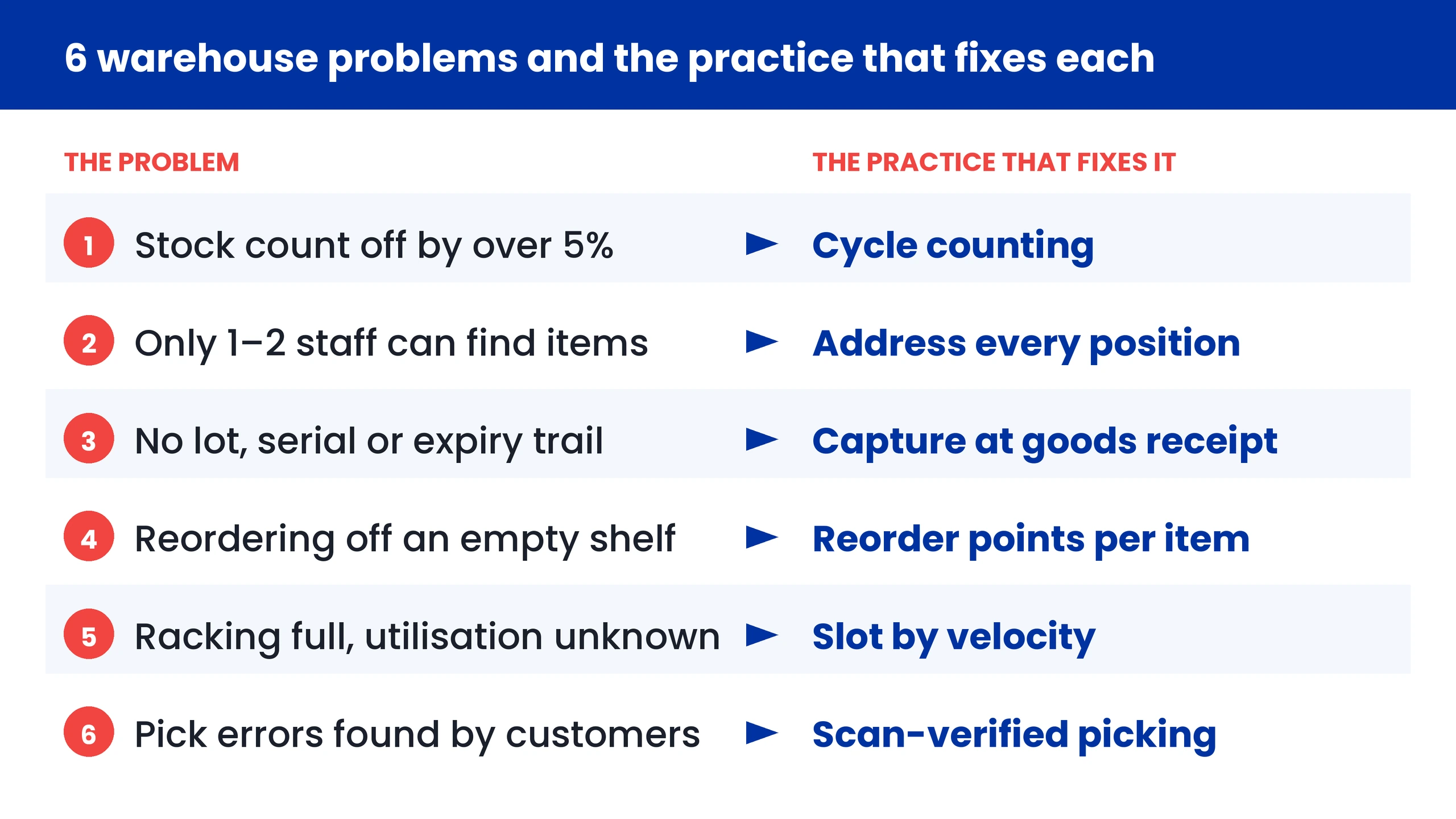
1. Stock accuracy: cycle counting
An annual stock take tells you how wrong you were over twelve months. It does not tell you why, and by the time you count, the cause has been repeating for months.
Cycle counting checks a small slice of stock on a rolling schedule: count your fastest-moving and highest-value items weekly, the middle band monthly, the slow tail quarterly. Two people counting for thirty minutes a day covers more lines per year than one weekend shutdown, and it catches the cause while the paperwork still exists. It also means you stop losing two days of dispatch capacity every December.
2. Location discipline: give every position an address
Bin location tracking means each rack, shelf and bin has a code, and the system records which code holds which item. It reduces most picking time in a small warehouse, because it converts searching into walking.
It also removes the key-person risk in sign 2 above. A new hire with an addressed pick list is productive on day one; without one, they shadow someone for a fortnight.
3. Traceability: lot, serial and expiry captured at receipt
Capture the lot or batch number, the serial number and the expiry date when goods are received.
Which field matters depends on what you hold:
- F&B and chemicals need lot and expiry for recall and for first-expired-first-out picking.
- Equipment and marine spares need serial numbers for warranty and service history.
- Construction materials need batch numbers tied to the project they were issued to.
4. Replenishment: reorder points
Set a reorder level and a reorder quantity per item, based on how fast it moves and how long the supplier takes. Then let the system raise the flag.
Doing this properly fixes 2 problems: Most SMEs are simultaneously out of stock on their fast movers and overstocked on slow ones.
5. Space: slot by velocity, then build upward
Put your fastest-moving items in the positions closest to packing, at waist height. Put slow movers high and far. Review the slotting quarterly, because what sold last year is not what sells now.
After slotting, the remaining lever is vertical: taller racking, narrower aisles with the right equipment, and a measured utilisation figure so you know whether the racking is genuinely full or merely looks it.
6. Picking: verify by scan, not by eye
Scanning the item against the order line catches the error before it leaves the building. A wrong item caught at the pick face costs a few seconds. The same error caught by the customer costs a return, a redelivery, a credit note and a phone call.
Where volume justifies it, this extends into automation. That is a separate decision with its own payback arithmetic.
Key Tools and Technology
| Tool | What it does |
|---|---|
| Warehouse management system (WMS) | Records and directs every step from inbound receipt through put-away, picking and packing to outbound dispatch, and holds the stock record that everything else reads from. |
| Barcodes | A printed code read by a handheld scanner at receipt, put-away and pick, so the movement is recorded at the moment it happens. |
| RFID | Tags read by radio rather than line of sight, so a pallet or a full trolley can be read at once instead of item by item. |
| Automation | Conveyors, automated storage and retrieval systems, and pick-assist or mobile robots that move goods or bring them to a picker. |
Barcodes and RFID improve how accurately a movement is recorded. Automation improves how fast goods move. Automating a process that records stock inaccurately produces wrong numbers faster.
Read more: WMS vs ERP system comparison
Warehouse Priorities by Industry
The stages are the same among most industries. What differs is which field you cannot afford to get wrong.
| Sector | The field that matters most | Why |
|---|---|---|
| Wholesale distribution | Reorder level and lead time per SKU | High line counts and thin margins; a stockout on a fast mover loses the order to a competitor the same day |
| General manufacturing | Separation of raw material, work in progress and finished goods | Consumption has to post against the production order, or job costing is guesswork |
| Food and beverage | Lot number and expiry date | First-expired-first-out picking and recall traceability are operating requirements, not reporting extras |
| Marine engineering | Serial number and certification record | Spares carry warranty and certification history that has to be produced on request |
| Construction | Materials issued against the project | Stock leaving the yard without a project reference becomes an unallocated cost that surfaces at final account |
Do I Need a Standalone WMS or an ERP System?
They solve different problems:
- A standalone WMS runs the warehouse only, so it still has to be connected to whatever you use for purchasing, sales and accounts.
- An ERP system holds all of those together, which removes the double entry between the warehouse and the ledger.
For most Singapore SMEs running one or two facilities with standard picking, an ERP system covers the requirement without a separate integration project. A standalone WMS earns that integration work when you need advanced execution such as wave picking, voice picking or automation control.
How Synergix ERP Covers the Warehouse
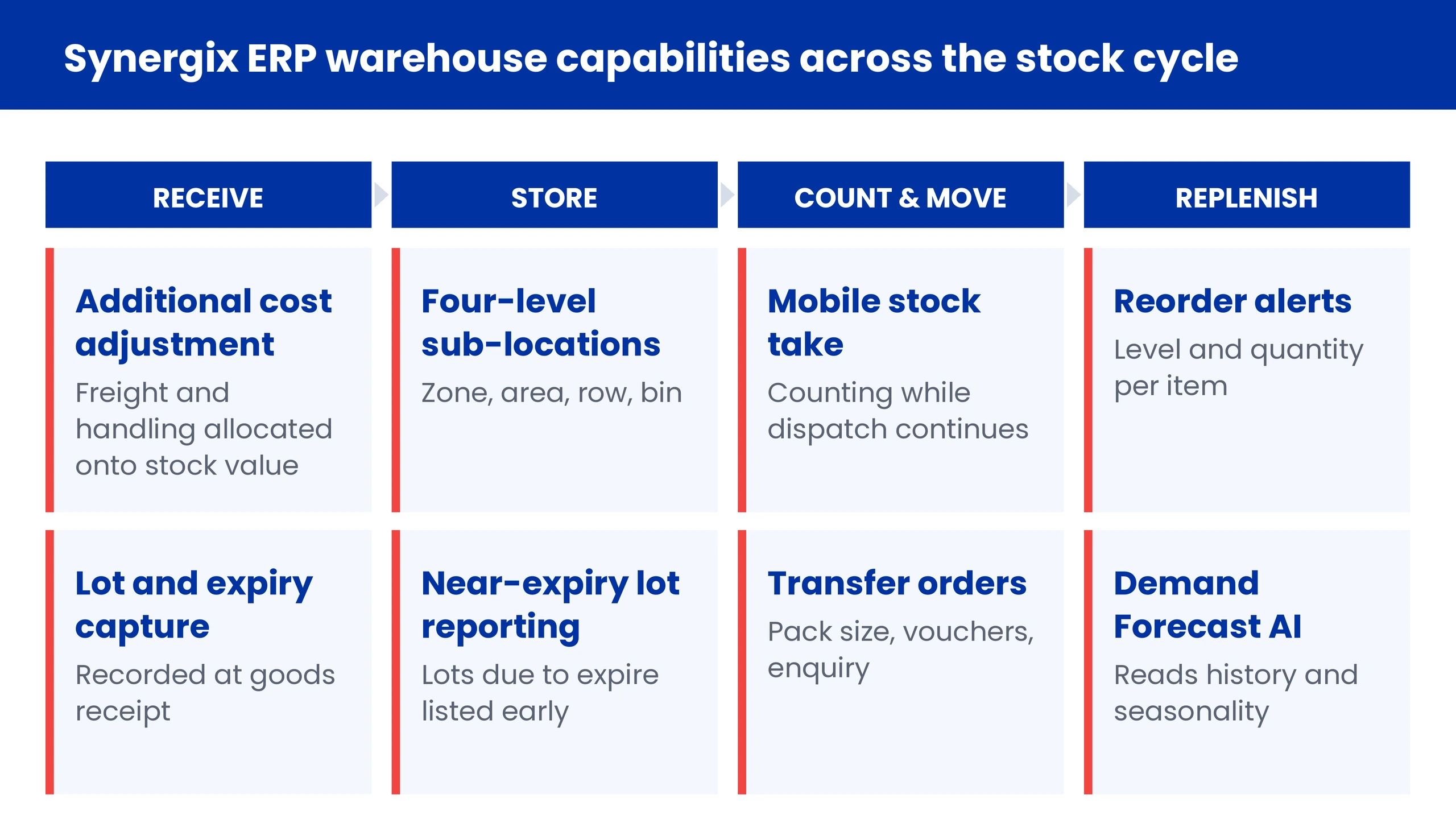
Warehouse capabilities in Synergix ERP
Synergix ERP covers the warehouse as a module:
- Four-level sub-locations. Each main warehouse breaks down into Zone, Area, Row and Bin, so a pick list points to an exact position.
- Reorder alerts. A reorder level and quantity are held per item, so the system raises the flag before a shelf runs empty.
- Near-expiry lot reporting. Lots approaching their expiry date surface as a list, so stock is picked, discounted or moved while it can still be sold.
- Mobile stock take with summary. Counting runs on a handheld while dispatch continues, and the summary shows what was counted, what varied and by how much.
- Additional cost adjustment. Freight, shipping and handling charges are allocated back onto the purchased goods, so stock is valued at what it actually costs to land rather than at the supplier invoice alone.
- One set of inventory functions. Inventory vouchers, pack size adjustment, stock take, transfer orders and inventory enquiry all read and write the same stock record.
- Demand Forecast AI. Built-in, it reads sales history, seasonality and promotions to recommend reorder timing and quantity by item and by warehouse.
Because the warehouse module shares records with Sales and Procurement, a goods receipt posts against the purchase order and a pick posts against the sales order without anybody re-entering the figures. The warehouse record and the accounting record are the same record, so there is nothing to reconcile by hand at month-end.
We have built ERP for Singapore SMEs for over 35 years and now support more than 600 of them across 30,000 users running exactly these warehouse processes. Singapore SMEs may also be able to offset part of the cost through government support schemes; current eligibility and rates are on our ERP grants page.