


Month-end in accounts payable rarely breaks down over anything complicated; it breaks down over volume and format.
One supplier sends a clean PDF. The next sends a scanned delivery note photographed on a phone. A third transmits through InvoiceNow, and a fourth still mails a hard copy. Each one has to be identified, keyed in, matched to a purchase order, checked against what was actually received, then routed for approval. Multiply that by a few hundred invoices before the reporting deadline.
Invoice processing automation software moves that work into the ERP, where the purchase orders, receiving records and ledger already sit.
This article covers what invoice processing automation software does, what the published benchmarks support, and why the InvoiceNow rollout has put a compliance deadline on a decision many SMEs were still treating as optional.
What Does Invoice Processing Automation Software Do?
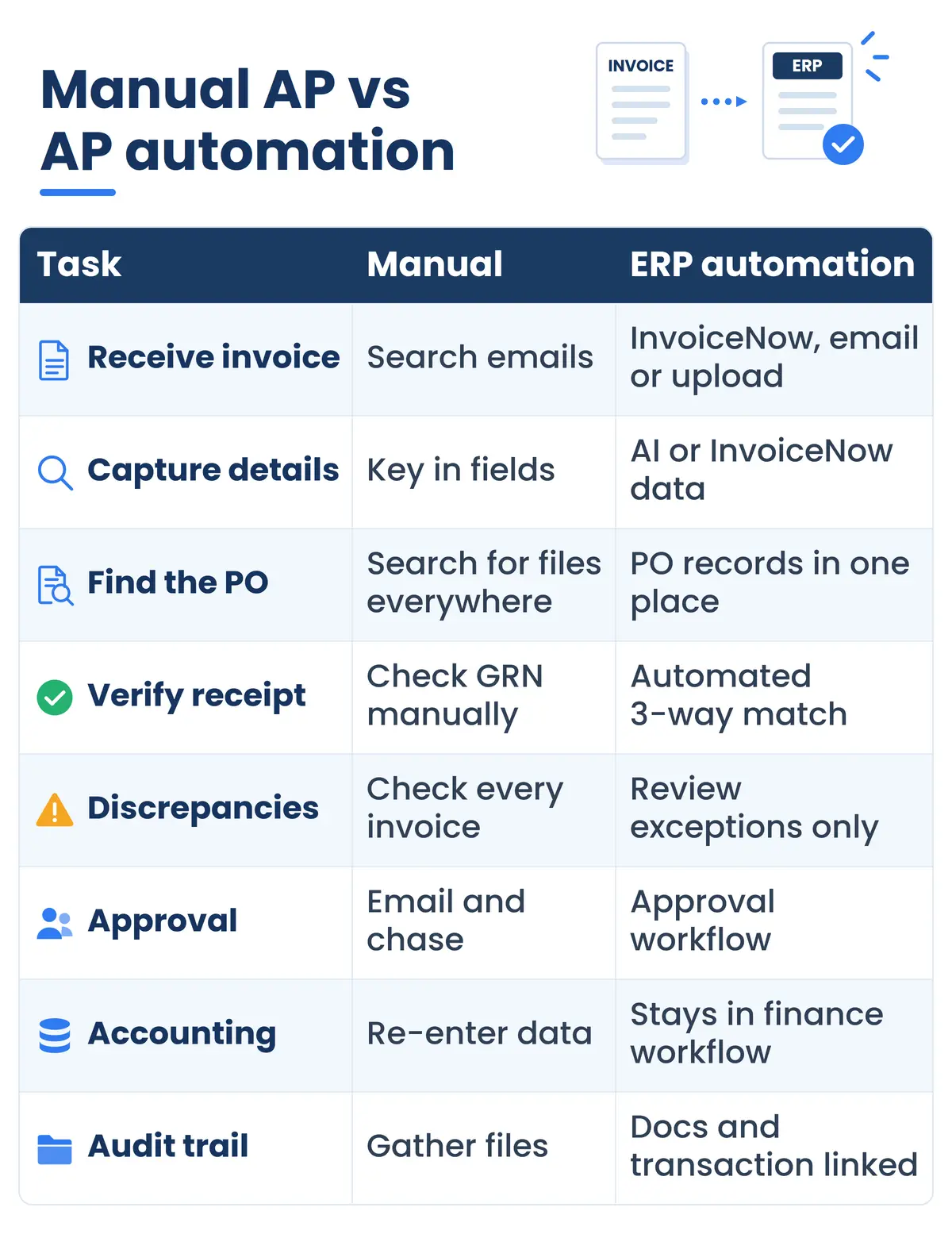
Invoice processing automation software takes a supplier invoice from arrival to posted payable without anyone typing the details in. It receives the invoice, reads the fields, matches them against the purchase order and goods receipt, sends only the failures to a person, and posts the approved invoice to the ledger with the source document attached.
In a manual AP process, a clerk performs every one of those steps. In an automated one, the clerk reviews the invoices that fail a check.
What it does not do
- It does not approve invoices.
- It cannot fix bad master data.
- It does not remove your GST obligations.
Why Invoice Processing Automation Software Matters More in Singapore in 2026
Ardent Partners, in Accounts Payable Metrics That Matter in 2025, puts the average cost of processing a single invoice at US$9.40. Best-in-class organisations do the same job for US$2.78.
On timing, the average invoice takes 9.2 days to get through the process. Best-in-class teams clear one in 3.1 days, while everyone else drags along at 17.4 days. Exception rates tell the same story: 9% among top performers, against an industry average of 22%.
InvoiceNow is Singapore’s nationwide e-invoicing network, built on the Peppol standard. At Committee of Supply 2026, IRAS reported that more than 63,000 businesses were already on the network, and that extending the requirement to all remaining GST-registered businesses should bring roughly 90,000 more on board.
The GST InvoiceNow requirement began as voluntary early adoption from 1 May 2025. It then applied to newly incorporated companies registering for GST voluntarily from 1 November 2025, and to all new voluntary GST registrants from 1 April 2026. Everyone else who is GST-registered gets pulled in through phases running to April 2031.
For the live schedule, go straight to the IRAS GST InvoiceNow Requirement page, and check the IMDA InvoiceNow-Ready solution provider list before you shortlist anything.
So what changes on the ground? Two things:
- Structured invoice data will start arriving whether your team is ready for it or not.
- Invoice data now travels to the tax authority. Sloppy capture now has a compliance cost attached.
How Synergix ERP Handles an Invoice
We build invoice processing automation from inside the ERP. Procurement, goods receiving, supplier master and accounts payable all read from the same transaction data.
1. Receive the invoice
Invoices come in through more than one door, and any system that only handles one door will disappoint you.
If you are on InvoiceNow, Synergix supports e-invoicing directly in the ERP, and Synergix is listed by IMDA as an InvoiceNow-Ready (previously Peppol-Ready) solution provider. A Synergix software update also documents automated retrieval of incoming supplier e-invoices, mapped against the matching goods receipt using PO and GRN information.
More detail is on the Synergix InvoiceNow e-invoicing page.
2. Extract the data from PDFs and scans
Synergix Document AI reads business documents such as invoices and delivery orders, then converts them into ERP transactions. The current version handles PDFs, scans and digital images.
Synergix AI-powered ERP can bring 95% extraction accuracy and up to 10 times faster document processing, with three-way invoice matching finishing in under a minute in the workflow we describe.
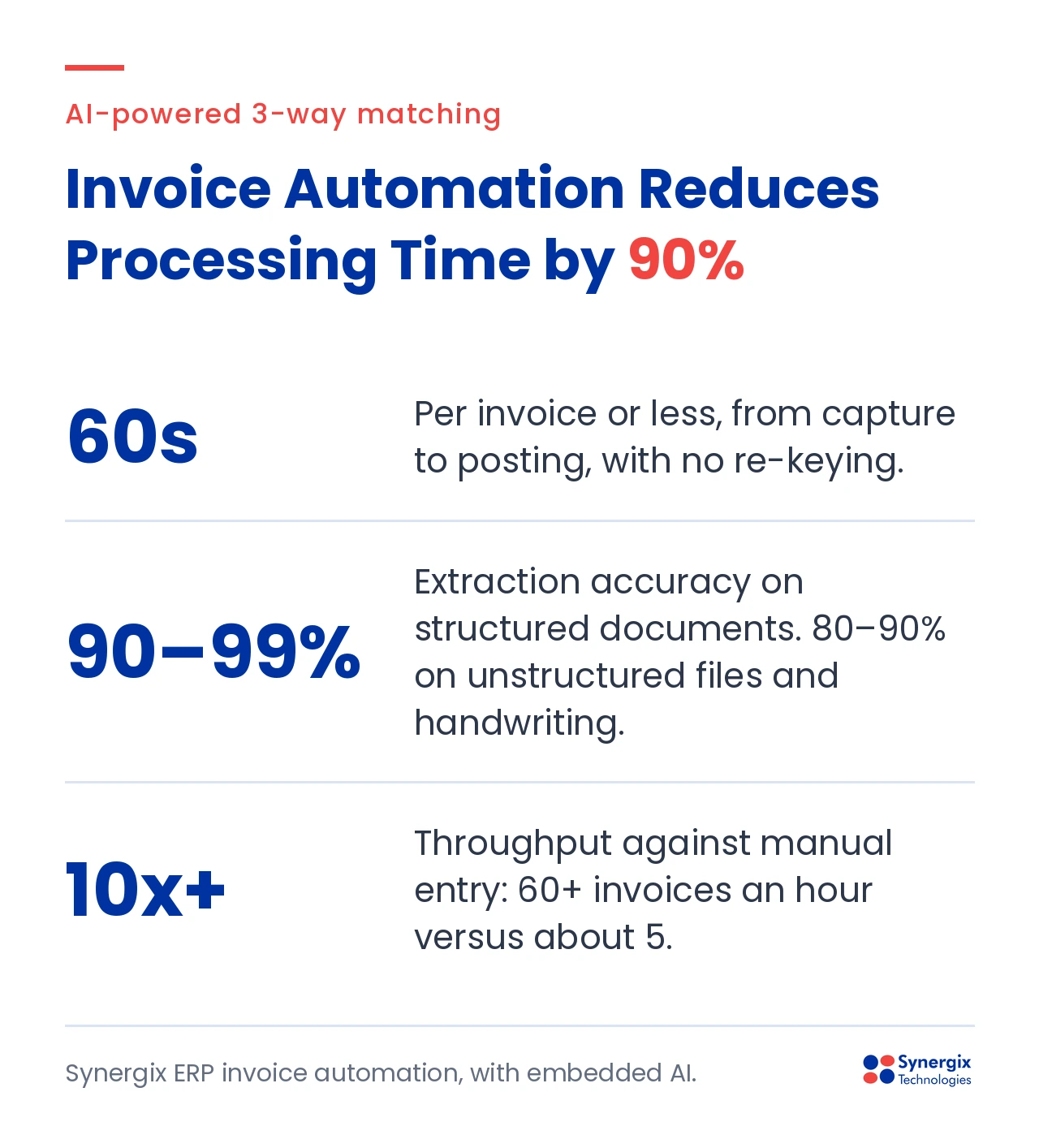
Note: Those two figures are our own product numbers, not third-party audited ones, and your real results will vary with document quality, how you configure it, and how messy your transactions are.
3. Match the invoice against ERP records
Synergix runs three-way matching across:
- the purchase order, showing what you agreed to buy
- the goods receipt, showing what arrived
- the supplier invoice, showing what the vendor is charging you
Prices that drift. Quantities that do not tally. A missing receipt. The system flags those and puts them in front of a user. Clean matches carry on through the configured workflow without bothering anybody.
4. Send the right invoices to a human
This step is where good automation and expensive automation part ways.
A price gap, a missing GRN, an unmatched supplier, a value that looks nothing like last month’s. Keep all of that visible.
Meanwhile, a clean PO-backed invoice for the same steel your team buys every fortnight does not need three sets of eyes on it. Set your confidence thresholds and matching tolerances properly and your finance team gets its week back for supplier disputes, cash commitments and closing the month.
Where Does The 90% Reduction In AP Work Come From?
Synergix reports document processing at up to 10 times faster with Document AI. That means a document-handling task that used to eat ten minutes of staff time now takes one, so the manual time on that stage has fallen by 90%. That is what the number describes: repetitive handling on work that automates well.
There is customer evidence at that scale. KMS Industrial, based here in Singapore, reported that Synergix ERP cut its paperwork by more than 90%, and that document trails became far easier to trace. One caveat, because it matters: that testimonial covers the wider ERP document process, not AP alone. Read it as proof of digitalisation rather than an AP-only benchmark.
On Ardent’s figures, best-in-class teams run at roughly 70% lower cost per invoice and a 66% shorter cycle than average. The same research puts the industry average touchless processing rate at 32.6%, with best-in-class at 49.2%.
Simply put: Straight-through processing has a ceiling, and that ceiling is set by how many of your invoices reference a purchase order and how clean your supplier data is.
What to Look For In Invoice Processing Automation Software?
Every vendor leads with extraction accuracy. It is the easiest number to quote and one of the least useful on its own.
Can it take structured e-invoices and ordinary supplier documents? Will it use the PO and receiving data you already have? What happens on a partial delivery, which in construction and marine work is most weeks? What happens when the invoice price sits 2% above the PO? And can you see who approved what, and when, without opening four screens?
A workable checklist for any invoice processing automation software shortlist:
- AI extraction for PDFs, scans and images
- InvoiceNow connectivity for Singapore transactions
- two-way and three-way matching
- clear exception handling with tolerances you can configure yourself
- approval rules by value, supplier or department
- integration with AP, purchasing and goods receiving
- document and transaction traceability that survives an audit
- support for the way your suppliers actually invoice you, not the way they should
Automation is only ever as good as the records sitting underneath it. If half your POs are incomplete, or goods receipts get keyed in a week after the goods arrived, there is nothing reliable for the system to match against.
Eligible SMEs should also look at available government support, since Synergix ERP is a pre-approved solution under the IMDA SMEs Go Digital programme.
Key Takeaways
When each invoice only takes a few minutes, it can be easy to forget about the benefits of invoice automation. Those minutes add up to hundreds per month and the cost becomes apparent.
By moving from typing the data on the invoice and repeatedly proving that transactions match to handling exceptions, approvals, cash commitments and supplier issues, finance can move towards the business future of invoice processing automation.
Because Synergix integrates AI document extraction, three-way matching, InvoiceNow and financial processing all into the same ERP environment, the automation is able to access the operational data necessary to make those matching processes useful.
And for a growing Singapore SME that is the true deal behind the 90: get out of the equation as much repetitive handling as the transaction will allow, and leave people in control of the decisions that should be theirs.