



Committed cost is the number that decides a project’s margin, and it is the number most contractors cannot see until the invoices arrive. That gap is what procurement software is bought to close.
Which type closes it depends on two things: what dominates your spend, subcontracts or materials? How many projects you run at once? The first decides which type of tool fits. The second decides whether a standalone purchasing app is enough, or whether procurement needs to sit in the same system as your job costing, as it does in a construction ERP.
What Construction Procurement Software Does
Construction procurement software manages purchasing across construction projects:
- subcontractor sourcing and buyout
- material requisitions
- requests for quotation
- quote comparison
- purchase orders
- goods receipt
- supplier invoice matching
The software records committed costs against each project budget at the point of order rather than at the point of payment, so project managers see overruns forming.
The harder question is which type of system a contractor should buy. Its answer changes completely depending on whether you run three projects or thirty, whether your spend is mostly subcontracts or mostly materials, and whether your procurement data needs to reach your project costing ledger or can stay in a separate tool.
Subcontractor Procurement vs Material Procurement
Subcontract-focused tools handle tender packages, letters of award, variations and retention.
Material-focused tools handle requisitions, RFQs, deliveries and three-way matching.
Most contractors do both, but one side dominates their spend.
Before comparing products, split your annual procurement spend into those two buckets. The ratio determines which category of software fits.
- Subcontract-heavy spend: Subcontracting accounts for 70 to 90% of construction works by contract value. The work is buyout: tender packages, comparing trade quotes, letters of award, subcontract agreements, variation orders, progress claims against each subcontract, and retention. Volume of transactions is low; value per transaction is high; contract administration is the hard part.
- Material-heavy spend: Specialty trade contractors, M&E firms, fabricators and marine engineering outfits buy in high transaction volume. Site requisitions, supplier price comparison, delivery orders, partial deliveries, stock on site, returns, and three-way invoice matching. Value per transaction is low; accuracy and speed are the hard parts.
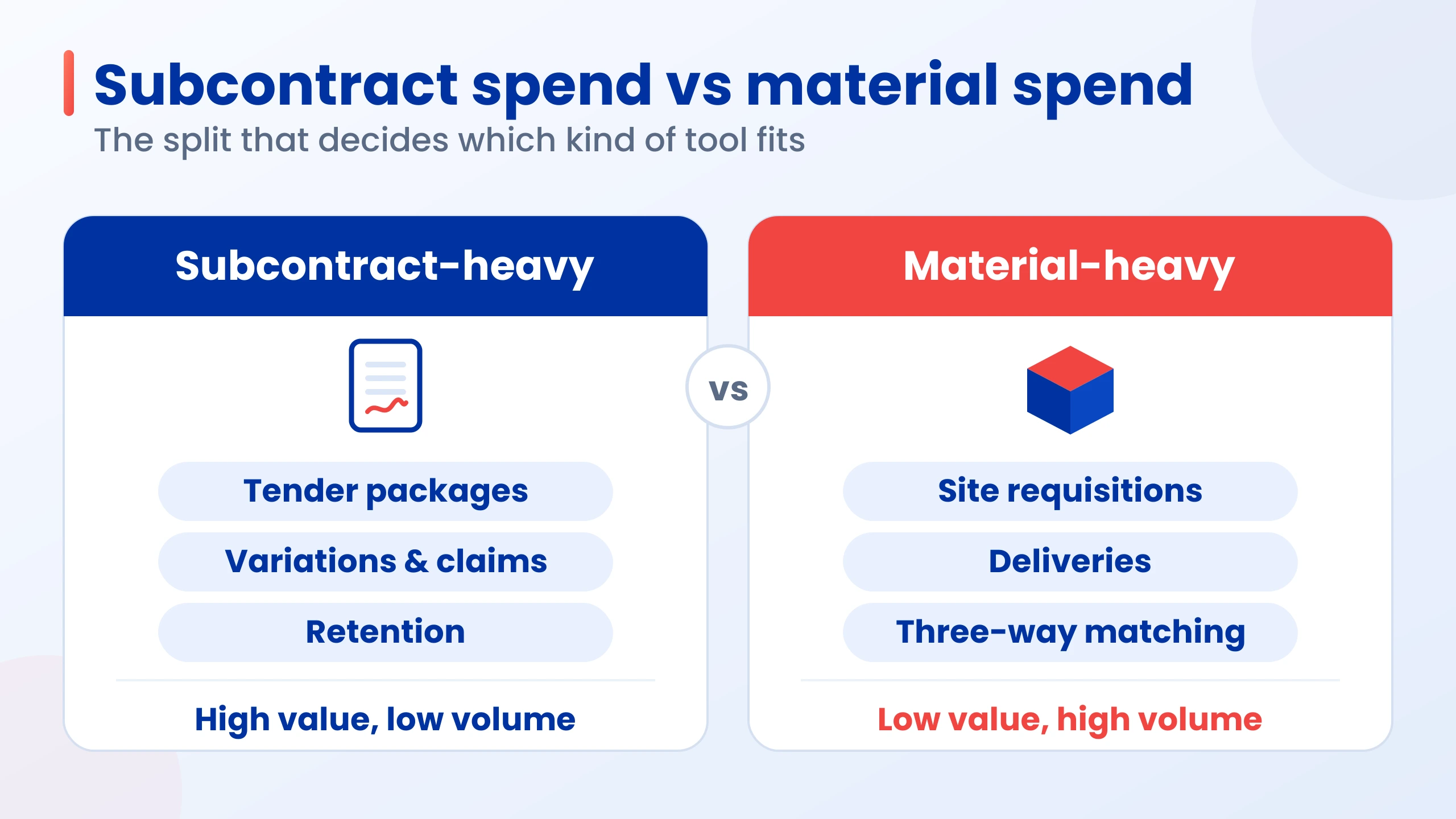 A tool built for subcontractor buyout handles 400 material delivery orders a month badly, and a material procurement tool has no concept of a retention sum or a letter of award. Buying the wrong side of this split is the most common – and most costly – mistake one can make when choosing procurement tools.
4 Types of Construction Procurement Software
| What it is | Best suited to | Limitation | |
|---|---|---|---|
| Point procurement tools | Standalone purchasing apps for requisitions, RFQs, POs and AP automation. | Trade contractors with heavy material volume and an existing accounting system they want to keep | Procurement data sits outside your financials; relies on sync quality |
| Construction PM platforms with procurement modules | Project management suites where procurement is one module among many. | Main contractors prioritising document control and subcontractor buyout | Accounting depth is usually shallow; many need a separate finance system |
| Construction or project ERP | Procurement built into one system with job costing, inventory, contracts, progress claims, payroll and financials. | Contractors running multiple concurrent projects who need committed cost and cash position in one place | Longer implementation; needs internal process ownership |
| Enterprise source-to-pay suites | Broad procurement platforms covering sourcing, spend analytics and supplier management. | Large EPC groups, multi-country operations, dedicated procurement departments | Generic to construction; little native handling of retention, SOR or progress claims |
Read more: How procurement works inside an integrated ERP system
Which System Fits Your Company Size
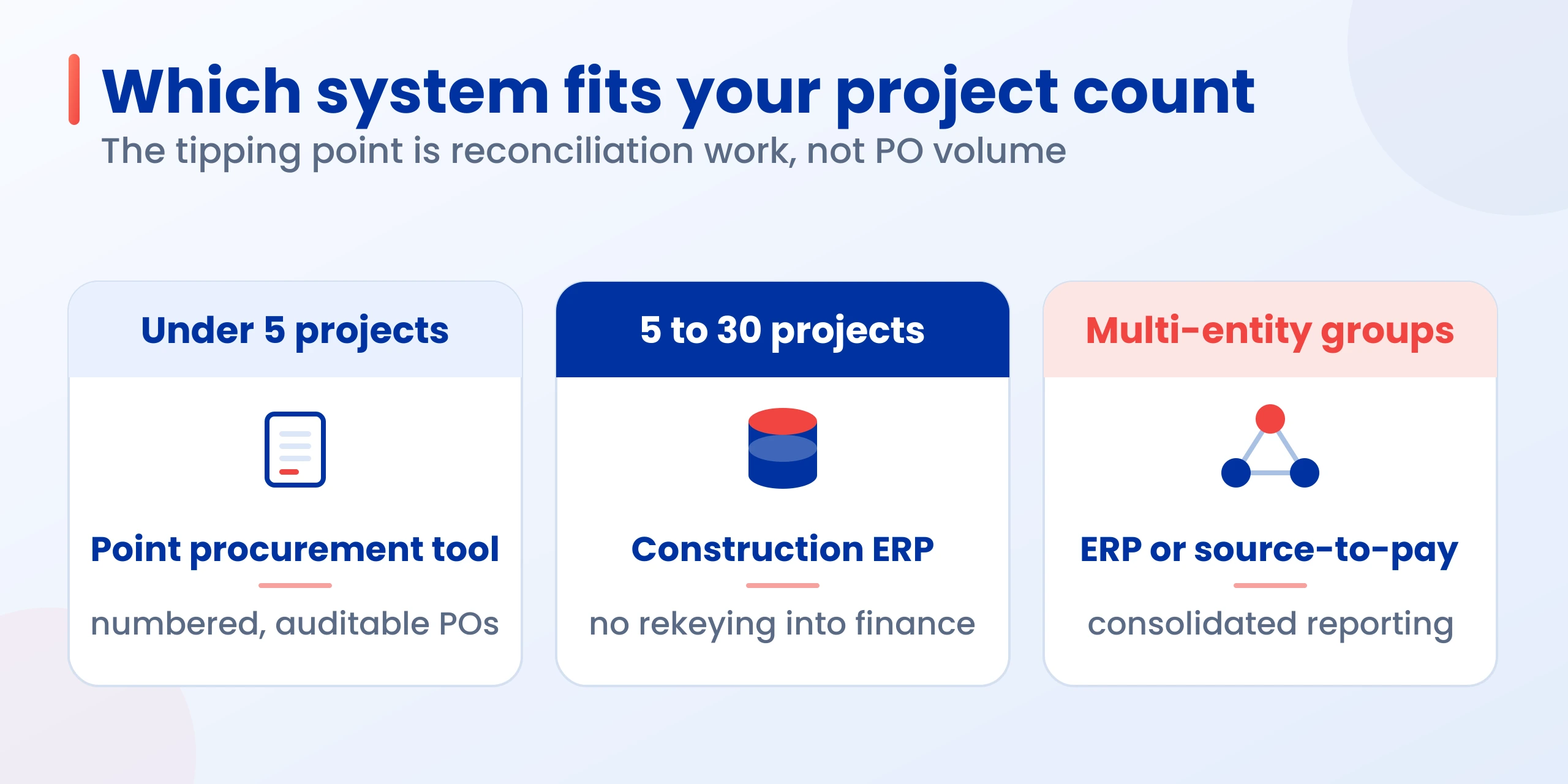
Small contractors: under 5 concurrent projects
A point procurement tool or the procurement module of your accounting system is normally sufficient. The priority is getting POs out of WhatsApp and email and into a numbered, approved, searchable record. Published list pricing for entry and mid-tier construction platforms starts in the high hundreds of US dollars per month at the time of writing, with ERP quoted per project.
Mid-sized contractors: 5 to 30 concurrent projects
This is where the standalone approach starts costing more than it saves. Typical symptoms: finance rekeying POs into the accounting system, committed costs tracked in a parallel spreadsheet, project managers unable to answer “what have we already committed on this job?”.
An integrated construction ERP generally earns its cost here, because the saving comes from eliminating reconciliation work, not from faster PO creation.
Large contractors and EPC groups
For firms above roughly 250 staff, multi-entity or multi-country, consider either a construction ERP with strong multi-entity and multi-currency handling, or an enterprise source-to-pay suite layered over an existing ERP.
If you work across Singapore, Malaysia, Vietnam and Indonesia, test consolidated reporting and inter-company transactions before anything else; they break more implementations than procurement features do.
Features to Check During a Software Demo
Core purchasing cycle: requisition to invoice matching
- Site or project-level requisition, including from mobile
- RFQ issued to multiple suppliers with a side-by-side quote comparison
- PO raised against a specific project and cost code
- Partial delivery and partial goods receipt
- Three-way matching of PO, goods receipt note and supplier invoice, with exceptions flagged
Approval workflow features
Approval routing is where most demos look identical and most implementations diverge. Test specifically for:
- Multi-level approval by value threshold
- Different routing by project, cost code or supplier category
- Delegation when an approver is on leave
- Mobile approval
- An audit trail showing who approved what and when
- The ability to block a requisition that would breach the remaining project budget
A workflow that cannot be reconfigured by your own admin team without vendor involvement will become a bottleneck.
Construction-specific functions: retention, variations, progress claims
- Committed cost posted at PO approval, visible against budget
- Subcontract agreements with variation orders and progress claim certification
- Retention held, released and tracked by contract
- Back-charges to subcontractors
- Schedule of Rates handling if you tender for public sector work, where pricing follows a published rate schedule
- Site stock and materials transfer between projects
Integration with your accounting and job costing system
- Which accounting or ERP systems are supported natively, and which need middleware
- Whether sync is real-time or batch, and what happens to a failed record
- Whether supplier master data lives in one place or two
What Singapore Contractors Need to Check
Most construction procurement software reviewed online is built for North American or UK contractors. Four regional requirements are easy to overlook and difficult to retrofit.
- GST InvoiceNow: IRAS is progressively requiring all GST-registered businesses to transmit invoice data directly through the InvoiceNow network. If your procurement system feeds your AP ledger, confirm its e-invoicing readiness now.
- Grant funding: Singapore SMEs can claim up to 50% of the cost of an ERP system under the EDGE Grant. Integrated enterprise systems draw on a S$30,000 allowance, which sits within a S$100,000 annual cap across all grant activities.
- Progress claims and retention: Payment claims, payment responses and retention sums run on a different rhythm to standard accounts payable. Software built for markets without statutory payment claim regimes treats a subcontractor claim as an ordinary invoice, which breaks certification and retention tracking.
- Multi-currency purchasing: Steel, equipment and marine components bought in USD, RMB or JPY need realised and unrealised exchange differences posted against the right project.
How Synergix Construction ERP Handles Procurement
Synergix is a proprietary ERP built for project-driven businesses, with procurement connected to project costing, contract management, supply chain and financials in one system. The checklist items above are handled natively: committed cost posts to the job on PO approval, subcontract claims certified with variations and retention tracked per contract, Schedule of Rates pricing and claiming is built in, and deployment is available cloud-hosted or on-premises. Three things go beyond that list:
Customisable without losing your upgrade path
Most vendors handle deep customisation by forking your instance, which leaves you on a frozen version that cannot take security patches or new features without a re-implementation. Synergix develops its ERP in-house, so your cost code structure, approval thresholds and claim formats are configured within the standard product and carried forward at each upgrade.
Embedded AI across the procurement cycle
Synergix’s AI capabilities run inside the ERP, so procurement data stays within the ERP boundary and inherits your existing roles and permissions.
- Three-way matching in under 60 seconds: Document AI reads the supplier delivery order and invoice, generates the goods receipt note and purchase invoice, and validates item, quantity and pricing against the purchase order with a full audit trail. Extraction accuracy is 95%, and processing runs around 10 times faster than manual entry.
- Procurement Assistant: A natural-language interface that evaluates stock, consumption, lead times and pricing across project budgets and open POs, so material shortages surface before they become emergency purchases.
- Cost Analysis Assistant: Budget-versus-actual, variance, margin and anomaly analysis across costing ledgers, POs, payroll and subcontracting, summarised in plain English for project managers.
- Cash Flow Intelligence: Live projections from AR, AP and bank feeds, so a large commitment can be tested against cash position before approval.
Implementation and support in-market
Four to six months depending on module scope, run by local implementation teams with role-based training for end users and a recorded training video so new staff can self-serve later.
Over 35 years, we have implemented for 600+ Singapore SMEs and 30,000 users, including construction firms such as GA Construction and Yong Fong Engineering & Construction.
Synergix fits contractors running multiple concurrent projects where committed cost, claims and cash position need to agree.

Request a demo, and we will walk through your requisition-to-payment process using your project structure and tell you honestly if a simpler tool would serve you better.