


Payroll business solutions are the systems and services a company uses to calculate pay, make statutory contributions and keep employment records. Choosing one is less about finding the best product than about matching a product to how your business actually pays people and where that cost needs to land in your accounts.
This guide covers what to define before you shortlist, the features worth weighting and what these solutions cost.
If you are still deciding between categories of solution, start with our comparison of the 5 types of payroll systems.
What to Document Before You Shortlist
- Your pay structures (every distinct one: monthly salaried, hourly, shift and site allowances, overtime, commission, contractors, foreign workers)
- Where labour cost posts (a monthly total in the general ledger, or each hour tagged to a project, job or work-order code)
- Every system that holds an employee record (attendance, leave, claims, accounting, access control, insurance)
- Who signs off (Finance, HR and IT, each vetoing on different grounds: ledger posting, employee record, access control, data residency)
Features That Matter Most
Every vendor shows the same feature list. These are the ones worth weighting, with what to verify.
Statutory Calculation and Filing
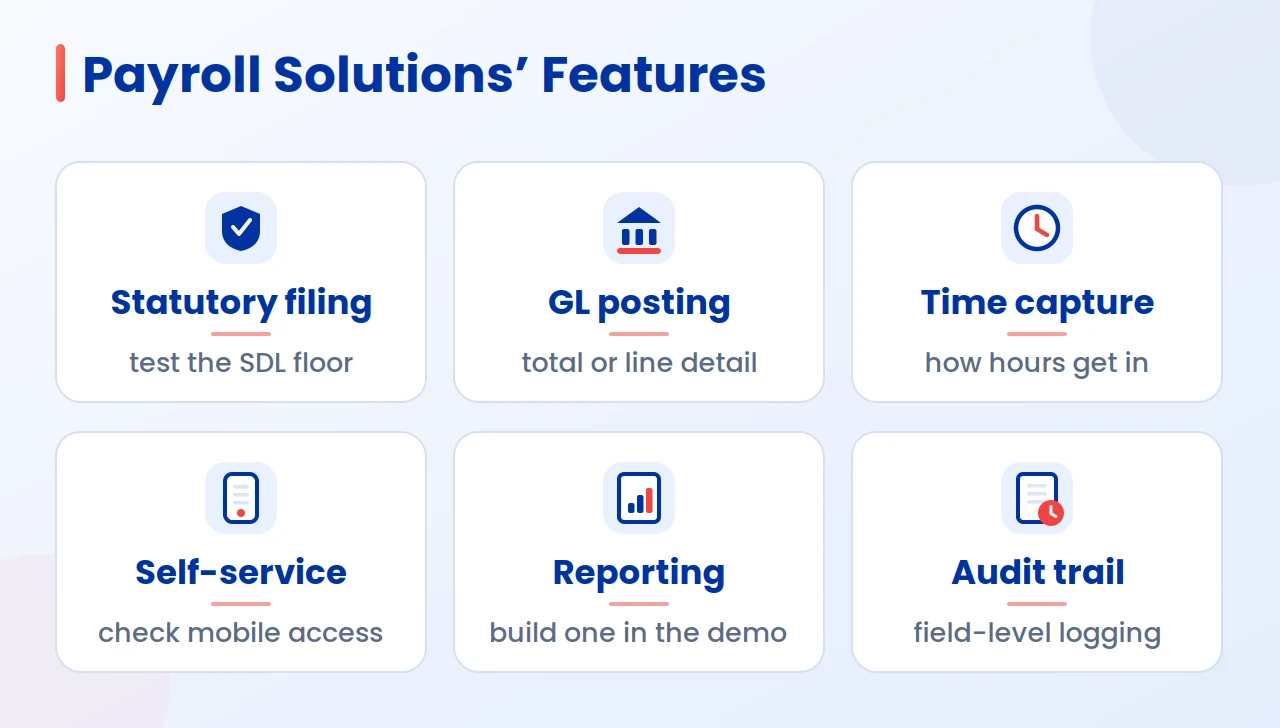
CPF, Skills Development Levy and IR8A output are table stakes. What differs is whether the edge cases are handled and how rate changes reach your system.
Two specific checks:
- The SDL floor: SDL is 0.25% of the first S$4,500 of monthly wages, with a minimum of S$2 and a maximum of S$11.25 per employee. Some systems apply the 0.25% without checking the minimum. Run an employee on S$600 and confirm the levy comes out at S$2, not S$1.50.
- The CPF ceilings: The Ordinary Wage ceiling is S$8,000 per month from 1 January 2026. Run an employee on S$9,000 and confirm contributions are calculated on S$8,000. Then check a bonus month against the Additional Wage ceiling.
How Payroll Reaches Your Accounts
Does a pay run post to the general ledger automatically, or does someone key a journal? And does it post a total, or line detail by cost centre, project or department?
For project-based businesses, the second question is the one that matters. A summary posting produces correct accounts and leaves project margins unknown.
Time and Attendance Capture
If you employ shift, site or production staff, how hours enter the system matters more than how pay leaves it. Check whether the solution captures time directly, imports from a separate clocking system, or expects a spreadsheet upload. Each option carries a different monthly workload and a different error rate.
Employee Self-Service
Payslips, leave balances, claims and personal detail updates handled by employees rather than by HR. Ask existing customers how far it has reduced HR enquiries rather than judging from the demo. Check mobile access if a meaningful share of your workforce is not at a desk.
Reporting You Can Build Yourself
There is a difference between a system that ships with reports and a system where your finance team can create one. Ask to watch someone build a new report during the demo, not select one from a menu. If every variation needs a support ticket, budget for that.
Audit Trail and Record Retention
Who changed a salary, when, and who approved it. Check that changes are logged at field level and that approval rights can be separated from entry rights, which matters in small finance teams where one person often holds every permission.
Singapore employers must keep employment records for two years for current employees and two years after an employee leaves. Confirm the system retains that history rather than overwriting it, and that a 2023 payslip can still be retrieved on request.
Read more: Solutions to Common Payroll Problems
What Payroll Business Solutions Cost
Pricing models differ enough that headline figures are not comparable between vendors.
| How it is priced | What to watch | |
|---|---|---|
| Standalone payroll software | Per employee per month, often with a minimum | Cost scales directly with headcount |
| HR system with payroll | Per user per month, tiered by feature bundle | You pay for recruitment and appraisal features whether you use them or not |
| Outsourced bureau | Per employee per month, plus per-event charges | Off-cycle runs, year-end filing and ad hoc reports are usually extra |
| ERP with payroll included | Quote-based on scope | Larger upfront scope, not priced per employee |
Costs That Do Not Appear in a Quotation
- Implementation and configuration, often charged separately from the licence or subscription
- Data migration, particularly year-to-date figures and the historical payslips you are required to retain
- Training, and retraining when payroll staff turn over
- Support tiers, where same-day response is a paid upgrade rather than the default
- Parallel running, where you pay for two systems for two or three months during cutover
- The finance hours spent each month on whatever the system does not do
A product that looks cheaper per employee often loses once implementation, migration and the manual bridge to accounting are counted.
Singapore SMEs can offset part of the cost of a business system through EDGE grant support. Apply before you commit.

Questions to Ask Every Vendor
Use the same list with each shortlisted vendor, so the answers compare.
- How do CPF rate and ceiling changes reach my system, and who applies them?
- Show me a CPF submission file and an IR8A export for the Auto-Inclusion Scheme.
- How does a month of payroll reach my general ledger? One journal, or line detail by cost centre?
- Can an hour worked carry a project or job code from timesheet through to cost report?
- What happens in an off-cycle run, a backdated increment, or a mid-month leaver?
- Is SDL calculated in the same run as CPF, and does it apply the S$2 minimum?
- Who holds my data, where is it stored, and how do I extract it if we part ways?
- What is included in support, and what is charged separately?
- Which of my existing systems have you integrated with before? Name the customer.
- What does implementation involve on my side, in people and in weeks?
The last two matter more than they look. A vendor who cannot name a comparable customer, or who describes implementation as something that happens to you rather than with you, is telling you something about the project ahead.
Running the Evaluation
Score Against Your Requirements
Build a scorecard from the four documents above, marking each requirement as must-have or nice-to-have, and weight the must-haves. A product scoring well across twenty features but failing one must-have is not a close second. It is out.
Make Them Run Your Payroll
Ask each vendor to process one month of your real data, with your actual pay structures, during the evaluation rather than after you sign. Give them the awkward cases: the mid-month joiner, the backdated increment, the employee on two allowances and overtime. Demos run on clean data. Your payroll does not.
Check References With a Similar Workforce
Ask to speak to a customer with a similar workforce shape, not a similar headcount. A distributor with 60 salaried staff and a contractor with 60 site workers have almost nothing in common from a payroll perspective.
Settle the Switch Before You Sign
Cutover timing, parallel running and what happens to historical records all affect cost and risk, and all are easier to negotiate before a contract than after. Our guide to the 5 types of payroll systems covers what to plan for when switching.
Where ERP-Integrated Payroll Fits
When payroll runs inside the same system as finance and operations, four things change by department.
- Finance sees labour cost in real time and posts to the general ledger automatically, instead of reconciling a monthly journal.
- HR works from one employee record shared with payroll, so a rate change or leave balance does not need re-entering elsewhere.
- Operations can trace hours to a specific project or production order, which is where labour cost becomes a margin figure rather than an overhead line.
- IT maintains one set of permissions and one data store rather than several.
The trade-off is scope. An ERP is a bigger commitment than payroll software and is not worth implementing for payroll alone. If payroll is slow but costing and finance already work, a dedicated payroll product is the more proportionate choice.
Next Steps
Document your pay structures and decide where labour cost needs to post. Those two answers remove most of the market before you book a single demo, and they make the demos you do book far more useful.
Synergix ERP is developed and supported in Singapore, with payroll running inside the same system as HR, financial management and project costing. Timesheets captured on site or on the production floor carry a project code through to both the payslip and the job cost, and CPF files and IR8A records come from the same employee record.
Bring your requirements document and we will tell you what to look for. Talk to our team.