


The best accounting software for a Singapore SME is the one that fits how your business actually runs — your transaction volume, your GST obligations, and whether you need it to talk to inventory, payroll, and project costing. For most small businesses, a cloud tool like QuickBooks Online covers the essentials. For growing SMEs whose operations have outgrown standalone bookkeeping, an ERP with embedded accounting becomes the better long-term fit.
This guide compares the leading options for 2026, explains the compliance requirements you can’t ignore (GST, IRAS, and the InvoiceNow e-invoicing mandate), and helps you decide when it’s time to move beyond accounting software altogether.
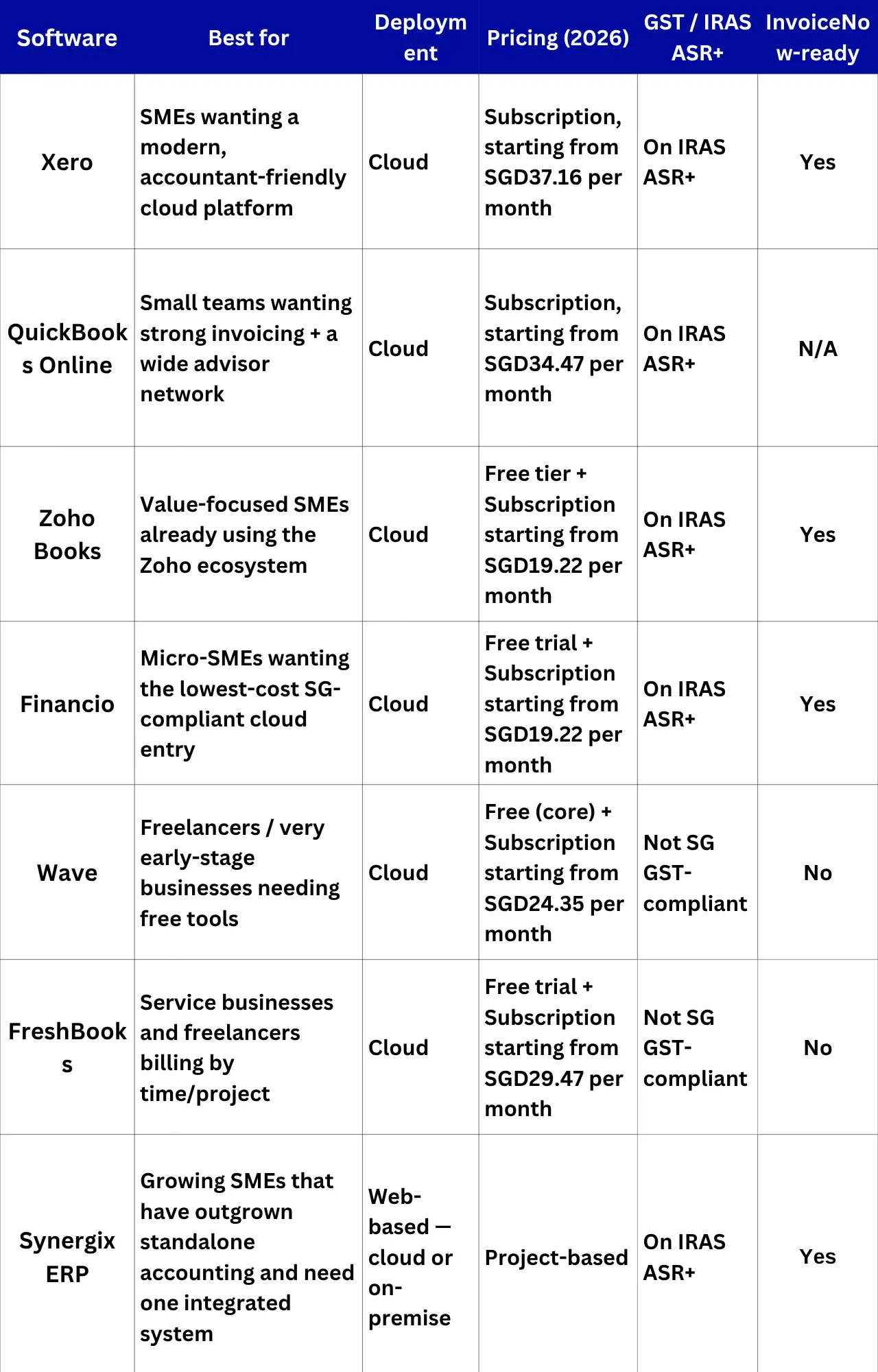
Quick Comparison: Best Accounting Software for Singapore SMEs
The first six are standalone accounting/bookkeeping tools, priced per month and built to do one job well: your books. Synergix is an ERP with accounting built in, which is why it’s project-based rather than a subscription. Which one you should choose depends on how your business runs:
- Choose one of the six cloud tools above if finance is genuinely your main software need: invoicing, expenses, GST, and reporting. If that’s you, a dedicated accounting tool is the more cost-effective, faster-to-adopt choice. Start there.
- Choose Synergix if you already run inventory, projects, multiple entities, or field operations and your finance data is disconnected from all of it. A standalone accounting tool only solves part of the problem – you’d likely be migrating again within a year or two. Synergix is the better starting point, not a future upgrade: accounting, operations, and compliance in one system from day one.
Not sure which camp you’re in? The self-check below will tell you in about a minute.
Synergix Technologies – AI-Powered ERP for Growing SMEs

- Best for: growing SMEs, especially in construction, marine, manufacturing, and distribution, that need accounting connected to inventory, projects, and operations, and want customisation or on-premises control.
- Not ideal for: micro-businesses or freelancers whose only need is bookkeeping and invoicing. A cloud accounting tool will serve you better and cost less.
Synergix Technologies is a full-service ERP partner for SMEs and mid-sized enterprises. Rather than a monthly bookkeeping subscription, Synergix is a web-based ERP — available in cloud or on-premises deployment — that brings accounting together with inventory, procurement, project costing, and industry-specific workflows in one system.
Because accounting sits inside the wider system, finance data flows automatically from sales, purchasing, and operations — eliminating the re-keying and reconciliation gaps that standalone tools leave behind.
Synergix is listed on the IRAS ASR+ register, and its E-Invoice module is InvoiceNow / Peppol-ready, so you’re covered for the e-invoicing mandate without bolting on a third-party connector.
Where the AI comes in. SME AI adoption in Singapore has climbed sharply, and Synergix embeds AI directly into the ERP rather than routing your data to outside vendors:
- Document AI turns PDFs and scans into ERP transactions at around 95% extraction accuracy — up to 10× faster document processing. This powers accounts payable automation with 3-way matching in under a minute per invoice, plus a bank reconciliation agent that can cut reconciliation time by up to 70%.
- Analytics AI turns finance data into predictive cash-flow projections, anomaly detection, and plain-English variance summaries — supporting faster, clearer accounts receivable and payment management.
- Knowledge Fabric lets your team ask questions in natural language and get accurate, permission-aware answers from company data.
Because the AI is embedded, it inherits your existing ERP roles and permissions, with data staying inside the ERP boundary.
Book a free demo → our consultants will show you how Synergix handles your accounting alongside the rest of your operations.
Xero
Xero is the platform most Singapore SMEs and their accountants reach for first. It’s easy to use, handles GST F5/F7 reporting, connects to local bank feeds from the major Singapore banks, and has one of the largest third-party app ecosystems of any accounting platform.
It’s listed on the IRAS Accounting Software Register Plus (ASR+), which is a meaningful compliance signal.
- Best for: growing SMEs that work closely with an external accountant and want room to scale.
- Not ideal for: very small businesses on the tightest budget. Entry plans can cap invoice volume, and payroll is a separate add-on.
QuickBooks Online

QuickBooks Online is strong on invoicing, expense capture, and project- or customer-level profitability reporting. Its large network of QuickBooks-trained accountants in Singapore makes it easy to find local support, and it handles IRAS-compliant GST tracking.
- Best for: small teams that want familiar dashboards and a big pool of advisors.
- Not ideal for: businesses that need deep inventory or manufacturing features.
Zoho Books

Zoho Books offers a clean interface, role-based access control, and built-in time and inventory tracking, with a capable mobile app. It’s especially compelling if you already use other Zoho products, and it has a free tier for the smallest businesses.
- Best for: cost-conscious SMEs already in the Zoho ecosystem.
- Not ideal for: businesses needing extensive local payroll or a very wide integration marketplace.
Financio
Financio is built for the Singapore/Malaysia market and is often the lowest-cost entry point among fully SG-compliant cloud platforms, typically with unlimited users on entry plans. A practical starting point for micro-SMEs that still need proper GST handling.
- Best for: micro-SMEs and startups wanting local compliance without a big subscription.
- Not ideal for: businesses with complex, multi-entity, or cross-border needs.
Wave

Wave is free for its core accounting and invoicing, which makes it attractive for freelancers and pre-revenue businesses. The important caveat for Singapore: Wave does not offer local GST compliance or InvoiceNow support, which makes it unsuitable for GST-registered businesses.
- Best for: freelancers and very early-stage, non-GST-registered businesses.
- Not ideal for: any GST-registered Singapore company.
FreshBooks

FreshBooks focuses on invoicing, expense tracking, and time tracking, which suits service-based businesses and freelancers who bill by project or hour. It integrates with a wide range of apps but has lighter inventory capabilities and can limit users per plan.
The important caveat for Singapore, as with Wave: FreshBooks does not offer local GST compliance or InvoiceNow support, so it’s not suitable for GST-registered businesses that need statutory reporting.
- Best for: non-GST-registered consultants, agencies, and freelancers billing by time or project.
- Not ideal for: GST-registered Singapore businesses, or product businesses needing robust inventory.
Read more: How to choose accounting software: a practical guide
Benefits of Cloud Accounting Software for SMEs
Moving from spreadsheets to proper accounting software delivers clear operational gains:
- Less manual work: automated invoicing, expense tracking, and bank reconciliation.
- Accurate, always-current records: access financial data from anywhere.
- Simpler compliance: streamlined GST reporting and, increasingly, InvoiceNow submission.
- Better collaboration: shared, real-time access for your accountant.
- Clearer decisions: dashboards and reports that surface cash flow and profitability.
- Room to grow: scale plans and features as the business expands.
The limitation: standalone accounting software manages the finance function. It doesn’t connect that function to inventory, procurement, project costing, or field service — which is where growing SMEs start to feel the strain.
When to Move from Accounting Software to an ERP
Accounting software is the right tool for many SMEs. But there’s a predictable point where it stops being enough. Consider moving to an ERP with integrated accounting when you recognise these signs:
- Disconnected systems — your accounting tool, inventory, and CRM don’t talk to each other, so data is re-keyed between them.
- Spreadsheet dependency — critical numbers still live in spreadsheets because the software can’t model your operations.
- No cross-department visibility — finance can’t see project costs, stock levels, or service jobs in one place.
- Inventory or costing inaccuracies — because sales, purchasing, and accounting aren’t a single source of truth.
- Manual processes at scale — month-end takes days, and every new customer or project adds admin.
Accounting software handles reporting from its own ledger. If your costs originate elsewhere, in projects, inventory, or production, you may need more than a ledger. Our guide to choosing financial reporting software compares the options.
Implementation Tips for Successful Cloud Accounting Software Integration
Successfully integrating cloud accounting software for SMEs involves several steps:
- Getting started: Begin by exploring the software and its features. During the demo session, you can see firsthand how the software works and ask questions specific to your business needs.
- Importing existing financial data: Transfer current records into the new system. It is best to use the import feature to seamlessly transition your past transactions, avoiding the painstaking task of manual data entry.
- Setting up chart of accounts: Organise financial accounts and workflows. You should set up categories that reflect your revenue streams and expense types, making it easier to track and analyse your finances.
- Training employees: Make sure the staff is well acquainted with the software’s use in their operations. Fortunately, most of the software providers provide a lot of resources and tutorials to enable your team to learn and understand the software in a short time.
- Ongoing maintenance: Regularly update and secure your financial data. It’s necessary to set up a monthly routine where you review and reconcile your financial data, keeping everything in order and up to date.
Conclusion
For most Singapore SMEs, the “best” accounting software is a compliance-ready cloud tool matched to your transaction volume and reporting needs. The two things you shouldn’t compromise on are IRAS ASR+ listing and InvoiceNow readiness, given the e-invoicing mandate now rolling out.
If your systems are disconnected, your team lives in spreadsheets, and finance can’t see the rest of the business, the smarter move is an integrated ERP. Synergix brings accounting, operations, and embedded AI into one Singapore-supported platform — built to grow with you and ready for the compliance requirements ahead.