



AI contract management uses automation, machine learning and structured contract data to manage the full contract lifecycle – from quotation and approval through delivery, billing and renewal. For service-, rental- and project-driven businesses, its main value is not document analysis. It is preventing revenue leakage: contracts that expire unbilled, work delivered outside entitlement, and assets on site that nobody is invoicing for.
For most SMEs in construction, rental, servicing, waste management, cleaning and distribution, the contract is not the hard part. Executing it profitably is.
This guide covers what automation actually delivers across the operational contract lifecycle, where it fails, and how to evaluate it.
The Contract Problem That Actually Costs Money
Ask a finance manager where contracts go wrong and you rarely hear about clauses. You hear about these:
- Silent expiry. A recurring contract lapses. Service continues. Billing stops. Nobody notices for two quarters.
- Unbilled variation. Additional scope is agreed on site, delivered, and never reaches an invoice because the contract record and the job record are separate systems.
- Entitlement drifts. A service contract covers four preventive visits. Technicians perform seven. The extra three are absorbed as cost.
- Off-hire gaps. Equipment is returned but still billed or still deployed and no longer billed. Either way, the contract and the asset register disagree.
- Invisible margin. Nobody can state the actual profitability of a contract without exporting from three systems into a spreadsheet.
Every one of these is a data problem, not a document problem. The contract terms are known. They are simply not connected to the operations that execute them.
That distinction determines which software solves your problem. Tools built to analyse contract text will not detect any of the five failures above, because none of them are visible in the contract document. They are only visible where contract terms, job records, asset movements and invoices sit together.
Where Singapore Businesses Currently Stand
The shift toward automated contract oversight is not speculative, and it is not confined to the private sector.
The Ministry of Finance confirmed that the Auditor-General’s Office now uses AI to identify higher-risk transactions and improve audit efficiency and has developed a tool to detect potentially fictitious documents.
Private-sector adoption tells a more mixed story. Research by Deloitte and Docusign, surveying 1,400 business leaders across 14 countries, found that Singapore organisations score strongly on governance – over 89% of leaders reported confidence in their systems’ ability to maintain integrity and flag local regulatory requirements – but lag regional peers on automation. Leaders in Australia, New Zealand and Japan were 21% more likely than those in Singapore to report using advanced automation in enterprise agreement systems. The same research found that organisations with more mature systems outperformed their strategic goals 27% more often.
The practical reading: Singapore businesses have the governance foundation in place. The gap is execution – connecting contract data to the systems that act on it.
What Automation Does Across the Contract Lifecycle
| Lifecycle stage | What automation delivers | Value for SMEs |
|---|---|---|
| Quotation | Contract quotations generated from standard templates and pricing, with online routing approval before anything reaches the client | High – enforces approval policy without chasing sign-off by email |
| Activation | Approved quotation converts to an active contract in one step, no re-keying | High – removes the most common source of data mismatch |
| Structured contract data | Terms, parties, values, billing frequency, start and expiry dates captured as queryable fields | Highest – every downstream capability depends on this |
| Delivery tracking | Contract linked to job records, service visits, deployed assets and consumed parts | High – makes entitlement visible before work is performed |
| Asset linkage | Serial-number monitoring of dispatched and collected assets, with barcode or RFID integration | High for rental, hire and equipment servicing |
| Billing | Automatic invoice generation on the contracted frequency | Highest – directly protects recurring revenue |
| Renewal and expiry | Status tracking across active, modified, terminated and expired, with alerts before lapse | Highest – one recovered renewal often exceeds annual system cost |
| Analytics | Contract profitability measured against actual delivered cost, portfolio-level reporting | High – turns contracts from admin into a management tool |
Two things worth noting from that table. Where genuine machine learning is applied to this data, it sits within the broader AI-powered ERP system layer rather than in the contract module alone.
- Structured contract data is the foundation, not a feature. Alerts, analytics and profitability reporting all depend on contract terms existing as data. If a system stores contracts as documents with a few tags bolted on, everything downstream will be approximate. This is why a contract management module inside an ERP system behaves differently from a document repository – the terms are already structured fields, not text to be parsed.
- Billing and renewal automation pay back fastest. Neither requires your team to change how they sell or negotiate. They simply stop money from leaking. For a business running hundreds of recurring contracts, that is usually the entire business case on its own.
Where Automation Underdelivers
Honest limitations, because the vendor version of this section rarely exists:
- It cannot fix bad source data. Contracts spread across shared drives, email and personal folders, in inconsistent formats, will not become clean structured data automatically. Budget for a consolidation exercise before you budget for software.
- It does not replace commercial judgement. Whether to grant a variation, accept a payment term or write off retention remains a business decision. Automation surfaces the information earlier and more completely. It does not make the call.
- Automation layered on a disconnected process adds a system without removing one. If contract data still has to be re-entered into finance or job costing, you have added a step. This is the single most common failure mode, and it is an architecture problem, not a software quality problem.
- Adoption, not capability, decides the outcome. Contract systems fail when site teams and sales teams find them slower than the spreadsheet they replaced. Evaluate the interface the end user will touch, not the one in the demo.
This is not a niche concern. The CCM Institute’s AI in Contracting 2026 report found that while executive appetite for AI has accelerated, many organisations lack the operating models, data foundations and governance structures needed to act on it. Contract automation fails at the data layer far more often than at the AI layer.
Standalone Contract Software vs Contract Management Inside Your ERP
This is the real decision. Both approaches work; they solve different constraints.
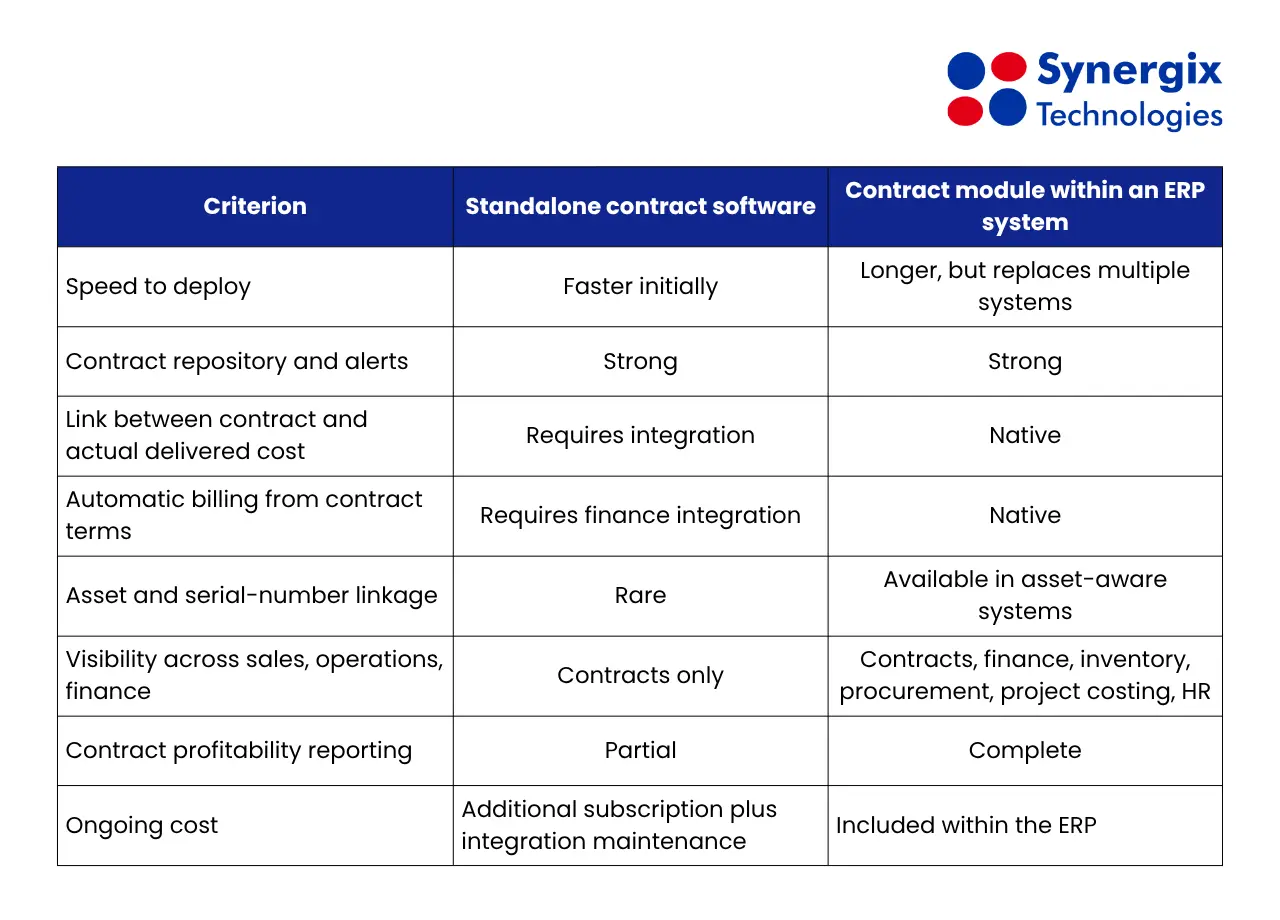
Standalone contract software vs Contract management ERP
The diagnostic question: ask your finance team how long it takes to answer “what is the actual margin on Contract 4471, including labour, parts, site costs and variations?”
If the answer involves exporting from more than one system, adding standalone contract software will not fix it. The constraint is that contract data and operational data live apart. Solving that requires them to share a system, not to be bridged by another one.
Standalone tools make sense where contracts are a self-contained function with little operational dependency. Where contracts drive billing, service delivery, asset deployment and project cost, integration is the whole point.
How AI-Powered Contract Management Works in Synergix ERP
Synergix Technologies has built and supported Enterprise Resource Planning systems for Singapore SMEs for over 35 years, across more than 600 businesses and 30,000 users. Contract management is delivered as an integrated module within the Synergix ERP System, not as a connected add-on.
Quotation to active contract
Contract quotations are raised in-system with online routing approval, ensuring company approval policy is satisfied before a quotation reaches the client. On confirmation, a single click converts the quotation into an active contract for monitoring, with no re-entry of terms.
Full lifecycle status monitoring
Every contract is tracked across active, modified, terminated and expired status from a central, web-based source of information. Authorised staff across sales, operations and finance see the same record.
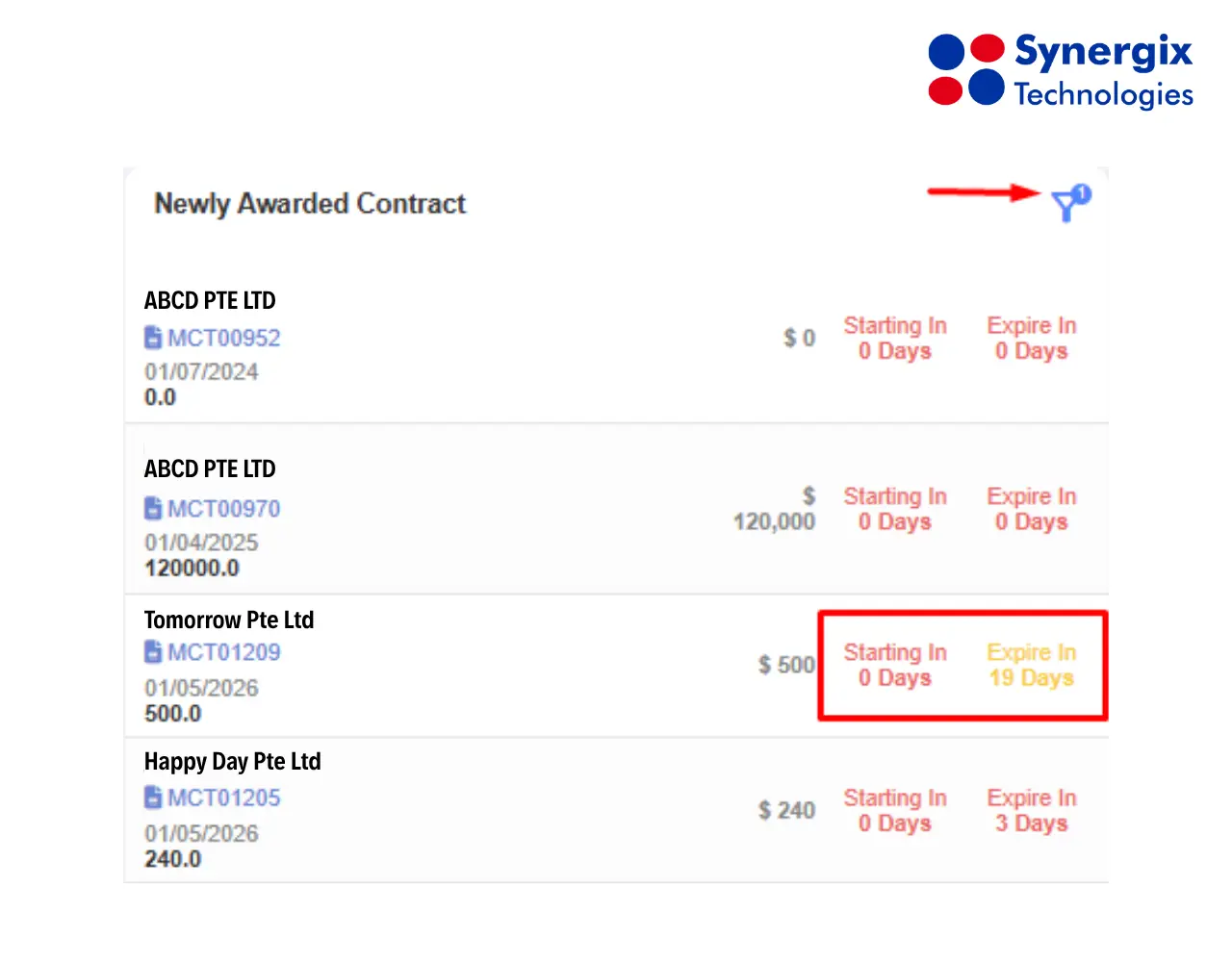
Synergix ERP flags contracts before they lapse, no manual tracking required.
Asset-aware contracts
For non-service contracts, contracts link directly to operational and fixed assets, including serial-number monitoring of dispatched and collected items, with the ability to integrate barcoding or RFID. For rental businesses, this is what closes the off-hire gap.
Automatic billing
Invoices are generated automatically on the contracted frequency: monthly, bi-monthly, quarterly, bi-annually, annually or usage-based. The system triggers billing when due rather than relying on someone’s memory. Billing flows directly into the Financial Management module.
Native integration across operations
The AI-powered Contract Management module is integrated with financial management, inventory control, procurement, project costing, equipment servicing and human resource management. Contract performance can therefore be measured against actual delivered cost without exports or reconciliation.
Reporting and analytics
Contract profitability and portfolio analysis run through integrated Business Analytics, alongside a library of over 500 standard reports.
For a wider view of how intelligence is being applied across the system, see Synergix AI-powered ERP systems.
Customisation without upgrade risk
Because Synergix develops our ERP in-house, non-standard requirements can be customised to your process without compromising your ability to take future upgrades. In industries where the process is the differentiator, that matters more than feature count.
Qualifying Singapore SMEs may be able to access government support for ERP adoption through schemes such as PSG, EDG and EIS. Eligibility and funding levels change, so confirm current terms before planning your budget.
Where to Start
See how contract management works inside an integrated AI-powered ERP. Request a free demo and we will walk through your actual contract workflow – quotation, approval, delivery, billing and renewal – and show you exactly where the gaps are.