


Supply chain management is one of the most impactful responsibilities within operations management, and one that is frequently not noticed until something fails. Late purchase orders, off counts in the warehouse, or deliveries that are not on time all have a direct impact on the customer and the bottom line. The average company is now facing disruptions for a month or more once every 3.7 years, according to McKinsey research, which has shown that a year of profit is lost in a decade due to such disruptions.
In this blog, we outline the meaning of supply chain management in operations management, its various roles and functions, and its implementation in businesses, using real-life examples from Synergix. Whatever industry you are running: trading, distribution, or manufacturing organisation, our ultimate goal is the same: to deliver the right product at the right place at the right cost.
What Is Supply Chain Management in Operations Management?
Operations Management is the management of operations to achieve maximum efficiency and profitability in a business. It is the process of planning, organising, and supervising the process of production of goods and services in a way that the inputs (human, material, technology) are transformed into outputs efficiently. Its core responsibilities might include: process optimization, supply chain management & logistics, quality control…The challenge is to balance operating costs and revenue to maximise net operating profit and reach a cost & resource allocation that is optimal for the business.
Supply Chain Management in Operations Management is a part that manages the flow of materials, information, and money from suppliers right through to the end customer. Operations Management answers the question “how do we produce well?” while supply chain management answers the question “how do we source, move, store, and deliver well?”
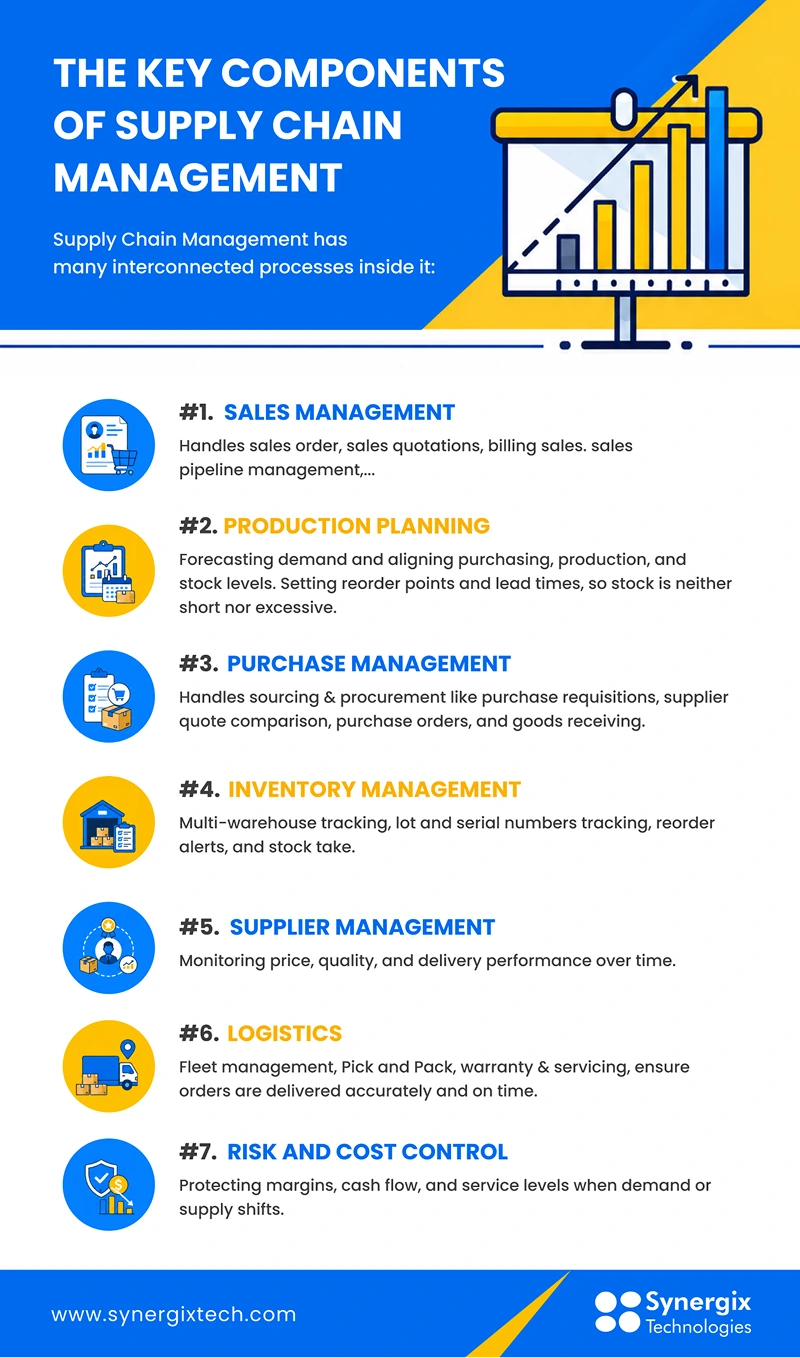
The Key Components of Supply Chain Management
Supply Chain Management has many interconnected processes inside it:
- Sales Management: handles sales orders, sales quotations, and billing sales. sales pipeline management,…
- Production Planning: forecasting demand and aligning purchasing, production, and stock levels. Setting reorder points and lead times, so stock is neither short nor excessive.
- Purchase Management: handles sourcing & procurement like purchase requisitions, supplier quote comparison, purchase orders, and goods receiving.
- Inventory management: multi-warehouse tracking, lot and serial numbers tracking, reorder alerts, and stock take.
- Supplier management: monitoring price, quality, and delivery performance over time.
- Logistics: Fleet management, Pick and Pack, warranty & servicing, ensure orders are delivered accurately and on time.
- Risk and cost control: protecting margins, cash flow, and service levels when demand or supply shifts.
Inside each role, there are several small tasks: purchase requisitions and supplier quote comparison; multi-warehouse tracking with lot and serial numbers; reorder points and lead times; the conversion of quotations into sales orders and delivery orders without re-keying; supplier performance monitoring; and the flow of landed costs into margin…. Each one has its own value, but the real hard question is how to connect all these roles and tasks smoothly and effectively.
Read more: Retail Supply Chain Management Software within ERP: A Practical Guide
Why Supply Chain Management Matters?
Because the losses are enormous and mostly invisible. IHL Group, which has tracked the problem for nearly two decades, put the total cost of inventory distortion at roughly US$1.7 trillion in 2024, with out-of-stocks accounting for US$1.2 trillion and overstocks US$554 billion. By 2025, the figure reached US$1.73 trillion- around 6.5 per cent of global retail sales – with Asia-Pacific carrying the heaviest regional burden at US$642 billion, some 37 per cent of the worldwide total.
Empty shelves cost roughly twice what excess stock does, yet overstock is the failure owners notice, because it appears in the accounts as ageing inventory or a markdown someone must approve. A stockout generates no journal entry at all – the customer simply buys elsewhere, and the loss registers as an absence. Most businesses are therefore systematically better at managing the cheaper problem. That is not a discipline failure. It is an instrumentation failure, and it is exactly what supply chain management exists to correct.
Where do many businesses’ Supply Chain Management processes go wrong? Its visibility. Many SMEs cannot see far enough to decide. McKinsey Global Institute research shows only 2 per cent of companies have visibility below their second tier of suppliers, and McKinsey estimates that disruptions lasting a month or longer now strike the average company every 3.7 years, costing roughly 45 per cent of a year’s profits over a decade. Disruption is not avoidable – it arrives for everyone. What varies is how early it is seen. A firm that learns a supplier’s slippage when goods fail to appear has no options left; a firm that watches the lead time drift three weeks earlier still has all of them. Internally, the same blindness shows up as three versions of the truth: a purchaser’s spreadsheet, a POS, and the warehouse supervisor’s memory.
How Does Supply Chain Management Work inside Synergix ERP?
Synergix Technologies is a Singapore ERP developer founded in 1990 and now part of the Tokyo-listed MJS Group. We have built supply chain management into our integrated ERP used by 600-plus customers across the region. Here is how the functions above map to real features:
- Procurement: purchase management, purchase requisitions-sourcing (multiple purchase requisitions can be consolidated into a single purchase order, emailed straight to suppliers, and protected by 3-way invoice matching and approval workflows). Back-to-back ordering auto-generates a PO from a confirmed sales order, so every item purchased has a destination. See the ERP for Wholesale Distribution guide.
- Fulfilment: quotations flow into sales orders and delivery orders without re-keying; several sales orders can be combined into one delivery, and gross profit is tracked per invoice. Production planning, material cost management,… See more details on ERP features for the manufacturing industry.
- Financial Management: the accounting module is linked to purchasing and delivery, landed costs, and margins update in real time, shortening month-end close.
- Sales Management: sales quotations, sales orders, billing sales. sales pipeline management, price,…and CRM: monitoring customer, leads, and supplier management.
- Inventory Management: warehouse management, inventory management that includes live Inventory Reorder Alert widget flags items below their minimum holding quantity and recommends a reorder quantity, while four-level sub-locations and lot/serial tracking keep counts accurate across unlimited warehouses.
- Goods receipt: QAQC, Goods Exchange
- Logistics: Fleet management, Pick and Pack, warranty & servicing, ensure orders are delivered accurately and on time.
Success Story
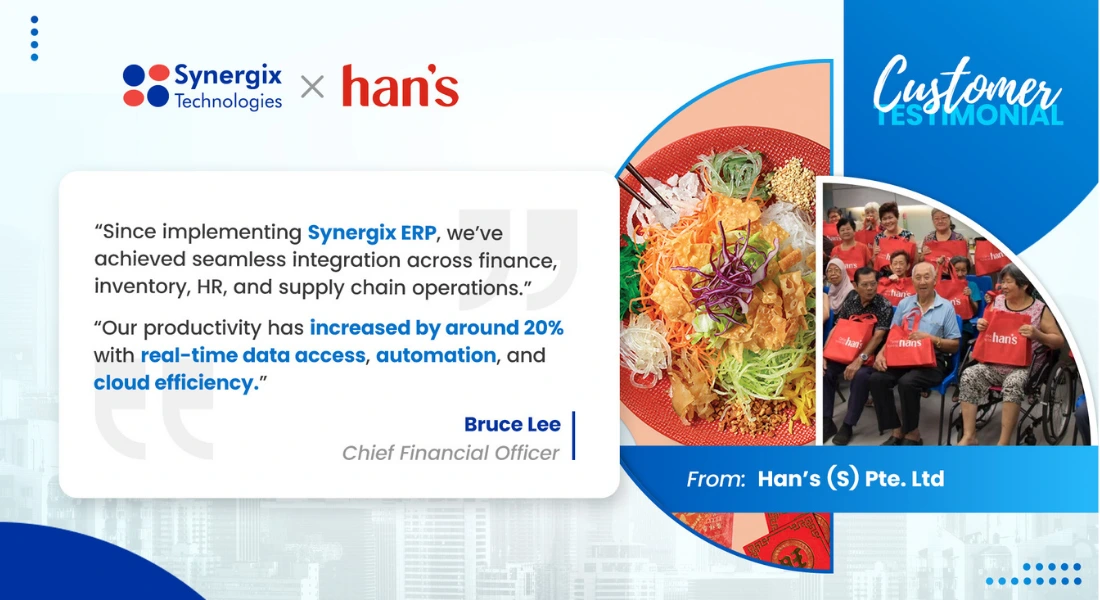
Customers describe the payoff in their own words. Han’s (S) Pte. Ltd credits automated goods-receiving notifications and the ability to convert multiple purchase requisitions into purchase orders with more accurate, streamlined supply chain management.
See Han’s (S) Pte. Ltd’s full feedback and other Synergix testimonials.
Key Takeaways
Supply Chain Management in Operations Management is no longer just an operations management back-office task; it’s where the margin gets won or lost. The evidence speaks for itself: losses are significant, the failures are costing a fortune without anyone noticing, disruption is a way of life, and the businesses that are ahead of the game are those that are using integrated data instead of additional software.
Begin to renovate your Supply Chain Management with Synergix – integrated software with real-time data, now has a dedicated AI assistant to help you run 10X faster and eliminate 90% manual work.