


Picture a Saturday. You sell your final product online at 2:14pm. After one minute, someone enters your store and grabs the same unit as you did a minute ago. You’ve sold one item twice, one who is about to receive an apology e-mail that you didn’t want to write.
This little mishap is all retail supply chain management software needs to be a case. Saturday’s situation is nothing unusual when your stock is spread across spreadsheets, a POS and a man’s brain. It’s time to look at the following points:
What Retail Supply Chain Management Software Actually Does
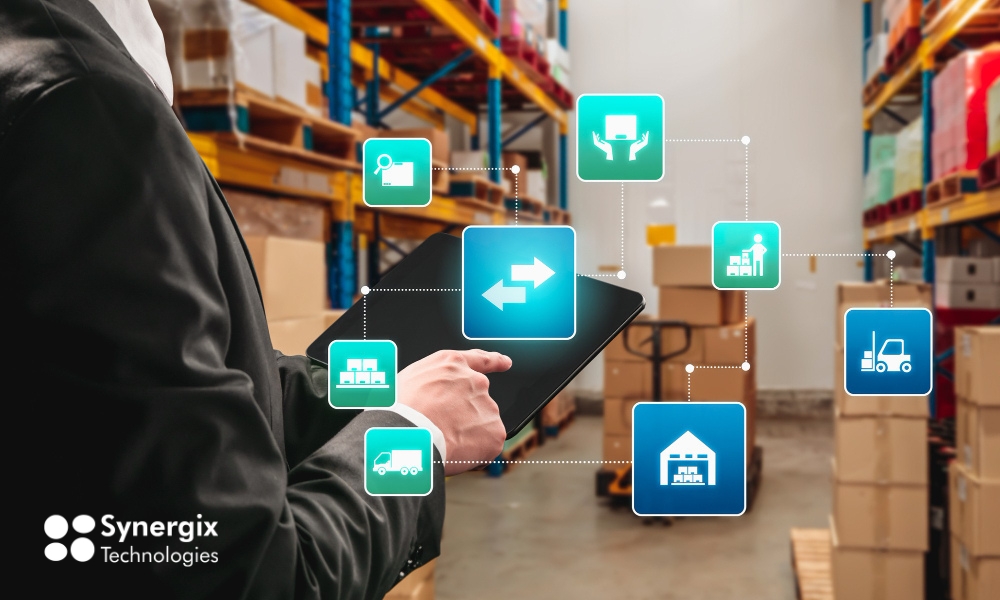
One job: Tracking the inventory and where the product goes afterwards. Supplier to warehouse, warehouse to shelf or doorstep of the customer. Retail supply chain management software can follow that path, and the number on your screen will coincide with the number in the back room. For the complete explanation, Synergix has a good tutorial on supply chain management systems.
The question isn’t standalone versus integrated; it’s whether it is standalone or integrated. In a stand-alone application, you’re able to manage inventory or order, but not both. Supply chain interfaces like accounting, sales and reporting are encapsulated within an ERP. Until the end of the month, that’s academic, when the stand-alone crowd is exporting away at midnight while the ERP crowd is already closed.

Why Retail Supply Chain Management Software Pays Off
Each time you go out of stock, you are giving a competitor a sale! All overstocked SKUs are sitting on a shelf, with the probability that they will be marked down soon. The software is designed to deal with both enemies.
According to Global Market Insights, the global inventory management software market was valued at USD 3.9 billion in 2024 and is estimated to register a CAGR of 6.4% between 2025 and 2034. So, retail stores purchase these tools because once they introduced the 2nd channel, manual stock control simply couldn’t keep up with it, and most have several channels: Shopee, Lazada, possibly Shopify, an actual retail shop, and the bizarre pop-up. You’ll over-sell if you sync them by hand. Every time.
The Problems Worth Fixing First
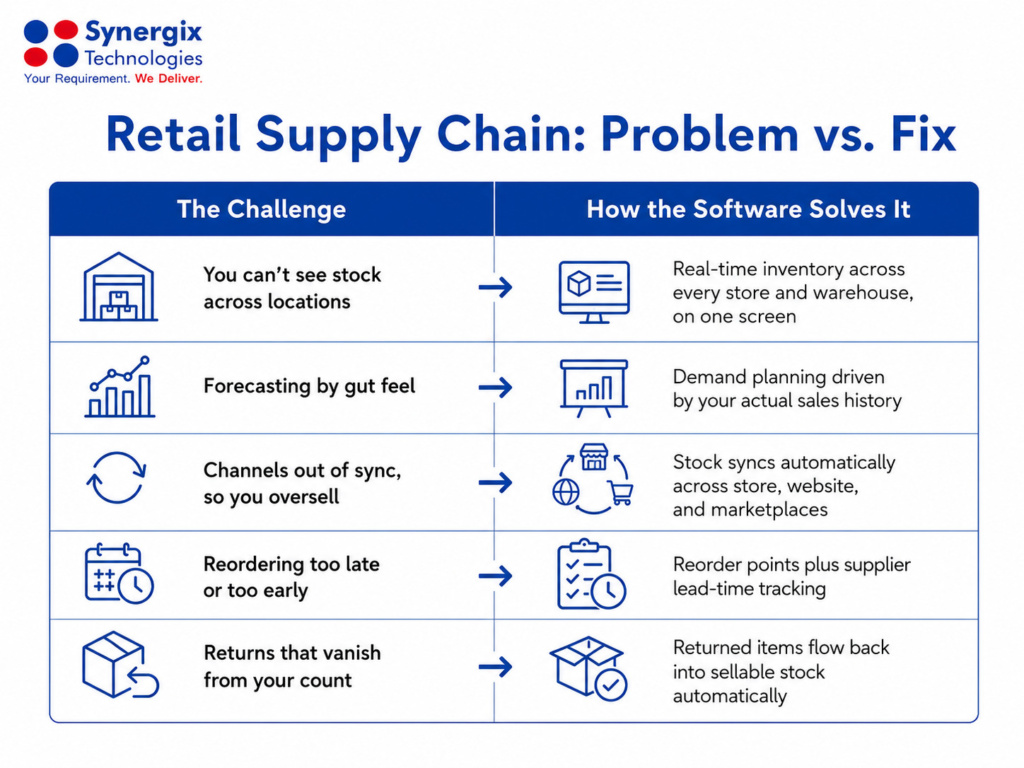
- Inventory you can’t see. There was no definite total amount of stock split across a store, a warehouse and a few outlets. This is problem one, and the origin of the double-sell above.
- Forecasting by gut. The result of that is that “I think we sold a lot last year” comes out at the end of February with a bunch of pallets still unsold. Instead, software is used to read your real sales to figure out.
- Out-of-sync channels. Online: says 5, Shelf: says 1, Marketplace: says sold out. Customers see, and so do the algorithms that tag cancellations as bad.
- Reorder timing. If the products are put on the shelves too late, the shelves are empty, and if they are put on the shelves too early, the money is trapped. Reorder points & lead-time tracking let you eliminate the guesswork.
- Untracked returns. When a product is returned but doesn’t return to sellable inventory, then you’re losing inventory that’s right under your nose.
For all those who have accuracy as their primary concern this is a more in-depth post about stock control software for SMEs.
What to Look for in Retail Supply Chain Management Software
Focus on these. The rest is up for negotiation.
- Real-time, multi-location inventory includes batch, lot and serial tracking with barcodes.
- Automated procurement that alerts reorders and automatically connects each purchase with a sale, thereby making sure nothing is homeless when you arrive.
- One dashboard for demand planning and analytics, no exports.
- Order and fulfilment control: split orders, combined deliveries, multiple billing and delivery addresses.
- No more updates of your inventory, no more dreading month-end because it’s already been handled through connected finance.
- Integration to marketplace (Shopee, Lazada, Shopify). Non-negotiable.
Watch it fit on the Synergix Supply Chain Management module
or take a quick walkthrough on the Synergix YouTube channel
AI Tools to Enhance Trading & Distribution
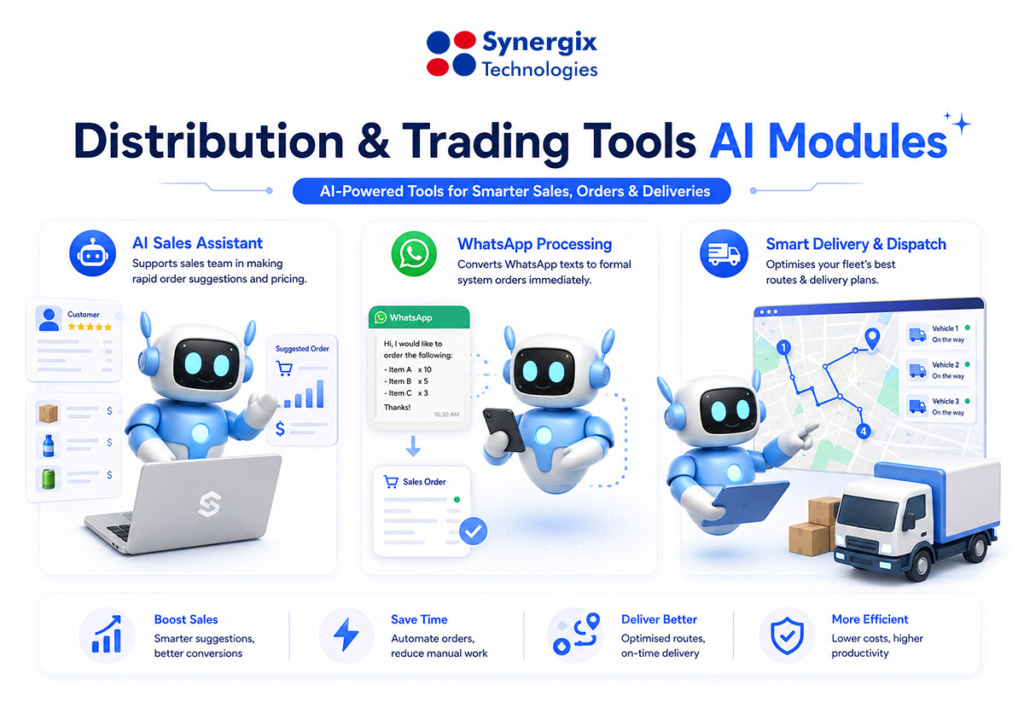
When you add the powerful software, your numbers are accurate, but put the smart software with the AI, and it becomes a working employee. Synergix comes with specific AI modules to do the heavy lifting in retail and distribution.
AI Sales Assistant
Customers’ questions answered, product suggestions, auto quote and auto order. It even prompts your team to do the research they need and learns from all interactions to improve over time!
WhatsApp Message / Purchase Order Processing
Customers want to utilise the messaging application, and ordering through text isn’t a bad idea; however, the duplication of messages into your framework wastes hours of your time. This module captures WhatsApp Business conversations or PDF orders and generates sales orders automatically. It reduces manual staff up to 90% and effectively means your order desk can be open 24/7.
Smart Delivery Plan & Dispatch AI
You can create the best routes and delivery times for your real-time orders and vehicle capacity. It arranges the whole plan on the wing, if suddenly it has to cope with a great surge in traffic or an emergency call.
Demand Forecast AI
Predicting the next item that will be purchased leads to an empty shelf or backroom. This tool helps you run the sales and seasonal data analysis to predict exactly what you need. It alerts you to restock and the quantity to purchase, avoiding stockouts and the tying up of capital in dead stock.
Standalone Tool or ERP? The Honest Answer
On the first day, a standalone app costs less, and it also works out to be rather inexpensive when you consider it only has a handful of SKUs in one store. Retail is seldom simple, though. Once you add an outlet, a warehouse, an online store and standalone tools, they all require connectors and manual recon to be connected to your accounting. Every hand-off lets numbers drift. An ERP integrates the supply chain, sales, purchasing, and finance data into a single database, one version of the truth: Distributors and multi-outlet retailers benefit the most from this, as outlined in the guide to ERP for wholesale distribution.
How to Choose Retail Supply Chain Management Software
- Industry fit. Has the vendor done retail like yours? A generalist education/training is at your expense.
- Total cost. Licensing, implementation, training and support. Please get the big picture.
- Local compliance. Multi-currency, GST and reports which your accountant will want. The phrase “built in” is not the same as “roadmap”.
- Adoption. A good system is not effective if people do not employ it. Evaluate the usability of the interface and training.
- Grant eligibility. The PSG scheme offers the opportunity for SMEs to obtain up to 50% funding for a pre-approved solution.
One demo tip: to have the vendor perform each of your three worst real scenarios (return, warehouse transfer, oversold item). This is better than any brochure! The results of Synergix’s work are easy to understand, and the payoff is evident in their testimonies page, which will provide real-time visibility and accuracy, that’s the proof.
The Short Version
- Retail supply chain management software is designed to ensure one stock number is accurate online, in-store and in the back room.
- The payoffs are fewer stock-outs, less cash stuck, and synchronised inventory across all channels.
- Focus on real-time stock, automated purchasing and finance connectivity.
- Standalone tools are appropriate for the simplest configuration; once retail becomes complicated, it’s the turn of ERP solutions
If you have any of that double-sell on your Saturday, then you’re getting your signal. It’s not more work from your team that’s the solution. It’s a system that prevents the problem from reoccurring.
Interested in retail supply chain management in your stores? Schedule a demo of Synergix and go through the three messiest scenarios.