


As a business expands, it is harder to control the spending. This can rapidly become a number of purchase requests and expense claims sent out, followed by several emails of approval, a variety of invoices, different payment options, and no indication of where the money is going.
With no process in place, finance departments typically take too long to monitor expenses, reconcile invoices, and ensure budgets are adhered to, rather than focusing on financial planning. Managers might also have trouble approving buy-off fast enough, without overspending their companies’ policies.
This is where spend management software can make a difference. It makes it easier for businesses to keep track of the entire spending process, all from one place, including requests and approvals, expense tracking, payment, and reporting. Enhanced visibility and more streamlined processes allow businesses to make informed spending decisions and lessen manual tasks.
Here, you’ll discover the meaning of spend management software, the value it brings to SMEs, and you’ll get some tips on what to consider when selecting a solution.
What Is Spend Management Software?
Spend management software is a tool for businesses that allows them to control and manage their business spend throughout the business purchase process. It combines the management of expenses, invoices, approvals, and budgets into one platform, rather than having multiple systems or spreadsheets for each of these.
Spend management software provides a comprehensive picture of business spending before, during, and after a transaction is completed, rather than just a single function, like employee expense claims or invoice payments.
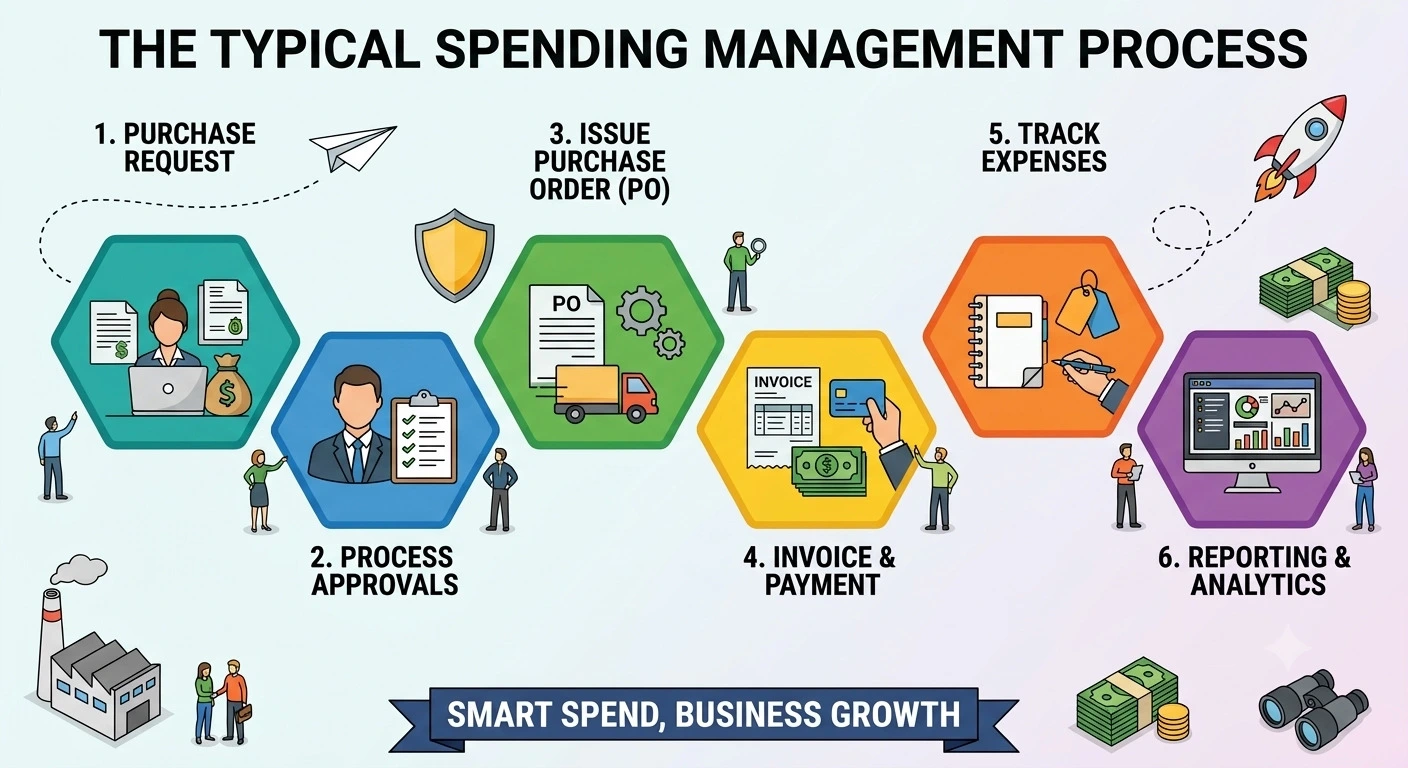
The typical spend management process
These activities will help companies minimise manual tasks, enhance financial transparency, and ensure that expenditures stay within budget.
This type of control is particularly beneficial for SMEs. With growing team sizes and more purchases, oftentimes manual approvals or disparate tools can result in delays, redundant spending, and a lack of visibility. Spend management software can help to create consistent processes and provide finance teams with access to real-time data on spending throughout the business.
Why Singapore SMEs Are Reviewing Spend Processes Now
Finance processes are basic for many SMEs. Requests for purchase are communicated via email, expenses are added to spreadsheets, and the invoices are kept in various folders, while who is available dictates approval. These can be effective for small teams, but can be hard to keep track of as the company expands.
Singapore is also encouraging businesses to digitise financial processes. According to IMDA, more than 63,000 businesses are already using the national InvoiceNow e-invoicing network, which helps reduce manual invoice processing, minimise errors, and shorten payment cycles.
Read more: ERP Budget Planning Software for Financial Control
Common Spending Challenges for Growing Businesses
The biggest issue is the lack of visibility of company spending. While finance teams can be aware of the amount already spent, they may not have a clear view of any requests for purchase that are pending, any payment that is about to be made, or department budgets. This can make it difficult to maintain cash flow and to know where to cut down on expenses before it gets too late.
Another frequent problem is manual approvals. The process of purchase requests can get bogged down in lengthy email threads, which can slow down the process and make it hard to see who approved what. If there is no standardisation of the approval process, businesses have a greater risk of unauthorised purchases.
Many SMEs also deal with different suppliers, different payment options, and software subscriptions. With no central records, duplicate purchases or duplicate subscriptions can easily be missed, and this will lead to an increase in operating costs over time.
Another source of frustration are month end reports. Finance teams commonly have to manually process data from multiple systems and follow up on receipts, reconcile, and report. This time-consuming process is inefficient and can lead to mistakes.
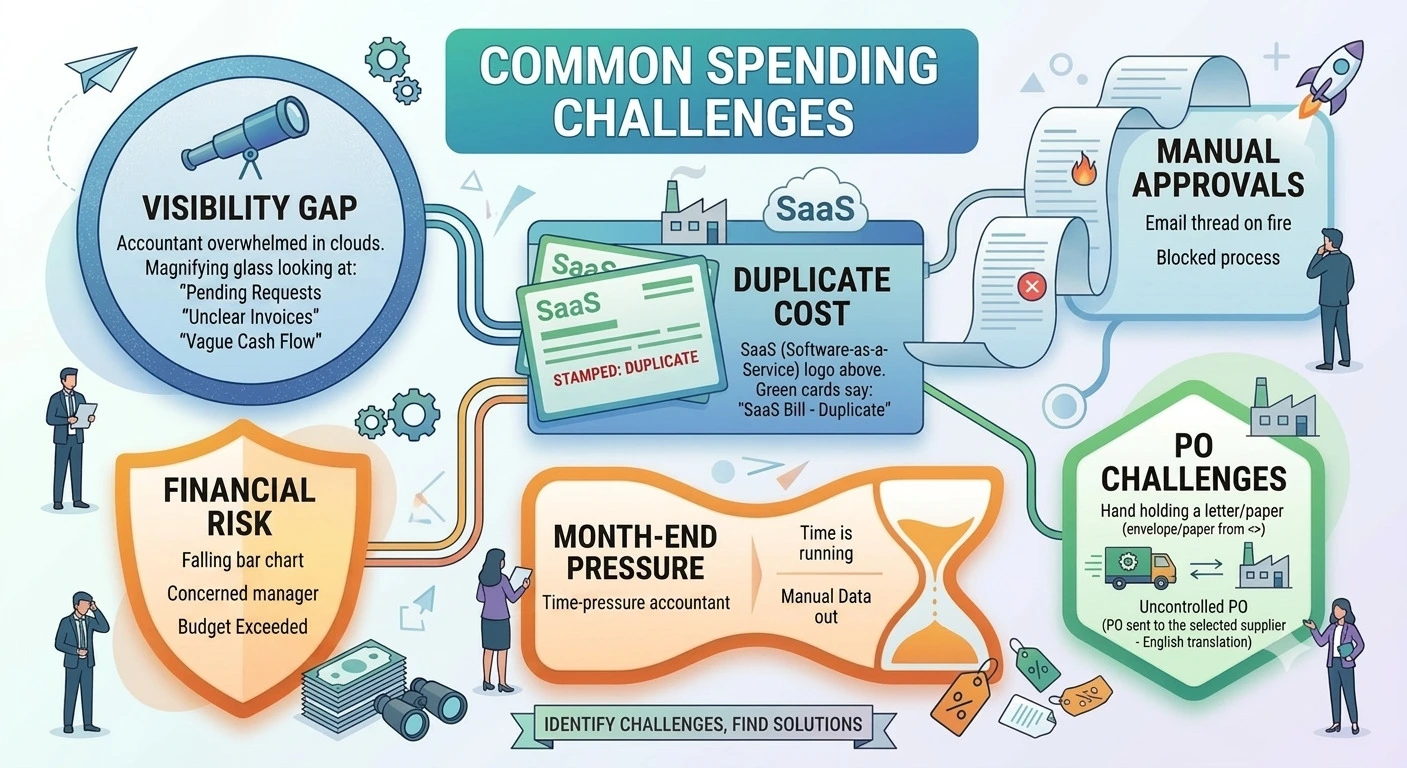
SME’s common spending challenges
How Spend Management Software Helps
This is where spend management software comes in handy, offering businesses a structured approach to managing their spend from the moment they request to purchase it until finally it is paid out.
- Employees can make purchase requests via a centralised system, rather than using email or spreadsheets.
- Approval workflows help businesses be consistent with spending policies by making sure that the requests are seen by the proper people before money is approved.
- It also captures all purchase information, invoices, expenses and payments in a single location to provide a finance team with a better view of both what they are spending and what they are aiming to spend.
- Real-time dashboards allow for easier budget tracking, detection of unusual spending and financial reporting without having to manually combine data from various sources.
Key Benefits for SMEs
Spend management software is more than just about saving paper for growing businesses.
It gives finance teams greater visibility into the company’s spending and helps them understand where the money is going and where they can save unnecessary expenses.
Another advantage is that it makes better use of spending control, as it helps in ensuring that all purchases are made in accordance with the approvals process, and not only after a payment has been made.
Finance departments can save time on mundane tasks like approving expenses, tracking expenses, and processing invoices while focusing more on supporting business decisions.
Lastly, real and current spending data allows business leaders to make informed decisions regarding their budgets, forecasting and purchases, thereby assisting in long-term business growth.
Features That Matter for an SME
All spend management software has different features. Some are primarily expense trackers; others can help with the purchasing and payment process. When selecting a solution, it is essential to examine beyond features and see how each feature can assist with your business operations.
These are the main features that SMEs would need to take into account.
Approval workflows
Approval workflows enable businesses to simplify the process of reviewing spend requests prior to the purchase. Rather than emails or chat messages, requests adhere to an established approval process that is based on such criteria as department, expense, or project.
Seek out software that will enable you to personalise the software for approval rules as your business develops. This can be beneficial in minimising delays and adhering to company policy.
Budget management
The best spend management tool should enable finance teams to keep an eye on budgets throughout the spending cycle and not after the spending has been made.
Budget allocation, spending limits, budget alerts and other features help managers keep track of what has been spent and what is still available in the budget. This way it is easier to avoid overpayments before they occur.
Buying and requesting supplies
Often, the initial phase in the business spending process is the purchase. Purchase request and purchase order management are part of a solution that provides an audit trail of all purchases, from request to supplier payment. This makes it easier for the finance team to hold them accountable, and it provides them with visibility of purchasing activities across departments.
Expense and Invoice management
When all the expenses of employees and suppliers’ bills are managed on a single platform, the manual effort is reduced and financial records are maintained in an organised manner. Search for software that can capture receipts and invoices, match transactions when applicable and provide a full history of business spending. This makes it easier to reconcile and helps to ensure financial reports are accurate.
Reporting and spend analytics
Reporting tools convert data on spend into insights for businesses. Rather than looking at individual transactions, finance teams can review spending by department, supplier, category or project. Customisable dashboards, budget reports, spending trends and exportable reports for financial planning and audits are just some of the features of reporting.
Integrations with business systems
Spend management software works best when it connects with the systems your business already uses.
Common integrations include accounting software, ERP systems, banking platforms, payroll solutions, and procurement tools. These connections reduce duplicate data entry and help keep financial information consistent across the business.
Configure security and access controls
Only authorised users should have access to financial information. Look for software with role-based permissions and approvals, audit trails, and activity logs. These elements offer safeguards for delicate monetary information and an unmistakable record of spending decisions.
Spend Management Software vs. Expense Management Software
Although these terms are often used interchangeably, they are not the same.
Expense management software is all about logging employee expenses and reimbursing them for expenses incurred. Common examples are travel, meal claims, mileage, and receipt submissions.
There’s a much wider range of spend management software. It allows businesses to have greater control over the company’s expenses, both before, during, and after a purchase, which helps them to manage spending more effectively.
In many respects, expense management is only part of a spend management initiative for many SMEs. But, as purchases begin to ramp up, companies need more visibility than ever before into purchase approvals, supplier payments, and budget control, not only employee reimbursements.
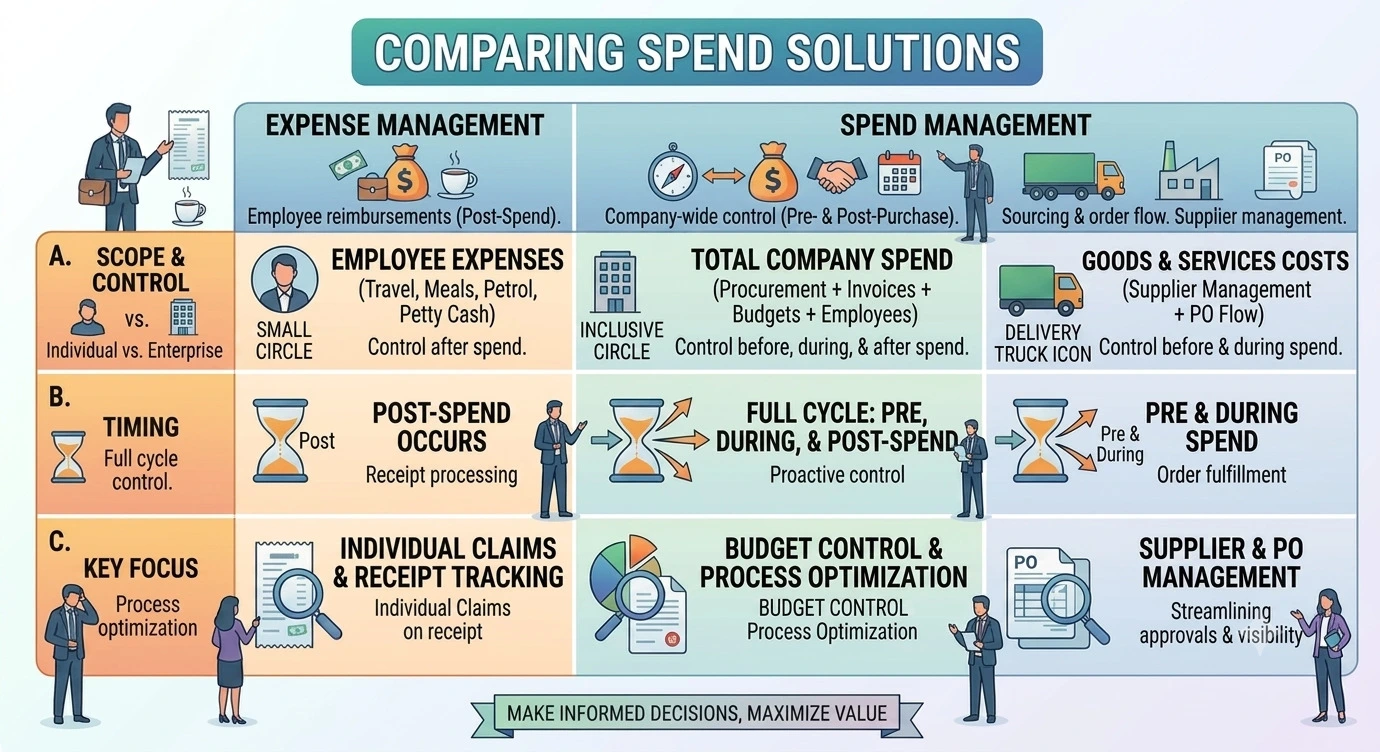
Differences between spend management software and expense management software
Read more: Guide to Expense Management Software in Singapore (2026)
How to Choose: A Practical Sequence
When it comes to picking spend management software, it’s not just about having the most features. The right solution should be aligned with existing processes, as well as future growth.
There are a few considerations to make before you do decide.
1. Define the problem before you shortlist
The first step to creating a solution is to define the problem you are trying to solve.
For instance:
- Do approvals take too long?
- Have trouble keeping track of your spending?
- Does your finance team spend too much time on invoice processing?
It’s important to know what things you’re looking for so you don’t end up paying for things you don’t need, and also try to limit your choices.
2. Test adoption, not demos
The software needs to be user-friendly for employees, managers and the finances. When there’s a complex system, employees end up going back to emails or spreadsheets for low adoption. A basic interface and easy workflow typically contribute to greater long-term success.
3. Interrogate the integrations
No spend management software should be another silo solution. Think about how it can fit your accounting, ERP, payroll or banking applications. Effective integration lessens manual effort and the risk of data inaccuracies within various departments.
4. Consider future growth
What you’re doing with your money now will be quite different in two or three years. Select software that will be able to house more users, departments, business entities, approval levels, and transactions without needing to replace the system.
5. Access reporting and visibility
Think about how the vendor integrates you, how they train you, their customer support and product updates. Good support will help a lot when it comes to implementation, as your business grows and evolves.
6. Evaluate support, not just software
Implementation is only the beginning.
Consider the vendor’s onboarding process, training resources, customer support, and product updates. Reliable support can make a significant difference during implementation and as your business requirements change.
Questions worth asking every vendor
- Is the software used for our approval process?
- Will it connect to our current accounting or ERP system?
- Will it grow with our business?
- What kind of reporting and analytics does it have?
- What is the approximate time required for implementation?
- What support and training are provided once deployed?
The answers will guide you to make an informed comparison between solutions based on business requirements and not on marketing hype.
Why an ERP System Can Be the Next Step for Growing SMEs
For a lot of SMEs, it is practical to use stand-alone spend management software to enhance spend control. It aids in organising approvals, tracking budgets, controlling costs, and giving visibility and insights into business spending.
However, with the business growth, spending becomes interlinked with the other business functions. A purchase request can impact inventory, supplier management, project costs, accounts payable and financial reporting. Separate systems can lead to duplication of work and to inconsistent data.
This is where an Enterprise Resource Planning (ERP) system can help.
An ERP system integrates financial, procurement, inventory, sales, project and other core business processes into one solution. Rather than sharing information across applications, teams share the same information in their department.
In our own implementations, this is the point at which project-driven SMEs usually reach the limits of a finance-only tool. Once a purchase changes the cost of a job, spend control and project costing stop being separate questions. Synergix ERP solutions were built around that link, which is why our project costing and procurement modules share the same transaction rather than syncing between systems.
If you are planning for long-term growth, an ERP system with financial and procurement functions already integrated removes the need to coordinate disparate systems later. The decision rests on understanding both what your business needs now and what it will need in three years.
Read more: Top 5 ERP Software Vendors in Singapore for 2026
Talk to a Specialist
Synergix has built and implemented ERP for Singapore’s project-driven SMEs since 1990. Our system integrates project costing, procurement, financial management and supply chain management, with full customisation and local support.