



The EDGE Grant is Enterprise Singapore’s single grant for business upgrading. It replaced the Enterprise Development Grant (EDG), Productivity Solutions Grant (PSG) and Market Readiness Assistance (MRA) grant, which ceased on 29 September 2026. EDGE opened the following day.
For an ERP project, two numbers decide what you get: a S$30,000 sub-cap for integrated enterprise systems, and a support level of up to 50% for SMEs.
This guide covers the published support levels, how the ERP application route works, and the rules that get applications rejected. For funding routes available to ERP buyers, see how the EDGE grant funds ERP buyers.
3 Things EDGE Changes for Singapore Businesses
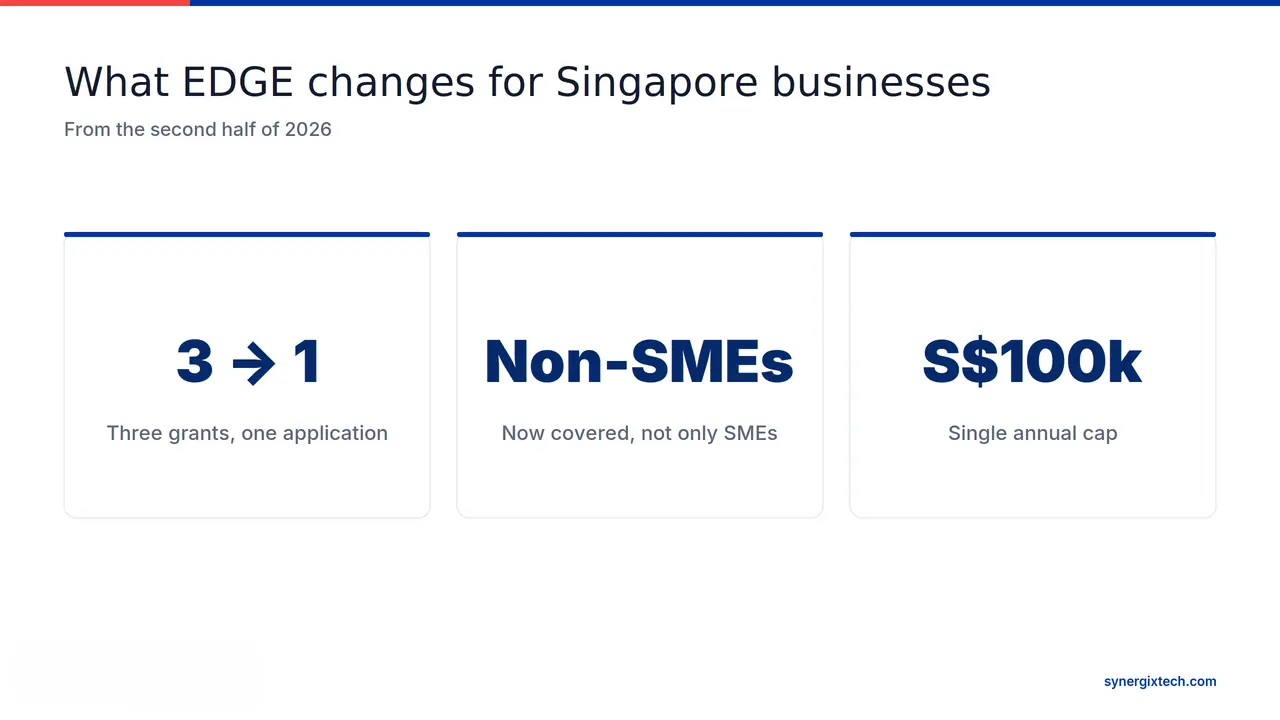
One consolidated application route replaces the need to choose between three grant schemes. Businesses no longer need to work out which scheme covers their activity before applying. EnterpriseSG has said applications will be based on intended activities, naming digitalisation capabilities, expansion into new markets, and improved enterprise efficiency as examples.
Non-SMEs can apply. EDGE covers all Singapore-registered business entities, not only companies under the SME thresholds that limit PSG today.
A single annual ceiling of S$100,000. Companies needing more can apply to EnterpriseSG for case-by-case assessment.
Support rates now vary by activity rather than by scheme. EDGE pays up to 70% for SMEs and up to 50% for non-SMEs, with the rate set per activity rather than a single figure across the grant. The S$100,000 cap is shared across everything you apply for and resets on 1 April each year, not on your financial year end.
What the EDGE Grant Covers
According to the EDGE Grant announcement, EDGE covers 8 business areas and over 150 activities. Rather than choosing between three schemes, you select the business area closest to your priority and apply for the activity within it.
EnterpriseSG names these areas: Automation & Digitalisation, Business Strategy, Financial Management, Innovation, Internationalisation, Standards and Sustainability.
ERP sits under Automation & Digitalisation, in the Integrated Enterprise Systems activity.
Four mechanics apply across every activity:
- One application per activity. You cannot combine a digitalisation project and an overseas expansion project into one submission. Multiple applications can run at the same time.
- Reimbursement only. EnterpriseSG does not provide cash advances. You pay in full, complete the project, then claim.
- The annual cap runs 1 April to 31 March. To use a year’s cap, submit before 31 March.
- Terminated projects release the cap. If you terminate an approved project without claiming, the amount returns to your balance for the year it was approved in.
How Much EDGE Funds
Support levels differ by activity, and the difference is large. EnterpriseSG’s published position:
| Activity type | SMEs | Non-SMEs |
|---|---|---|
| Internationalisation and sustainability | Up to 70% | Up to 50% |
| All other activities, including digitalisation and ERP | Up to 50% | Up to 30% |
The two caps
| Cap | Amount |
|---|---|
| Total grant support per company per year, across all activities | S$100,000 |
| Within that: single-function digital solutions, integrated enterprise systems and selected automation | S$30,000 |
The S$30,000 is carved out of the S$100,000, not added to it. Both refresh on 1 April.
Two consequences worth planning around:
- Integrated enterprise systems are limited to one application per UEN. You get one submission for your ERP, so the scope needs to be right before you file.
- Second, previous EDG, PSG or MRA funding does not count against your EDGE cap, but EDGE will not fund a project that has already received support under one of those schemes.
>> Overview of government grants for ERP systems in Singapore
EDGE vs EDG, PSG and MRA: How the Schemes Compare
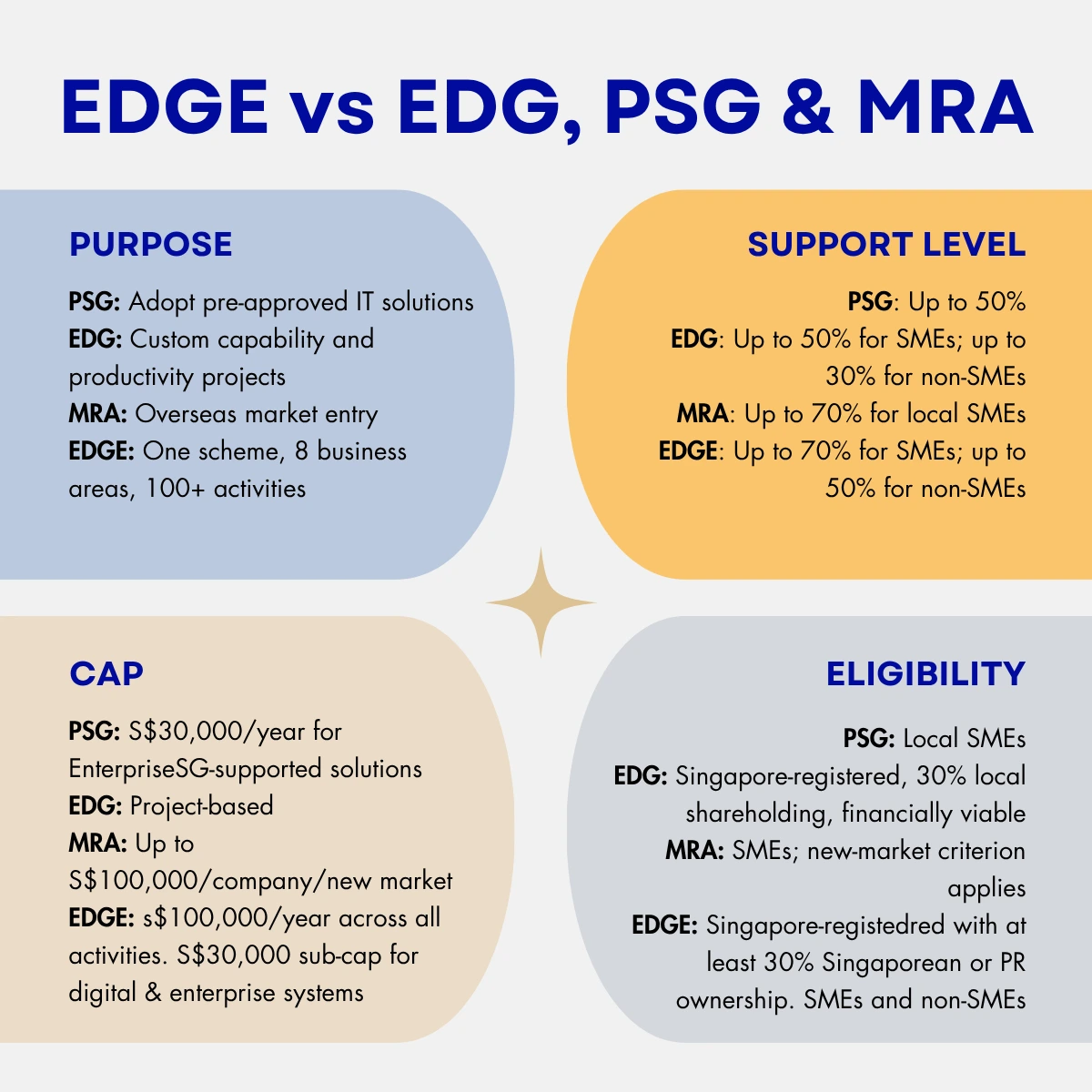
Under PSG the ERP cap was S$30,000 standing alone. Under EDGE that same S$30,000 now sits inside a shared S$100,000 envelope that also has to cover consultancy, overseas expansion, standards and sustainability work. If you plan to use EDGE for more than one thing this year, sequence the applications.
The change that helps: non-SMEs can now access this category of support, which PSG excluded entirely.
How to Apply for an ERP System Under EDGE?
Your package has to be built on IMDA’s SMEs Go Digital platform before you can apply on the Business Grants Portal.
- Check your vendor is listed. Only solutions listed on SMEs Go Digital can be packaged for a grant application, so check this while you are still shortlisting.
- Pick a base package. Choose the listed package closest to what you need, and confirm it with your vendor before you build.
- Build the package and get your Package ID. The Package Builder lets you set user numbers, implementation period and training. Sign in with Corppass to save it, which generates your Package ID.
- Get a matching quotation. Your vendor’s quotation has to match the package line for line.
- Submit on the Business Grants Portal. Apply with your Package ID and quotation. Only a BGP Preparer or Acceptor in your company can submit.
- Wait for the Letter of Offer. You can start before it arrives, but costs outside the approved scope are not supported.
- Complete, pay, then claim. EDGE reimburses after the project is finished. Claims for integrated enterprise systems open from 1 November 2026.
The nine-week difference
Processing time depends entirely on which vendor route you take: 1 week for a pre-approved vendor, 10 weeks for a non-pre-approved vendor.
One deliverable catches people out at claim stage: integrated enterprise systems require a unique identifier as proof of adoption. A software licence number, user ID or user email address. Make sure your vendor can supply it.

Rules That Get ERP Applications Rejected
Retrospective applications are not supported. If you have started work, or paid any deposit to a vendor, before you submit the application, the application fails. This is the most common reason good projects lose funding.
The timing is more generous than most people assume, though. The cut-off is application submission, not approval. You may purchase the solution after successfully submitting and before receiving approval, and that payment can still be supported if the application is approved. You carry the risk if it is not.
5 more that matter:
- Only one claim. EDGE accepts a single, final claim. The approved amount is final and additional claims are not allowed, so any cost your vendor bills after project completion is yours.
- No vendor changes after approval. Only the project end date and claim due date can be amended, and change requests open from 1 November 2026. Changing vendor or scope means terminating and resubmitting.
- No related-party vendors. Your suppliers must have no relationship, connection or common shareholding with your company or its directors.
- No double funding. You cannot apply for EDGE on expenses already approved by EnterpriseSG or another agency.
- Eligibility must hold at claim stage. If your local shareholding drops below 30% after approval, claims will not be supported.
EDGE supports Singapore-registered business entities only. Non-profits, societies, voluntary welfare organisations, statutory boards and government subsidiaries are rejected.
What EDGE Means for AI-Enabled ERP Funding
On the grant side, AI capabilities built into an ERP system fall inside the same Integrated Enterprise Systems activity and the same S$30,000 sub-cap as the rest of the implementation. They are not funded separately.
On the tax side, the Enterprise Innovation Scheme (EIS) is a separate tax route. Eligible businesses can claim 400% tax deductions or allowances on up to S$50,000 of qualifying AI expenditure per year, for YA 2027 and YA 2028. Note that the cap applies to the expenditure, not the deduction.
One point worth raising with your tax advisor early: qualifying expenditure for tax purposes is generally computed net of any government grant or subsidy received, so grant-funded costs would reduce what you can claim under EIS.
Checklist Before You Submit
- Confirm your SME status: An SME has group annual sales turnover of not more than S$100 million, or group employment of no more than 200 workers. The group covers companies owning more than 50% of you, and companies you own more than 50% of. This decides whether you are at 50% or 30%.
- Check your Corppass roles. Someone needs BGP Preparer or Acceptor access before you can submit. Sorting this out afterwards costs days.
- Get ACRA and financial records current. Assessment draws on registered particulars and financial statements.
- Scope the ERP before you approach vendors. You get one application per UEN for an integrated enterprise system, and no scope changes after approval. Knowing which modules you need makes the quotation and the application faster.
- Write down the business case, not the software. The specific problems you are solving: disconnected systems, manual re-entry between departments, inventory counts that do not match the ledger, and the improvement you expect.
- Check the cap year. Caps refresh 1 April. An application submitted in late March draws on that year’s balance.
- Do not pay anything until you have submitted. No deposits, no signed commitments, no work started.
Planning an ERP Project This Year?
Grant timing is one input into an ERP decision, not the whole of it. The larger question is whether the system fits how your business actually runs – and that answer does not change when EDGE launches.
That fit is what we have spent 35 years working on. Synergix has built and implemented ERP for Singapore SMEs across construction, marine engineering, manufacturing, wholesale distribution, field service and more, supporting 600+ companies and 30,000 users.
Once the requirements are right, the funding route is easier to settle.
Talk to our team and we will walk through your requirements, which modules address your bottlenecks, and which funding route suits your project.