


AI for supply chain management uses machine learning to forecast demand, turn historical and live data into decisions, cut carrying costs, and speed up planning. For small and mid-sized businesses, the biggest gains rarely come from a standalone “AI tool.” They come from AI embedded directly inside the systems that already run the business – the ERP where your orders, inventory, and purchasing data already live.
This guide breaks down where AI delivers measurable value across the supply chain, what the ROI benchmarks actually look like, and how a Singapore SME can adopt it without an enterprise budget.
What Is AI in Supply Chain Management?
AI in supply chain management is the application of machine learning, predictive analytics, and automation to plan, source, make, and deliver goods more accurately and efficiently.
Instead of relying on static spreadsheets and reactive human judgement, AI systems continuously read data: sales history, seasonality, lead times, supplier performance, and external signals, and recommend or automate the next action.
In practice, that means four shifts:
- From reactive to predictive – anticipating demand and disruption instead of responding after the fact.
- From manual to automated – high-volume administrative work (data entry, matching, reordering) handled by software.
- From gut-feel to evidence – decisions grounded in patterns across thousands of variables, not one planner’s memory.
- From siloed to connected – a single, continuously updated view of demand shared across sales, operations, and finance.
Analysts frame AI as a core planning element rather than an optional add-on. Gartner projects that 70% of large organisations will adopt AI-based forecasting to predict future demand by 2030, and that spend on supply chain software with agentic AI features will grow from under US$2 billion in 2025 to roughly US$53 billion by 2030 — one of the fastest-growing enterprise software categories.
The direction of travel is clear. The open question for most SMEs is how to adopt it practically.
See how AI in ERP drives SME efficiency and the future of AI-driven ERP software.
The 6 Core Applications of AI in the Supply Chain
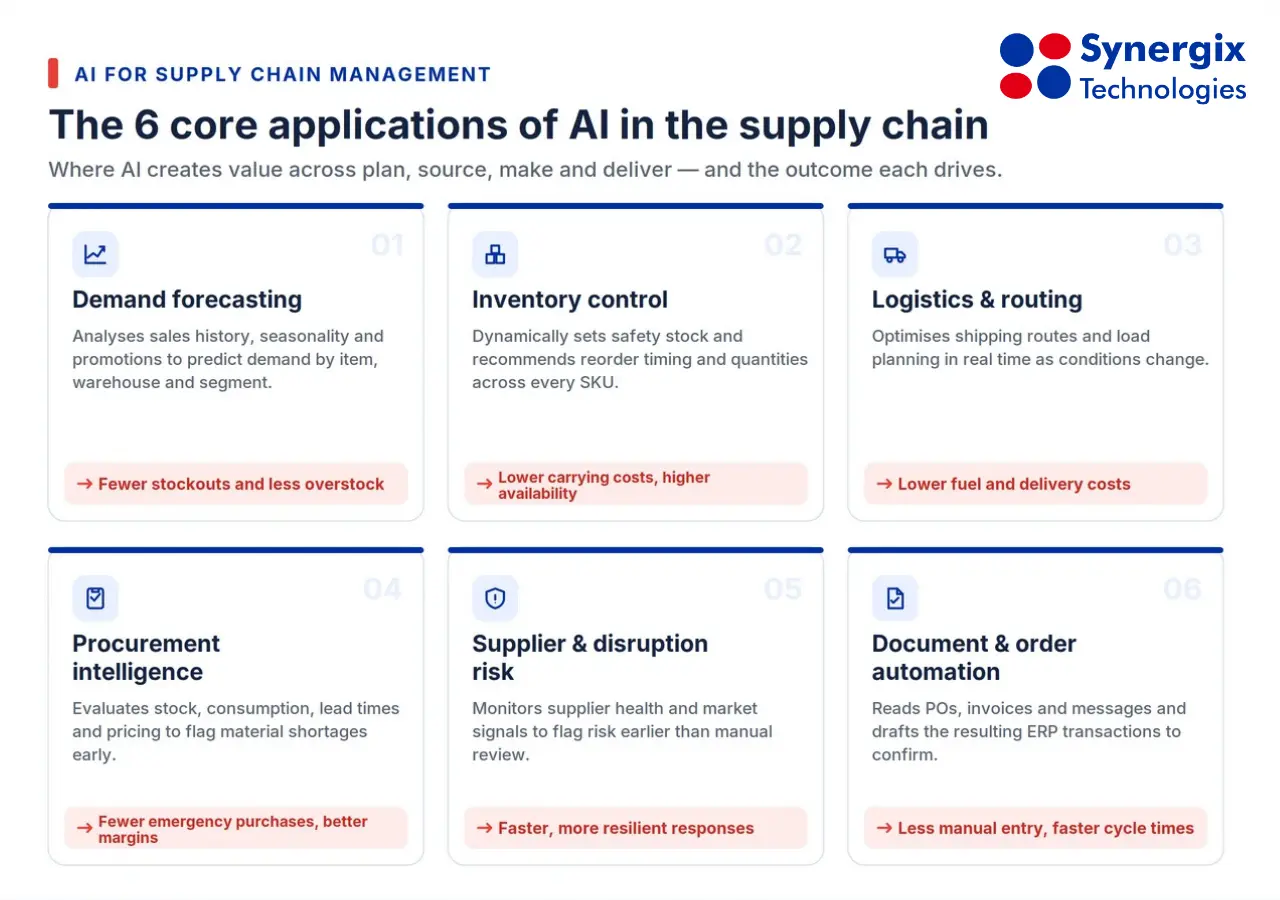
6 highest-value applications of AI across the supply chain and the business outcome each drive.
Here is where AI creates value, and the business outcome each application drives.
1. Demand forecasting
This is consistently the highest-value AI use case in the supply chain, and the one with the strongest evidence behind it. According to McKinsey research, AI-driven forecasting can reduce forecast errors by 20–50% compared with traditional statistical methods, cut lost sales from stockouts by up to 65%, and lower inventory levels by 20–30%.
The mechanism matters: AI models ingest signals that spreadsheet forecasts ignore: weather, promotional calendars, and macroeconomic indicators, and update continuously as new data arrives.
2. Inventory control
Forecasting is only useful if it changes what you hold. AI translates demand predictions into concrete inventory actions: adjusting safety stock per SKU, recommending reorder points, and balancing service levels against carrying cost. For distributors and manufacturers juggling thousands of SKUs, this is where forecast accuracy converts into cash freed from the warehouse.
3. Logistics and routing
Machine learning optimises shipping paths, consolidates loads, and reroutes dynamically when conditions change. McKinsey’s supply chain analysis attributes logistics cost reductions of roughly 10–15% and fuel savings of up to 20% to AI-driven routing and load planning.
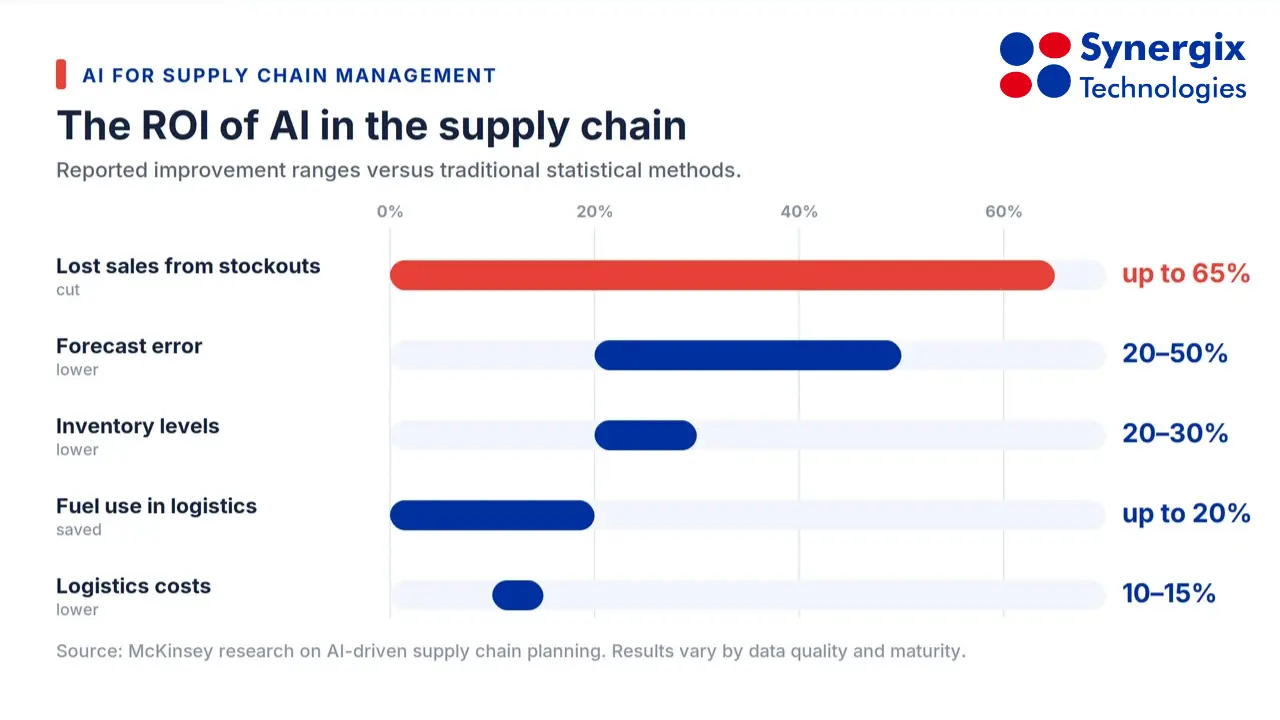
Reported improvement ranges from AI-driven supply chain planning versus traditional methods.
4. Procurement intelligence
AI reads across project budgets, purchase orders, consumption, and lead times to warn of material shortages before they halt a job — replacing panicked, premium-priced emergency buys with planned procurement. This is particularly valuable in project-driven industries like construction and marine engineering, where a single missing material can stall an entire schedule.
5. Supplier and disruption risk
Modern supply chains face more frequent disruptions than they did a few years ago. AI-powered “control towers” monitor supplier health, geopolitical feeds, and market signals to flag risk earlier than manual review — giving teams weeks, not days, to react. Related capabilities extend into AI contract management, where AI surfaces obligations, renewal dates, and risk clauses buried in supplier agreements.
6. Document and order automation
A large share of supply chain effort is administrative: keying in purchase orders, matching invoices, chasing goods receipts. This is exactly the “high-volume, rules-based” work AI handles best: reading documents, extracting fields, and drafting the resulting ERP transactions for a human to confirm.
Why “Embedded AI” Beats a Bolt-On Tool (Especially for SMEs)
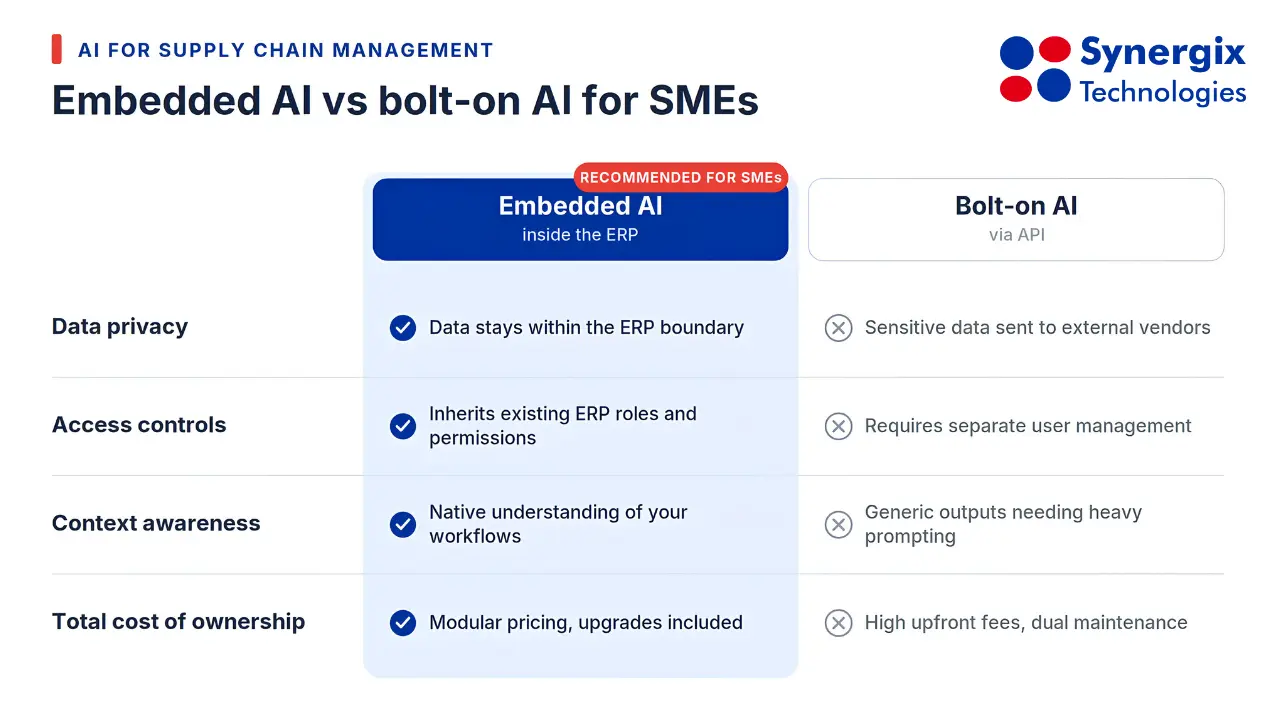
There are two very different ways to add AI to your supply chain:
- Bolt-on AI – a separate tool connected to your systems by API.
- Embedded AI – AI built inside the ERP where your supply chain data already lives.
For SMEs without dedicated data or security teams, the difference is significant:
| Consideration | Embedded AI (inside the ERP) | Bolt-on AI (via API) |
|---|---|---|
| Data privacy | Data stays within the ERP boundary | Sensitive data sent to external vendors |
| Access controls | Inherits existing ERP roles and permissions | Requires separate user management |
| Context awareness | Native understanding of your workflows | Generic outputs needing heavy prompting |
| Total cost of ownership | Modular pricing, upgrades included | High upfront fees, dual maintenance |
An embedded model also avoids the most common failure point in AI projects: fragmented data. AI is only as good as the data it reads, and when that data is scattered across disconnected systems, accuracy suffers. Consolidating operations into a single AI-powered ERP system gives AI a clean, unified dataset to work from.
Businesses evaluating modern enterprise resource planning solutions can see how integrated ERP platforms create the data foundation needed for successful AI adoption. This is why the ERP is the natural home for supply chain AI rather than a separate platform bolted on top.
How to Get Started with AI in Your Supply Chain
A pragmatic, low-risk rollout for an SME looks like this:
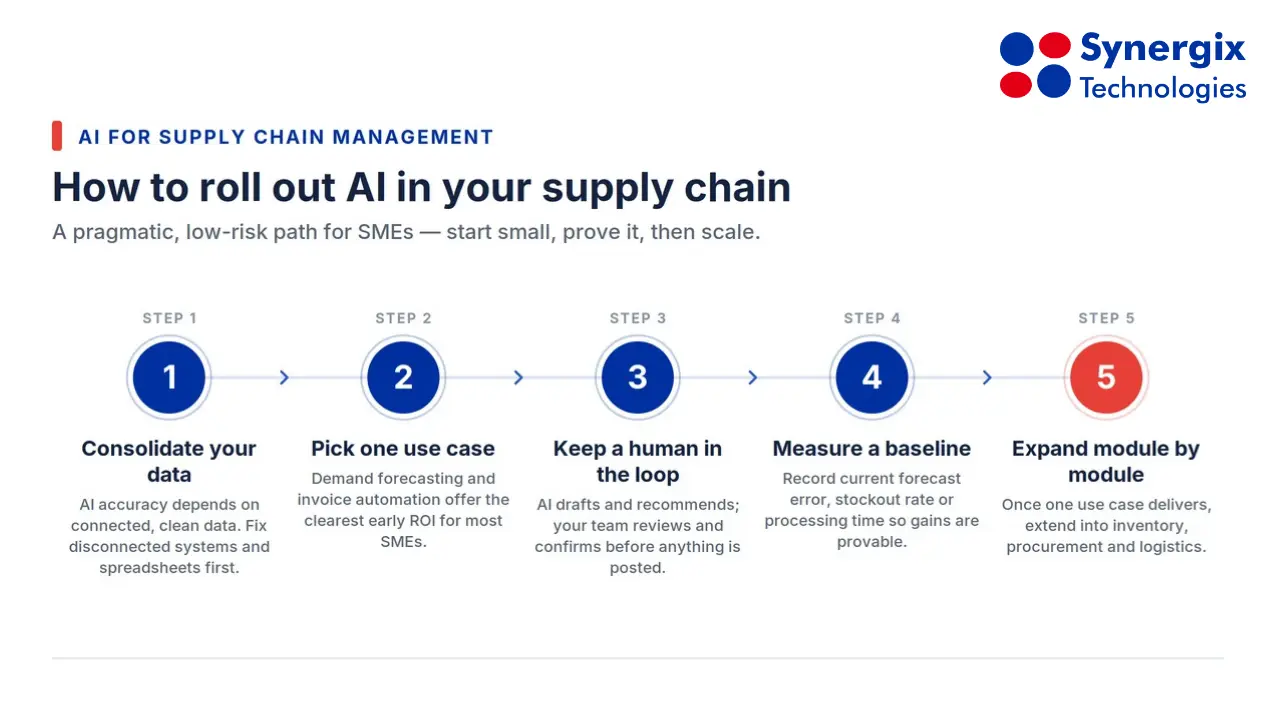
A low-risk rollout: consolidate data, prove one use case, then scale module by module.
- Consolidate your data first. AI accuracy depends on connected, clean data. If your operations run on disconnected systems and spreadsheets, fix that foundation before layering on AI.
- Pick one high-value use case. Demand forecasting and invoice automation offer the clearest early ROI for most SMEs.
- Keep a human in the loop. The safest deployments have AI draft and recommend, while your team reviews and confirms before anything is posted.
- Measure against a baseline. Record current forecast error, stockout rate, or invoice-processing time before you start, so gains are provable.
- Expand module by module. Once one-use case delivers, extend into inventory, procurement, and logistics.
A note for Singapore SMEs: funding the adoption
Cost is the most common barrier for SMEs, and Singapore’s grant landscape directly addresses AI adoption. Under the Enterprise Innovation Scheme (EIS), qualifying AI expenditure can attract enhanced tax deductions, with a dedicated annual cap for AI-related projects (applicable for YA 2027 and YA 2028).
For eligible businesses, this materially lowers the cost of getting started. We recommend confirming current eligibility and caps with a qualified tax advisor or the relevant government agency before budgeting, as scheme details can change.
Where Synergix Fits
Synergix builds AI directly into your ERP rather than bolting it on, so the data your supply chain runs on stays within your ERP boundary, inheriting your existing roles, permissions, and workflows. Relevant modules include:
- Demand Forecast AI forecasts demand by item, warehouse, and segment using historical sales, seasonality, and promotions, and recommends optimal reorder timing and quantities.
- Procurement Assistant is a natural-language interface that evaluates stock, consumption, lead times, and pricing to prevent material shortages and reduce emergency procurement.
- Purchase Order & Document AI reads incoming POs and supplier documents, validates them against ERP master data, and drafts sales orders and transactions for your team to confirm.
- Analytics AI turns ERP data into predictive insights with plain-English narrative summaries for faster reporting.
Every module is human-in-the-loop by design: it drafts and recommends; your team reviews and confirms before posting.
Ready to Put AI to Work in Your Supply Chain?
You don’t need a data-science team or an enterprise budget to start. You need clean, connected data and the right first use case. Synergix’s embedded AI ERP gives your supply chain a unified foundation and modules that forecast, automate, and flag risk from day one.
Request a free demo to see Demand Forecast AI and Procurement Assistant applied to your industry.
Synergix Technologies is a Singapore-based full-service ERP partner with 35+ years in the market, serving 600+ SMEs and 30,000+ users. We develop our own ERP in-house, enabling deep customisation without compromising future upgrades.